
Saptadhara is a seven-stream development framework outlined by the Prime Minister of India during his address from the Red Fort on India’s 80th Independence Day on 15 August 2026. It identifies seven areas of national strength that aim to accelerate India’s journey towards Viksit Bharat by 2047.
The seven streams cover manufacturing, agriculture, emerging technologies, infrastructure, defence, green and blue economy, and India’s soft power. The Prime Minister said these areas could give India new momentum over the next five to seven years.
For UPSC, APSC and other State PCS aspirants, Saptadhara connects current affairs with economy, science and technology, infrastructure, agriculture, defence, environment and international influence.
What is Saptadhara?
The word Saptadhara broadly means “seven streams.” The Prime Minister invoked the idea while referring to India’s civilisational association with Sapta Sindhu and presented seven modern streams of national strength.
Importantly, Saptadhara is best understood as a strategic development framework. Its central objective is to strengthen India’s economic competitiveness, technological capabilities, strategic autonomy and global influence while supporting the larger goal of Viksit Bharat.
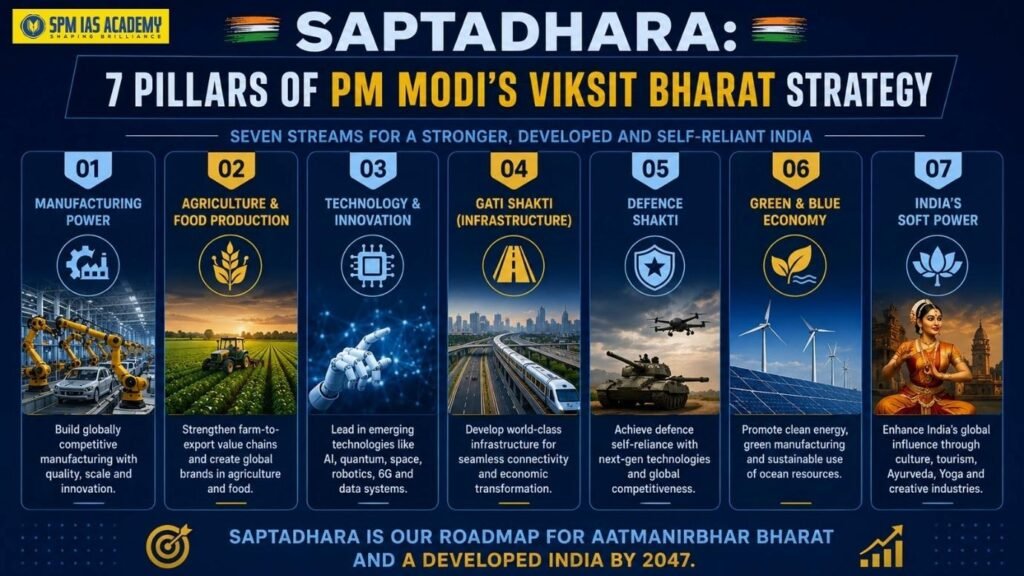
Saptadhara: Seven Streams at a Glance
| Saptadhara Pillar | Main Focus |
| Manufacturing Power | Complete domestic value chains, quality and global competitiveness |
| Agriculture & Food Production | Farm-to-export value chains and global agricultural brands |
| Technology & Innovation | AI, quantum, space, robotics, data centres and 6G |
| Gati Shakti | Railways, highways, waterways, airports and logistics |
| Defence Shakti | Defence self-reliance and next-generation technologies |
| Green & Blue Economy | Clean energy, green manufacturing and ocean economy |
| India’s Soft Power | Culture, Ayurveda, Yoga, tourism and creative industries |
1. Saptadhara and Manufacturing Power
- The first pillar focuses on making India a competitive global manufacturing hub.
- The Prime Minister emphasised an end-to-end domestic value chain, covering design, components and complete products. He also stressed three factors – cost, quality and scale, along with zero-defect manufacturing and globally competitive products.
- Therefore, this pillar closely connects with Make in India, Aatmanirbhar Bharat, MSMEs and global supply-chain integration.
2. Agriculture and Food Production
- The second stream seeks to connect Indian agriculture more strongly with global markets.
- The framework calls for a farm-to-export approach and encourages India to turn millets, spices, fruits, flowers and traditional foods into global brands. It also highlights chemical-free agriculture and the need to meet international product standards.
- Thus, Saptadhara views agriculture not only through food security but also through value addition, exports and farmer income.
3. Technology and Innovation
- Technology forms the third pillar of Saptadhara.
- The Prime Minister highlighted Artificial Intelligence, quantum technology, space, robotics and data centres as emerging areas in which India should build leadership. He argued that India should move beyond becoming merely a market for foreign technologies and instead emerge as an innovation hub.
- The framework also sets an ambition for Made-in-India 6G technology to achieve global reach.
4. Gati Shakti and Infrastructure
- The fourth stream focuses on faster and more integrated infrastructure. It includes high-speed rail, modern highways, inland waterways and airports. Moreover, it also includes multimodal logistics and port-led development.
- The approach seeks to create seamless connectivity and lower logistics barriers across the economy.
5. Defence Shakti
- The fifth pillar focuses on strategic self-reliance in defence. India aims to develop next-generation technologies while moving from a major defence buyer towards becoming a global supplier.
- Moreover, the Prime Minister specifically mentioned drones, counter-drone systems, hypersonic defence technologies and cybersecurity. This stream strongly reinforces the broader objective of Aatmanirbharta in defence manufacturing.
6. Green Economy and Blue Economy
- The sixth component of Saptadhara combines sustainability with economic growth.
- The Green Economy component includes green hydrogen, renewable energy, energy storage, green mobility and green manufacturing. Meanwhile, the Blue Economy focuses on India’s maritime resources, including fisheries, coastal tourism and ocean technologies.
- Therefore, this pillar links economic development with energy transition and sustainable resource use.
7. India’s Soft Power
- The seventh stream seeks to expand India’s cultural and creative influence globally.
- It includes Yoga, Ayurveda, holistic healthcare, Heal in India, handicrafts, culture, films, VFX, animation, gaming and digital content. The Prime Minister also highlighted tourism, international sporting events and concerts as avenues for expanding India’s global presence.
Consequently, Saptadhara treats culture and the creative economy as strategic assets rather than merely heritage sectors.
Why is Saptadhara Important for Viksit Bharat?
- Saptadhara brings together economic power, technology, connectivity, strategic security, sustainability and cultural influence within a single development vision.
- The framework also reflects a shift from incremental targets towards larger global ambitions. During the same address, the Prime Minister called for Indian companies, banks, pharmaceutical firms, technology businesses and professional-services firms to compete among the world’s leading institutions.
- Its larger message is that India must strengthen domestic capabilities while becoming more competitive internationally.
Conclusion
Saptadhara brings together seven strategic pillars of India’s development vision: Manufacturing Power, Agriculture and Food Production, Technology and Innovation, Gati Shakti, Defence Shakti, Green and Blue Economy, and India’s Soft Power.
Together, these pillars strengthen economic growth, self-reliance, technological capability, infrastructure, sustainability and global influence. Moreover, the framework connects different sectors instead of treating them in isolation.
Therefore, Saptadhara is important for understanding Aatmanirbhar Bharat and the broader goal of Viksit Bharat 2047. It also remains a highly relevant current-affairs topic for UPSC, APSC and other competitive examinations, especially under economy, infrastructure, science and technology, defence, environment and international relations.
UPSC/APSC Mains Practice Question:
Q. “Saptadhara provides an integrated framework for accelerating India’s journey towards Viksit Bharat 2047.” Discuss the seven pillars of Saptadhara and examine their significance for India’s development.
Read More:
Source:
FAQ:
Saptadhara is a seven-stream development framework presented by Prime Minister Narendra Modi during the 80th Independence Day address on 15 August 2026. It focuses on manufacturing, agriculture, technology, infrastructure, defence, green and blue economy, and India’s soft power. Therefore, the framework connects multiple sectors with the broader goal of Viksit Bharat 2047.
The seven pillars of Saptadhara are Manufacturing Power, Agriculture and Food Production, Technology and Innovation, Gati Shakti, Defence Shakti, Green and Blue Economy, and India’s Soft Power. Together, these pillars aim to strengthen India’s economic competitiveness, strategic autonomy, sustainability, technological capability and global influence.

Behind every article at SPM IAS Academy is a team of skilled content writers and subject experts committed to making preparation easier for aspirants. From answering common doubts to breaking down complex issues and current affairs, we create content that is accurate, easy to understand, and directly useful for UPSC, APSC, and other competitive exams.