The Union Budget 2026-27 announced seven new high-speed rail corridors and one dedicated East-West freight corridor. It aims to boost sustainable transport, reduce travel time, improve logistics efficiency, and support India’s economic growth. These projects are highly relevant for UPSC, APSC, APPSC, and other State PCS exams.
The Union Budget 2026-27 marked a major milestone for India’s transportation sector. The government announced seven high-speed rail corridors and one new dedicated freight corridor. It aims to transform passenger mobility and cargo movement across the country.
According to Finance Minister Nirmala Sitharaman, these corridors will strengthen economic connectivity, promote clean mobility, and reduce logistics costs. Railway Minister Ashwini Vaishnaw also highlighted that railways remain focused on safety, efficiency, and passenger comfort.
For UPSC, APSC, APPSC, and State PCS aspirants, these announcements are important for GS Paper 3 (Infrastructure, Economy, Environment) and Essay papers.
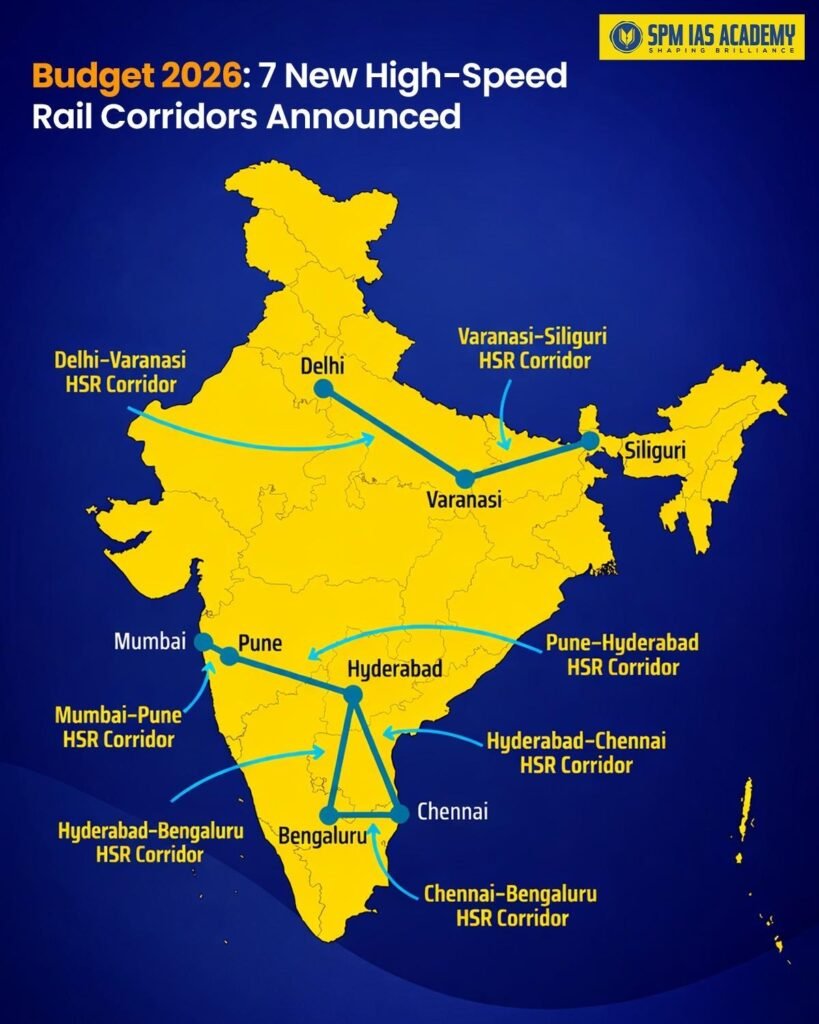
Seven High-Speed Rail Corridors Announced:
The Budget proposed the following seven high-speed rail corridors:
- Mumbai – Pune
- Pune – Hyderabad
- Hyderabad – Bengaluru
- Hyderabad – Chennai
- Chennai – Bengaluru
- Delhi – Varanasi
- Varanasi – Siliguri
These corridors will connect major economic, industrial, technological, and cultural cities of India. Therefore, they will act as “growth connectors” for regional development.
A reputed institute offering quality UPSC coaching in north east India helps aspirants excel in competitive exams.
Budgetary Support for Railways:
The government announced massive financial support for rail infrastructure:
- Budgetary support: ₹2.78 lakh crore
- Total capital expenditure: ₹2.93 lakh crore
- Investment in safety: ₹1.20 lakh crore
Because of this focused approach, railway accidents have reduced by 95%. Moreover, the government will strengthen safety through:
- Track and rolling stock maintenance
- Rapid installation of Kavach
- CCTV cameras
- Overhead electrical equipment upgrades
- Station redevelopment
Dedicated Freight Corridor: Dankuni to Surat
Apart from passenger transport, the Budget strongly focused on freight and cargo movement.
Key Freight Corridor Announcement:
- East-West Dedicated Freight Corridor
- Route: Dankuni (West Bengal) to Surat (Gujarat)
This corridor will improve logistics efficiency, reduce congestion on passenger lines, and support sustainable cargo transportation.
National Waterways for Multimodal Transport:
In addition, the Finance Minister announced:
- 22 new national waterways to be operationalised over the next five years
- Initial focus on Odisha, connecting:
- Talcher and Angul (mineral-rich regions)
- Kalinga Nagar (industrial hub)
- Paradeep and Dhamra ports
Furthermore, the government plans to set up Regional Centres of Excellence for youth training and develop ship repair ecosystems at Varanasi and Patna. These measures will create jobs and reduce logistics costs.
What are the Significances of High-Speed and Freight Corridors?
- Economic Growth: Firstly, these corridors will connect financial hubs, industrial zones, and population centres, thereby boosting productivity and investment.
- Sustainable Transport: Secondly, high-speed rail and waterways promote clean mobility, lower carbon emissions, and reduce dependence on road transport.
- Reduced Travel Time: Thirdly, faster passenger systems will improve business efficiency and regional integration.
- Logistics Efficiency: Moreover, dedicated freight corridors will reduce delays, cut costs, and strengthen India’s supply chains.
- Employment Generation: Furthermore, large infrastructure projects will create direct and indirect employment across sectors.
What are the Challenges and Difficulties of these seven high speed railway corridors?
Despite the benefits, several challenges remain:
- High Capital Cost: One of the important challenges is that the High-speed rail projects require huge investment and long gestation periods.
- Land Acquisition Issues: Secondly, acquiring land across multiple states may face legal and social resistance.
- Environmental Concerns: Thirdly, projects must balance development with ecological sustainability.
- Coordination Between States: Moreover, effective implementation needs strong Centre-State cooperation.
- Technology and Skill Gaps: At the same time, advanced rail systems require skilled manpower and continuous technology upgrades.
Conclusion:
The announcement of seven high-speed rail corridors and a new dedicated freight corridor in the Union Budget 2026-27 reflects India’s long-term vision for modern, safe, and sustainable transportation. While challenges exist, effective planning and execution can turn these corridors into powerful engines of growth.
For serious UPSC, APSC, APPSC, and State PCS aspirants, understanding these initiatives is essential, not just for exams, but also for understanding India’s development trajectory.
For expert guidance, join a trusted UPSC coaching center Guwahati for structured preparation and mentorship.
Source:
Frequently Asked Questions:
The Seven High-Speed Rail Corridors announced in the Union Budget 2026-27 are Mumbai–Pune, Pune–Hyderabad, Hyderabad–Bengaluru, Hyderabad–Chennai, Chennai–Bengaluru, Delhi–Varanasi, and Varanasi–Siliguri. These corridors aim to improve passenger mobility, reduce travel time, and connect major economic and cultural centres of India.
The Seven High-Speed Rail Corridors & Dedicated Freight Corridor will act as growth connectors by linking financial hubs, industrial zones, and population centres. As a result, they will boost productivity, attract investment, improve regional connectivity, and support long-term economic growth.
The Union Budget 2026-27 announced a new East-West Dedicated Freight Corridor connecting Dankuni in West Bengal to Surat in Gujarat. This corridor will improve logistics efficiency, reduce congestion on passenger rail lines, and promote sustainable cargo transportation across India.
High-speed rail corridors reduce dependence on road transport and lower carbon emissions. At the same time, 22 new national waterways will enable cleaner and cost-effective cargo movement. Together, these initiatives support clean mobility, multimodal transport, and environmentally sustainable logistics systems.
These projects are highly relevant for UPSC, APSC, APPSC, and other State PCS exams, especially for GS Paper 3 (Infrastructure, Economy, Environment) and Essay papers. They cover key syllabus areas such as transport infrastructure, sustainable development, logistics efficiency, and Centre–State coordination.