
The Thar Desert, also known as the Great Indian Desert, is the largest desert in India and one of the most important physical geography topics for UPSC, APSC, and State PSC examinations. Due to its unique climate, landforms and ecology, the Thar Desert frequently features in Prelims, GS Paper I, and Geography optional.
Introduction to the Thar Desert (Great Indian Desert):
The Thar Desert forms India’s main hot desert region. It occupies the north-western part of the Indian subcontinent and plays a crucial role in shaping the region’s climate, economy, and settlement patterns. Although deserts usually signify barrenness, the Thar Desert supports vibrant ecosystems, resilient human communities, and strategic importance for India.
Aspirants can strengthen geography preparation with expert guidance from UPSC & APSC Coaching in Guwahati Assam.
Location of Thar Desert (Great Indian Desert):
- An extensive arid region characterized by rolling sand hills and sandy plains.
- Located on the northwestern part of the Indian subcontinent.
- Covers an area of approximately 200,000 square kilometres.
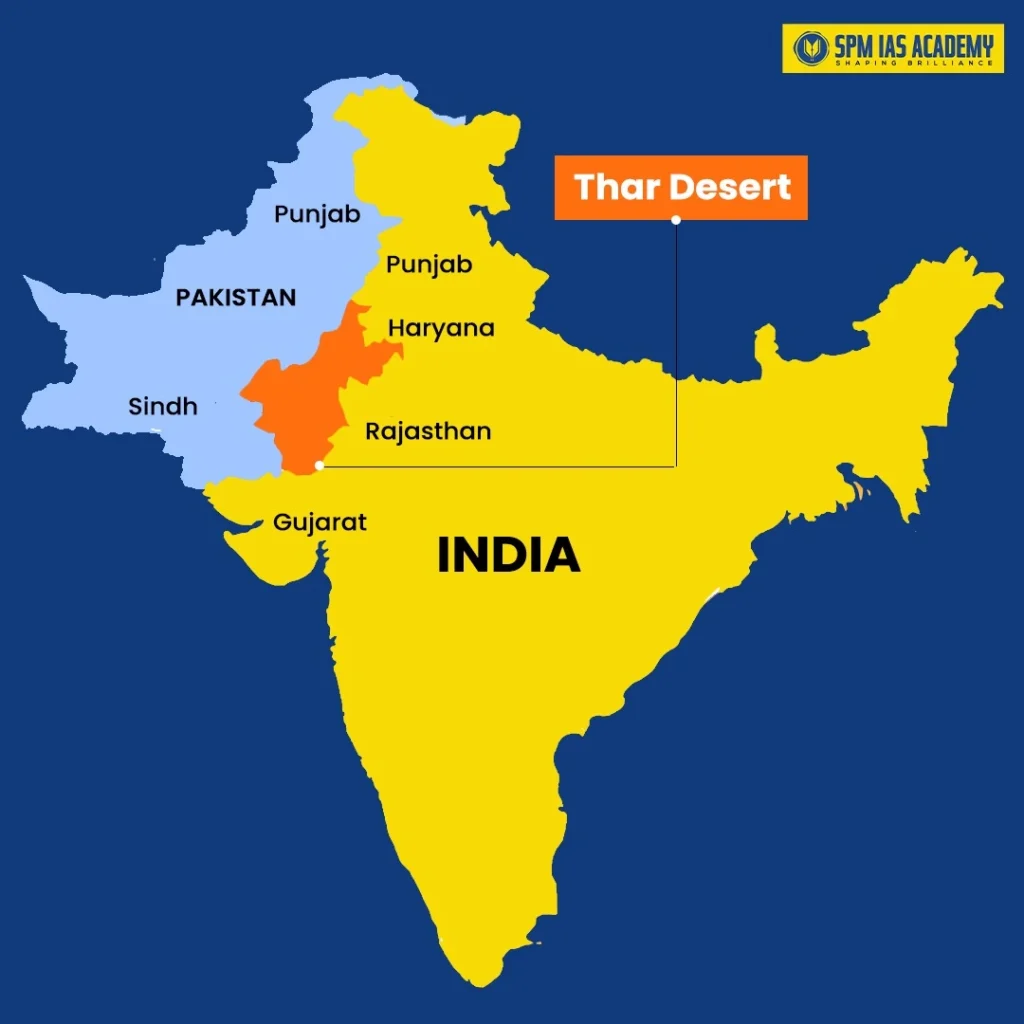
- Spreads across northwestern India, including Rajasthan, Gujarat, Punjab and Haryana.
- It extends into southeastern Pakistan, covering Sindh Province and Punjab Province.
- Importantly, the Aravalli Range marks its eastern boundary and prevents the desert from expanding further eastward.
Origin and Evolution of the Thar Desert:
Scholars propose multiple theories regarding the origin of the Thar Desert. Some link it to:
- Climatic changes during the Quaternary period.
- Drying up of ancient rivers like the Saraswati-Ghaggar system.
- Shifting monsoon patterns over geological time.
As a result, the Thar Desert evolved as a climatic desert rather than a cold or polar desert.
Climate of the Thar Desert:
The Thar Desert experiences an extreme continental climate.
Key Climatic Features:
- Very high summer temperatures (often above 50°C).
- Extremely low and erratic rainfall (100-500 mm annually).
- High rate of evaporation.
- Frequent dust storms and sandstorms.
Consequently, water scarcity remains the most dominant environmental challenge in the region.
Physiographic Features and Landforms:
The Thar Desert displays a variety of aeolian landforms created by wind action.
Major Landforms:
- Sand dunes (Barchans, longitudinal dunes)
- Sandy plains
- Rocky surfaces (Hamadas)
- Playas and salt lakes (e.g., Sambhar Lake)
Wind erosion and deposition actively reshape these landforms even today.
Soil Characteristics:
The desert soil remains sandy and porous, low in organic matter, deficient in nitrogen. However, with irrigation support, parts of the Thar Desert have become agriculturally productive.
Flora and Fauna:
Despite harsh conditions, the Thar Desert supports adapted vegetation and wildlife.
- Flora:
- Thorny shrubs (Acacia, Prosopis)
- Xerophytic grasses
- Date palm in irrigated zones
- Fauna:
- Camel (ship of the desert)
- Desert fox
- Indian gazelle (Chinkara)
- Critically endangered species like the Great Indian Bustard
The Desert National Park plays a vital role in conserving desert biodiversity.
Human Life and Economic Activities:
Human settlements in the Thar Desert reflect remarkable adaptation to arid conditions.
- Livelihood Patterns:
- Pastoralism (camel, sheep, goat rearing)
- Rainfed agriculture (millets like bajra)
- Handicrafts and embroidery
- Tourism and border trade
Moreover, traditional water-harvesting systems such as khadins, tankas, and johads sustain life in water-scarce zones.
Environmental Challenges of the Thar Desert:
- Desertification: Continuous soil erosion, loss of vegetation cover, and unsustainable land use are expanding barren areas within the Thar Desert.
- Overgrazing: Excessive grazing pressure by livestock degrades grasslands and prevents natural regeneration of vegetation.
- Groundwater Depletion: Over-extraction of groundwater for agriculture and domestic use has led to falling water tables and increased salinity.
- Climate Change Impacts: Rising temperatures and erratic rainfall patterns are intensifying droughts and increasing environmental stress in the region.
Therefore, sustainable land management and climate-resilient practices have emerged as critical policy priorities for the Thar Desert.
Linking geography with updated current affairs helps aspirants answer dynamic UPSC and APSC questions effectively.
Strategic and National Importance of the Thar Desert:
- The Thar Desert forms a large part of India’s western border with Pakistan, making it strategically sensitive.
- It hosts several key military bases and training areas essential for national defence preparedness.
- The desert acts as a natural buffer zone, limiting large-scale troop movement and providing strategic depth.
As a result, the Thar Desert plays a crucial role in safeguarding India’s national security and defence strategy.
Conclusion:
In conclusion, the Thar Desert represents far more than a barren landscape. It reflects a complex interaction of climate, landforms, ecology, and human resilience. While development has improved livelihoods, sustainable planning remains essential to protect this fragile ecosystem. For civil services aspirants, the Thar Desert offers a high-scoring geography topic when presented with conceptual clarity and interlinkages.
Source:
FAQ:
The Thar Desert is located in northwestern India, covering Rajasthan, Gujarat, Punjab, and Haryana, and it extends into southeastern Pakistan across Sindh and Punjab provinces.
The Thar Desert is called a hot desert because it experiences extremely high summer temperatures, low and erratic rainfall, and intense evaporation throughout the year.
The Thar Desert contains aeolian landforms such as sand dunes (barchans and longitudinal dunes), sandy plains, rocky surfaces called hamadas, and playas and salt lakes like Sambhar Lake.
People in the Thar Desert survive through pastoralism, rainfed agriculture, handicrafts, tourism, and by using traditional water-harvesting systems like khadins, tankas, and johads.
The Thar Desert faces environmental challenges such as desertification, overgrazing, groundwater depletion, and climate change–induced temperature rise, which together threaten its fragile ecosystem and human livelihoods.