
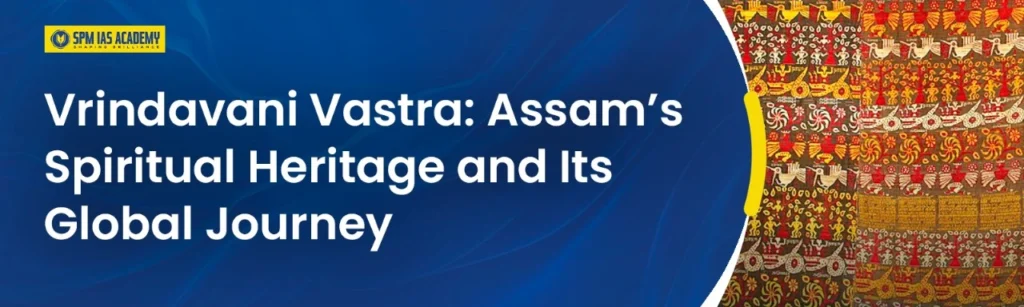
The Vrindavani Vastra is one of Assam’s most treasured cultural masterpieces. This is a 16th-century woven silk textile that beautifully narrates the divine life of Lord Krishna in Vrindavan. Today, as India works toward bringing the Vrindavani Vastra back home, its story has gained renewed relevance for culture, heritage conservation, and Assam’s identity on the world stage.
Vrindavani Vastra represents the spiritual vision, artistic excellence, and cultural identity of Assam. UPSC and APSC aspirants must understand its history, symbolism, and current relevance. The topic connects directly to culture, heritage, conservation, and India-UK relations. This blog explains the Vrindavani Vastra’s origins, global journey, rediscovery, conservation issues, and its recent return to Assam for exhibition.
What Is Vrindavani Vastra?
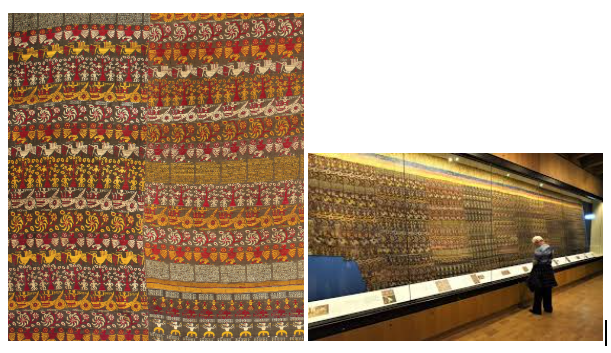
- Vrindavani Vastra is a 16th-century woven silk textile depicting scenes from the life of Lord Krishna in Vrindavan.
- It stands as a masterpiece of Assamese handloom tradition. Artisans created it under the direct guidance of Mahapurush Srimanta Sankardeva, the great Vaishnavite saint-reformer of Assam.
- The Koch king Naranarayana commissioned the Vastra. Artisans from the Sattriya culture participated in its creation.
- The textile originally consisted of at least fifteen silk panels. These pieces were later stitched together into a nine-and-a-half-metre-long masterpiece. The work reflects exceptional craftsmanship, spiritual depth, and artistic precision.
Historical Significance of Vrindavani Vastra:
- The Vrindavani Vastra represents a unique combination of devotion, literature, performance, and weaving traditions.
- Sankardeva’s influence shaped the iconography and narrative structure of the textile.
- The Vastra visualises episodes from the Bhagavata Purana and the transcendental life of Lord Krishna.
- Moreover, the textile reflects the rise of the ‘Ek Saran Naam Dharma’, a neo-Vaishnavite movement that transformed Assam’s culture. Therefore, the Vastra is not only a textile but also a visual scripture.
How the Vrindavani Vastra Left Assam:
- The Vastra mysteriously left Assam during the late medieval period.
- Historical evidence suggests that traders carried it across the Himalayas to Tibet.
- European collectors later acquired several fragments. The British Museum obtained a major piece in 1904.
- Other sections reached museums in Paris, Boston, and Los Angeles.
- This dispersal resulted from historical upheavals, limited local preservation, and lack of awareness.
Where Is the Vrindavani Vastra Today?
Different parts of the Vastra remain in international museums. Major fragments are displayed at:
- The British Museum, London
- Musée Guimet, Paris
- Museum of Fine Arts, Boston
- Los Angeles County Museum of Art
These institutions have safely preserved the Vastra for decades, using advanced preservation technology.
Recent Development: Assam Signs LoI to Bring the Vrindavani Vastra Back:
- On 17 November 2025, the Government of Assam signed a Letter of Intent (LoI) with the British Museum.
- The goal is to bring the Vrindavani Vastra back to Assam on loan. The British Museum agreed to send the textile for an 18-month exhibition in 2027.
- This marks a historic moment for Assam. It reflects a renewed commitment to reclaiming and honouring cultural heritage.
Why Is the Loan Conditional?
- The British Museum has strict conservation standards. Therefore, Assam must establish a state-of-the-art, climate-controlled museum to house the Vastra.
- The structure must ensure stable humidity, temperature regulation, and advanced security.
- The Government of Assam has already started building a specialised museum in Guwahati.
- This requirement highlights the technological gap between global museums and local institutions.
Why Preservation Matters for Assam:
- The Vrindavani Vastra’s return exposes a decades-long problem.
- Assam’s museums lack advanced preservation technology.
- Many antique handloom pieces, manuscripts, and sculptures have suffered due to poor storage conditions.
- The Assam State Museum, despite being the best in the region, struggles with conservation issues.
- Therefore, building the new museum can transform heritage preservation in Assam.
- It will introduce global standards for storage, research, and conservation. It can also encourage more international collaborations.
Symbolism of the Vrindavani Vastra:
- The Vrindavani Vastra portrays devotional scenes from Krishna’s life. These scenes highlight his divine play, spiritual power, and compassion. The motifs reflect:
- Bhakti tradition
- Literary contributions of Sankardeva
- Flourishing Sattriya culture
- Artistic excellence of Assamese weavers
- The textile shows how spirituality and art merge in Assamese society.
Vrindavani Vastra and Srimanta Sankardeva:
- Srimanta Sankardeva was not just a spiritual leader. He was a revolutionary social reformer, writer, dramatist, painter, and philosopher.
- His guidance shaped the Vastra’s themes. Artisans followed his descriptions in the Kirtan Ghosa and Bhagavata.
- Therefore, the Vastra is a visual extension of Sankardeva’s teachings. It shows how art can promote social harmony, devotion, and cultural identity.
Vrindavani Vastra in the Context of Koch Kingdom:
- The Koch king Naranarayana played a major role in Assamese cultural development.
- His patronage encouraged art, literature, and Vaishnavite traditions.
- Commissioning the Vastra reflected royal support for Sankardeva’s movement.
- This collaboration between monarchy and spiritual leadership shaped early medieval Assam.
How the New Museum Can Transform Heritage Preservation:
The upcoming museum in Guwahati can change this scenario. It can –
- Introduce global conservation technology
- Train experts in textile preservation
- Promote cultural tourism
- Create research opportunities
- Encourage public participation
Therefore, the museum can safeguard several endangered artifacts.
Why Vrindavani Vastra Still Inspires Assam:
- The Vrindavani Vastra connects modern Assam with its vibrant spiritual past.
- It reminds people of Sankardeva’s inclusive vision and artistic brilliance.
- The textile also inspires new research on Sattriya art.
- Moreover, the Vastra creates pride among young generations. It reminds them of Assam’s contribution to India’s civilisational heritage.
Conclusion:
The Vrindavani Vastra is not only an artistic treasure. It is a living memory of Assam’s spiritual strength and cultural identity. Its return to Assam marks a significant moment in heritage recognition. However, the event also highlights the urgent need for stronger preservation technology. UPSC and APSC aspirants must understand the textile’s origins, symbolism, global journey, and conservation challenges. Understanding these elements will strengthen cultural awareness and analytical skills. The Vrindavani Vastra teaches us an essential lesson. A civilisation survives not only through development but also through the values it chooses to preserve.
Also read : IAF to Host Special Air Show at Lachit Ghat, Guwahati – Celebrating 93 Glorious Years of Air Power
Sources:
- https://www.atributetosankaradeva.org/vrindavani_vastra.htm
- https://en.wikipedia.org/wiki/Vrindavani_vastra
- https://www.britishmuseum.org/collection/object/A_As1905-0118-4?selectedImageId=1613194929
The Vrindavani Vastra is a 16th-century Assamese silk textile depicting scenes from Lord Krishna’s life, woven under Srimanta Sankardeva’s guidance.
Artisans of the Sattriya tradition created the Vrindavani Vastra under the spiritual direction of Srimanta Sankardeva, commissioned by Koch King Naranarayana.
Major fragments are preserved in the British Museum (London), Musée Guimet (Paris), Museum of Fine Arts (Boston), and LACMA (Los Angeles).
The Assam Government signed an LoI with the British Museum for an 18-month loan exhibition, planned after a climate-controlled museum is completed in Guwahati.
The Vrindavani Vastra is important because it connects to Indian culture, Assam’s heritage, museum conservation, and India-UK cultural diplomacy – key themes in GS-1 and GS-2.