
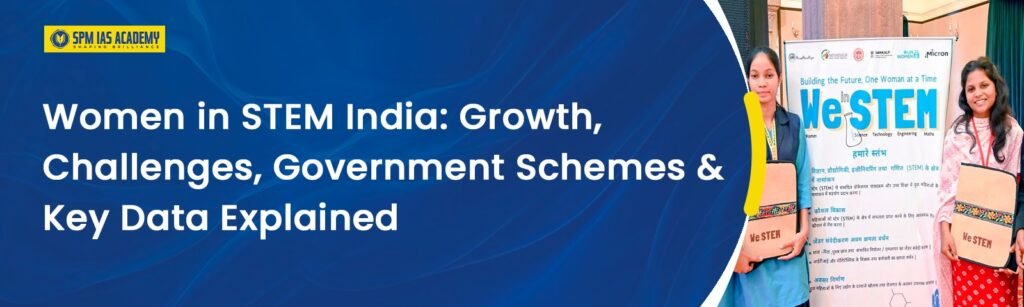
India is making rapid progress in bringing more women into Science, Technology, Engineering, and Mathematics (STEM). According to the latest government data, women now make up 43% of total enrolment in STEM courses at the higher education level. The government has launched several powerful schemes to support women scientists at every stage of their careers. This topic is highly relevant for UPSC CSE, APSC CCE, and all State PCS exams — from Prelims to the Essay paper to the Interview stage.
Students preparing for civil services can explore the best apsc upsc coaching centre in guwahati for expert mentorship and structured preparation.
What is STEM?
STEM stands for Science, Technology, Engineering, and Mathematics. It is an integrated approach to education and careers that focuses on these four key disciplines. These fields play a crucial role in driving innovation, economic growth, and technological advancement in any country.
In simple terms, STEM includes:
- Science – Understanding natural phenomena such as physics, chemistry, and biology
- Technology – Applying scientific knowledge through tools, software, and digital systems
- Engineering – Designing and building structures, machines, and systems
- Mathematics – Solving problems using numbers, logic, and data analysis
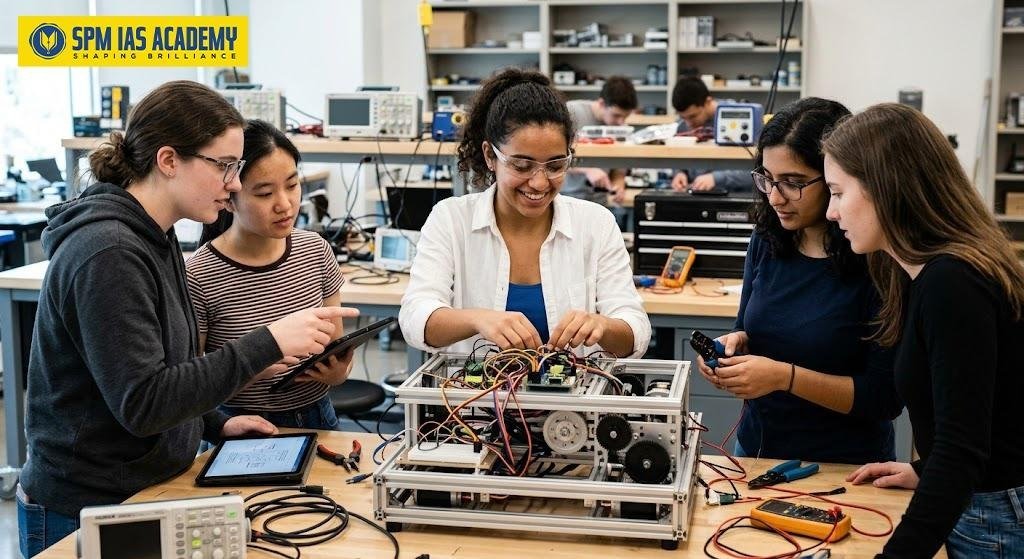
Moreover, STEM education encourages critical thinking, problem-solving, and creativity. Therefore, it prepares individuals for modern careers in sectors like research, artificial intelligence, space technology, healthcare, and infrastructure.
In the Indian context, STEM has gained significant importance due to rapid advancements in science and technology. As a result, the government actively promotes STEM education, especially among women, through various initiatives and schemes.
Thus, understanding STEM is essential for analyzing topics related to science policy, innovation, gender equality, and national development.
Stay updated with reliable current affairs analysis to strengthen your UPSC and APSC preparation.
Key Statistics: Women in STEM India — Data You Must Know
The following data comes directly from a recent Parliamentary reply by the Union Minister of State for Science & Technology, Dr. Jitendra Singh.
| 43% | Women’s share in total STEM enrolment at higher education level (AISHE 2021-22) |
| 18.6% | Women’s share of total STEM professionals in R&D activities (DST Report 2023) |
| 45.87% | Women in R&D working in government institutions |
| 27.62% | Women R&D professionals in the higher education sector |
| 26.51% | Women R&D professionals in the industrial sector |
| 42.7% | India’s female STEM graduates as % of tertiary education – highest among major economies (World Bank, 2018) |
Notably, India’s 42.7% figure is much higher than the United States (34%), the United Kingdom (38.1%), Australia (32.1%), and Germany (27.6%). This is a powerful data point that challenges common assumptions about gender gaps in Indian education.
The Gap Between Enrolment and Employment
However, there is a clear gap between enrolment (43%) and professional participation in R&D (18.6%). This gap is very important to understand. It shows that while women enter STEM education in large numbers, many drop out of STEM careers later.
The reasons include personal responsibilities, lack of mentoring, financial barriers, and career breaks due to marriage or maternity. Consequently, the government has launched several targeted schemes to bridge this gap.
Major Government Schemes to Promote Women in STEM
The Department of Science and Technology (DST) leads most of these initiatives. Additionally, the Department of Biotechnology (DBT) and the Council of Scientific and Industrial Research (CSIR) run their own programmes. Together, these schemes form a comprehensive support system for women scientists in India.
1. WISE-KIRAN: The Flagship Scheme for Women in Science
WISE-KIRAN stands for Women in Science and Engineering – KIRAN. It is the government’s most comprehensive scheme to promote women’s participation and retention in R&D. The scheme targets women at multiple career stages, including those returning after a career break.
Under WISE-KIRAN, the government runs several sub-programmes. Each one addresses a specific need:
| Sub-Programme | What It Does |
| WISE-PhD Fellowship | Supports women pursuing doctoral research in basic and applied sciences |
| WISE-PDF (Post Doctoral Fellowship) | Encourages women to pursue post-doctoral research after a career break |
| WISE-SCOPE | Supports post-doctoral research; helps women re-enter science careers |
| WISE-IPR | One-year training in Intellectual Property Rights for women scientists aged 25-45 |
| WIDUSHI | Supports senior women scientists, including retired and unemployed professionals |
2. Vigyan Jyoti: Inspiring Girls from School Level
Vigyan Jyoti targets meritorious girl students in Classes IX to XII. Its primary goal is to encourage girls to pursue higher education and careers in STEM, especially in areas where female participation is low.
Currently, the programme runs in 250 districts across 34 States and Union Territories. It provides scholarships, exposure visits, interactions with role models, and hostel facilities.
3. BioCARe Fellowship: Supporting Women in Biotechnology
BioCARe (Biotechnology Career Advancement and Re-orientation) comes from the Department of Biotechnology. It specifically helps women scientists re-enter the biotechnology sector after a career break. This fellowship removes one of the biggest barriers women face — the fear of being left behind after time away from research.
4. CSIR ASPIRE: Promoting Women-Led Research
In 2023, CSIR launched ASPIRE — A Special Call for Research Grants for Women Scientists. This initiative directly funds women-led research projects. It aims to strengthen women’s career advancement across all scientific disciplines in India.
5. NIDHI: Supporting Women Entrepreneurs in Technology
NIDHI (National Initiative for Developing and Harnessing Innovations) supports women entrepreneurs through capacity building, incubation facilities, mentorship, and early-stage seed funding. It also supports Technology Business Incubators in women’s universities like IGDTUW in Delhi.
Additional Support Measures
- Hostel accommodation for women researchers
- Structured mentoring and career counselling
- Maternity benefits for women scientists
- Exposure visits and interactions with role models
- Online learning via SWAYAM and SWAYAM PRABHA platforms
- Overseas Fellowship Scheme for global research opportunities
- CURIE Programme for research infrastructure in women’s institutions
- WINGS Programme for Indian women scientists to work in international labs
Women Leading India’s Biggest Science Missions
Beyond schemes and statistics, Indian women are now leading the country’s most ambitious scientific projects. This directly connects to the theme of women in STEM leadership.
- India’s Aditya-L1 solar mission is headed by Nigar Shaji.
- Kalpana Kalahasti served as the Associate Project Director of the Chandrayaan-3 lunar mission.
- Dr. N. Kalaiselvi became the first woman Director General in CSIR’s 80-year history.
- Six CSIR laboratories are led by women today.
Why India’s Women in STEM Data Matters Globally
India’s progress in women’s STEM enrolment deserves special attention. The data shows that India outperforms several developed nations in female STEM graduation rates. This is both a source of national pride and a policy success story worth discussing in your UPSC Mains answers and essay papers.
However, the challenge remains at the professional level. While enrolment is high, only 18.6% of R&D professionals are women. Bridging this gap requires continued policy focus. Therefore, aspirants should understand both the achievements and the pending challenges in this area.
Challenges That Still Remain for Women in STEM
Despite significant progress, several challenges still hold women back in STEM careers. Understanding these challenges is equally important for a balanced exam answer.
The Dropout Problem at Career Stages
Many women drop out of STEM careers at key life stages — especially at marriage and after childbirth. Social and family responsibilities often take priority. As a result, the number of women in senior research roles remains low.
Lack of Mentoring and Role Models
Young girls often lack access to women role models in science and technology. Without visible examples of success, many students do not choose STEM careers. This is why government schemes actively provide mentoring and arrange interactions with established women scientists.
Financial Barriers
Higher education and research careers require significant financial investment. Many women from economically weaker sections cannot afford this. Consequently, the government offers scholarships from school level all the way to post-doctoral studies.
Infrastructure Gaps
In many institutions, women face a lack of safe hostel facilities, childcare support, and research infrastructure. The government’s CURIE programme specifically addresses infrastructure in women’s colleges and universities.
Conclusion: Women in STEM – India’s Strength and Future Priority
India’s journey in women’s participation in STEM reflects both strong progress and future potential. On one hand, the country has achieved a significant milestone, with 43% female enrolment in STEM education, which is higher than many developed nations. On the other hand, only 18.6% of women participate in R&D professions, which clearly highlights a structural gap that still requires focused attention.
Therefore, the Government of India has taken proactive steps to bridge this gap. It has launched flagship schemes such as WISE-KIRAN, Vigyan Jyoti, BioCARe Fellowship, CSIR ASPIRE, and NIDHI. These initiatives provide financial support, mentorship, research opportunities, and infrastructure to women at different stages of their careers.
Moreover, this topic holds strong importance because it connects multiple dimensions such as science policy, gender equality, social justice, and national development. Thus, by understanding the data, analysing government schemes, and recognising existing challenges, one can develop a well-rounded perspective on this issue.
Source:
Frequently Asked Questions:
Currently, women make up 43% of total STEM enrolment in India, which shows strong participation in education. However, only 18.6% of women work in R&D roles, indicating a gap between education and employment.
Women’s participation in STEM is important because it promotes innovation, economic growth, and gender equality. Moreover, it strengthens India’s scientific and technological development. Therefore, increasing women’s participation benefits both society and the economy.
The Government of India has launched several schemes such as WISE-KIRAN, Vigyan Jyoti, BioCARe Fellowship, CSIR ASPIRE, and NIDHI. These programmes provide financial support, mentorship, and career opportunities for women scientists at different stages.
Women in STEM face challenges such as career breaks, lack of mentorship, financial barriers, and infrastructure issues. Moreover, many women drop out at key life stages like marriage and maternity. Therefore, these factors create a gap between education and employment.
India can improve participation by strengthening mentorship, financial support, infrastructure, and flexible career opportunities. In addition, promoting awareness and providing role models can encourage more women to pursue STEM careers.