

Deepor Beel, Assam’s only Ramsar wetland, is facing serious environmental threats today. Unchecked human activities are steadily pushing this vital ecosystem towards irreversible damage.
As a result, Deepor Beel has become an important environment current affairs topic for UPSC and APSC.
What Is Deepor Beel?
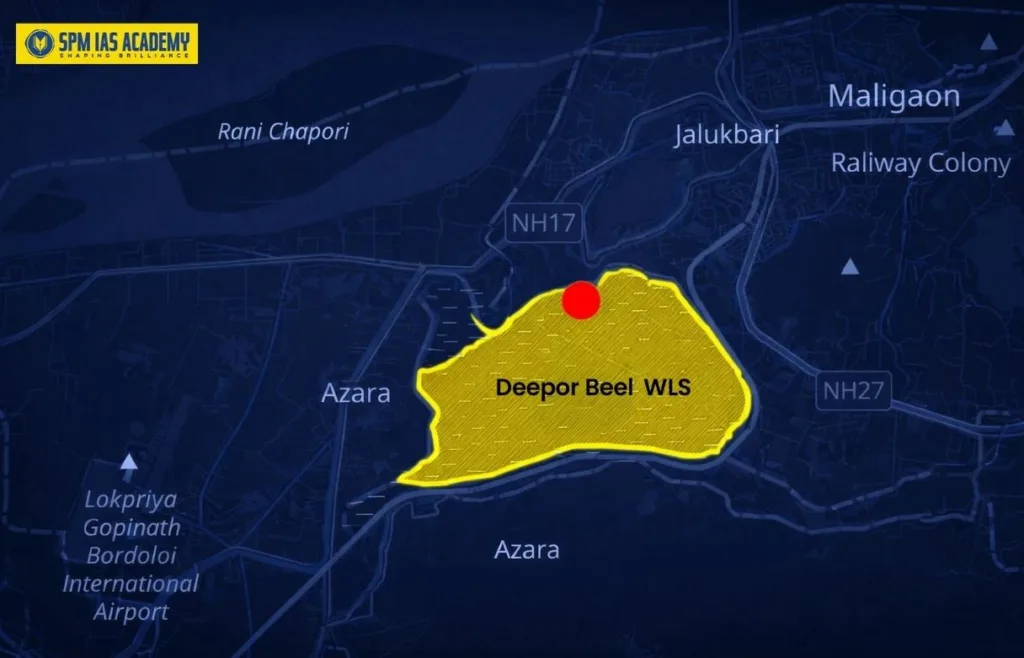
Deepor Beel is a freshwater wetland located near Guwahati, Assam.
It holds international importance due to its rich biodiversity and ecological functions.
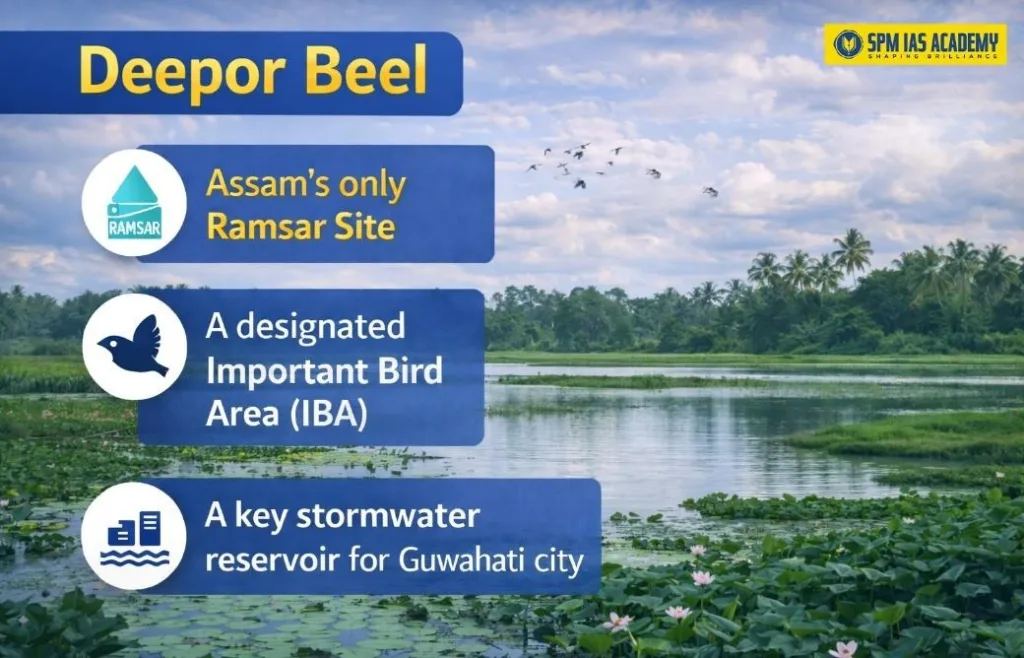
Deepor Beel is a wetland of international importance and holds a special ecological position in Assam.
- Firstly, it was listed under the Ramsar Convention in November 2002, recognising its global environmental value.
- Interestingly, the name ‘Deepor Beel’ has a historical origin. The term “Deepor” comes from the Sanskrit word “dipa”, meaning elephant, while “beel” refers to a wetland. Therefore, the name literally means a large wetland inhabited by elephants.
- Geographically, Deepor Beel was formed in an old channel of the Brahmaputra River, to the south of the main river course. As a result, it possesses immense biological, hydrological, and environmental significance.
- Moreover, Deepor Beel functions as a bird sanctuary and supports a large number of resident bird species. In addition, the wetland attracts migratory birds every year, including several globally threatened species such as the Spot-billed Pelican (Pelicanus philippensis), Lesser and Greater Adjutant Storks (Leptoptilos javanicus and Leptoptilos dubius), and Baer’s Pochard (Aythya baeri).
- Apart from birds, Deepor Beel is also recognised as a wildlife sanctuary. Notably, wild Asian elephants from the nearby Rani and Garbhanga forest reserves frequently visit the wetland. It highlights its importance as an elephant habitat.
- Furthermore, the wetland supports rich aquatic biodiversity. Around 50 fish species are found in Deepor Beel, providing livelihoods to surrounding villages. Additionally, products such as nymphaea nuts and flowers, ornamental fish, medicinal plants, and seeds of the giant water lily (Euryale ferox) generate significant income in local markets. Orchids of commercial value are also found in the neighbouring forests.
Thus, Deepor Beel is not only an ecologically rich wetland but also a vital source of livelihood and biodiversity conservation.
Threats for Deepor Beel:
Deepor Beel is facing multiple environmental threats that are steadily degrading its ecological health.
- Firstly, overfishing has reduced fish populations. It has disturbed the wetland’s natural food chain. At the same time, hunting pressure on waterbirds poses a serious risk to both resident and migratory bird species.
- Secondly, pollution from agricultural pesticides and chemical fertilizers enters the wetland through surface runoff. As a result, water quality deteriorates and aquatic life suffers long-term damage.
- Moreover, the rapid spread of water hyacinth (Eichhornia crassipes) has become a major concern. This invasive species blocks sunlight, reduces dissolved oxygen, and restricts water flow, thereby choking the wetland ecosystem.
Together, these threats are pushing Deepor Beel towards ecological imbalance and demand urgent conservation measures.
World Wetland Day and Focus on Deepor Beel:
World Wetland Day was observed near Deepor Beel with active community participation. The event was organised by NGO North East Wetlands along with local school students.
The World Wetland Day 2026 theme, “Wetland and Traditional Knowledge – Celebrating Cultural Heritage”, carried a strong message. It emphasised the role of indigenous knowledge in conserving fragile ecosystems.
Rising Anthropogenic Pressures on Deepor Beel:
Human activities now pose the biggest threat to Deepor Beel.
These pressures have intensified over the years.
Encroachment and Land Grabbing:
Firstly, illegal encroachment has reduced the wetland’s natural area.
Unscrupulous land grabbers have altered the wetland’s boundaries for private use. As a result, Deepor Beel has lost much of its ecological buffer zone.
Industrial and Commercial Expansion:
Secondly, industrial and commercial activities have expanded rapidly around the wetland. These activities discharge waste and disturb natural water flow patterns. Consequently, the wetland’s ecological balance continues to weaken.
Indiscriminate Waste Dumping:
Moreover, large quantities of garbage and construction waste enter the wetland daily.
Industrial waste and urban debris further degrade water quality. Therefore, Deepor Beel now struggles to sustain its former biodiversity.
Impact on Biodiversity and Local Communities:
Deepor Beel once supported diverse bird species and aquatic life.
Today, many species face habitat loss and declining food availability.
At the same time, indigenous communities have become increasingly marginalised.
Earlier, these communities acted as primary stakeholders in wetland conservation.
However, modern development has pushed them away from decision-making processes.
Governance Failure and Institutional Accountability:
Environmental experts have raised serious concerns over governance failures.
They have specifically pointed to lapses by the district administration and Forest Department.
Due to weak enforcement, encroachments continue without effective action.
Thus, protected status alone has failed to save Deepor Beel.
Deepor Beel as Guwahati’s Natural Flood Shield:
Deepor Beel functions as Guwahati’s natural stormwater reservoir.
It absorbs excess rainwater during heavy monsoon periods.
Therefore, its degradation increases the risk of urban flooding.
This also worsens climate vulnerability in the city.
Importance of Awareness and Education:
During World Wetland Day events, organisers conducted quizzes and discussions.
They also distributed biodiversity books to participating students.
Educators stressed that public apathy remains a major concern.
Hence, awareness plays a key role in long-term conservation.
Conclusion:
In conclusion, Deepor Beel reflects the growing crisis of wetland degradation in India.
Anthropogenic pressures, encroachment, and weak governance have pushed this Ramsar site to the edge.
For UPSC and APSC aspirants, Deepor Beel connects wetlands of Assam, Ramsar Convention, biodiversity loss, and sustainable urban planning.
Therefore, understanding this issue strengthens answers in environment, ecology, and current affairs sections.
Source:
https://gscl.assam.gov.in/portlet-innerpage/deeporbeel-lake-wetland
👉Click here to explore more blogs.
FAQ:
Deepor Beel is Assam’s only Ramsar wetland located near Guwahati. It is important for biodiversity conservation and urban flood management.
Deepor Beel is in the news due to anthropogenic pressures, encroachment, and wetland degradation. All these issues make Deepor beel a key environment topic of current affairs for UPSC and APSC.
The major anthropogenic threats to Deepor Beel include illegal encroachment, industrial expansion, and indiscriminate waste dumping. All these damages its ecological balance.
Deepor Beel acts as Guwahati’s natural stormwater reservoir. It absorbs excess rainwater and reduces the risk of urban flooding during monsoons.
Deepor Beel links Ramsar Convention, wetlands of Assam, biodiversity loss, and sustainable urban planning. These linkages make this topic highly relevant for UPSC and APSC environment questions.