

Only 90 days left for the UPSC, and you are wondering if it is even possible? The answer is yes, but only if you stop second-guessing and start executing a proper plan right now. UPSC Prelims in 90 days is not a myth. Hundreds of candidates have cleared prelims with just 3 months of focused, structured preparation. The key to success lies in effectively utilizing each day of the 90-day preparation period.
The UPSC Civil Services Prelims covers a vast syllabus, and covering it in 90 days requires you to devote 10 to 12 hours daily without exception. The mantra for this phase is simple: make a subject-focused plan, allocate specific time to each subject, and revise and practice as much as possible. If you are wondering exactly how to do that, this blog breaks it all down, a 3-month study plan, a daily timetable, a subject-wise strategy, and practical tips to maximize your UPSC Prelims in 90 days preparation.
Essentials to Prepare for UPSC Prelims in 90 Days
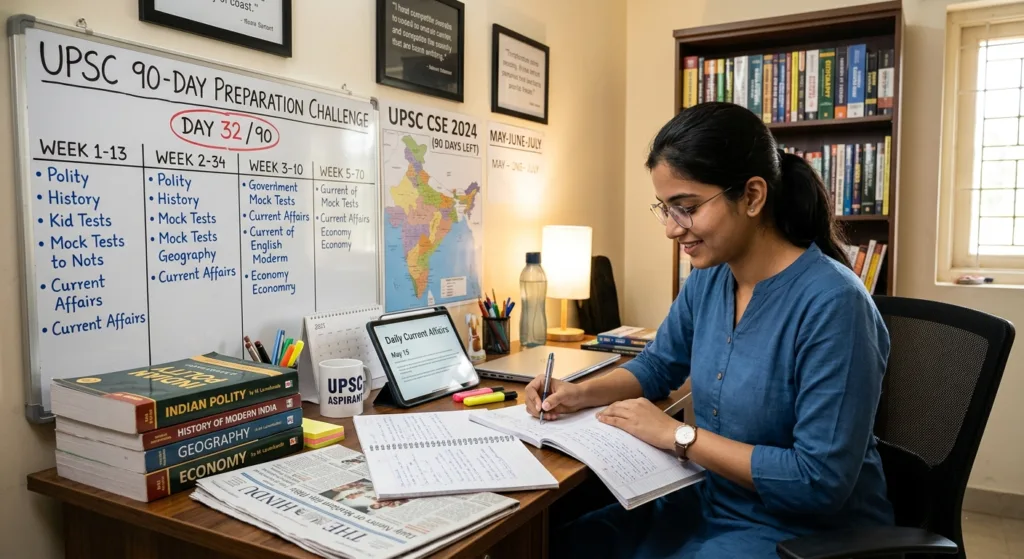
Before you start day one, make sure all your study material and tools are ready. Going in without the basics in place wastes the first few days of your precious 90-day window. Here is what you need to have ready:
- NCERT Books: Gather the relevant NCERT books recommended by toppers, particularly Class XI and Class XII across subjects like History, Geography, Science, and Economics.
- Reference Material: Collect standard reference books that complement foundational NCERT knowledge. For example, standard books for geography and polity are non-negotiable.
- UPSC Previous Year Question Papers (PYQs): Have UPSC PYQs from 2011 onwards ready. These papers are your best guide to understanding the pattern, difficulty level, and recurring themes of the exam.
- Timetable: Create a realistic and detailed timetable that covers all subjects and allocates sufficient time for revision and mock tests. A plan without a timetable is just a wish list.
- Mock Tests: Keep 30 to 40 mock tests for GS and a minimum of 10 mock tests for CSAT ready. These should cover each topic of the UPSC Prelims syllabus so that you are not exposed to any topic gap on exam day.
- Past 1 Year Current Affairs: Refer to quality current affairs magazines that comprehensively cover the past one year. This is one area where many candidates lose easy marks, so treat it with the same priority as static subjects.
For structured mentorship and expert guidance, explore UPSC coaching in Assam offered by SPM IAS Academy.
How to Prepare for UPSC Prelims in 90 Days – 3-Month Phase-Wise Plan
A 3-month study plan for UPSC Prelims in 90 days requires focused effort, consistency, and a clear phase-wise approach. Breaking your 90 days into three phases, Foundation, Intensive Learning, and Revision and Mock Tests which helps you stay on track without feeling overwhelmed.
Weeks 1 to 4 – Foundation Phase
The first month is all about building a strong base. At this stage, focus on understanding the basic concepts and fundamentals of each subject. Do not rush through topics and understanding them thoroughly now will make revision in the final month much faster and more effective.
Key subjects and focus areas during this phase:
- Polity and Governance: Understand the structure of the Indian Constitution, the role of institutions like the President, Parliament, and Judiciary, and fundamental rights. These are the building blocks for everything else in Polity.
- Geography: Begin with the basics of physical geography, maps, and major landforms of India and the world. NCERTs are the best starting point here.
- History: Focus on ancient and medieval history first. Read NCERTs for clarity on important events, personalities, and movements.
- Current Affairs: Start reading a trustworthy newspaper daily. The Hindu or The Indian Express works best. Make concise notes of important events and their implications on governance, economy, and society.
- General Science: Cover the basics of physics, chemistry, and biology through NCERTs from Class 6 to Class 12.
Weeks 5 to 8 – Intensive Learning Phase
During the second month, go deeper into each subject. This phase is about consolidating your knowledge, making detailed notes, and starting to solve practice questions. Speed and accuracy start becoming important now.
Key areas to focus on:
- Polity: Move into important advanced topics such as the electoral system, emergency provisions, and constitutional bodies.
- Geography: Shift focus to economic geography, natural resources, and important geographical phenomena like monsoon, soil types, and river systems.
- History: Move to Modern History, including the freedom struggle movements and significant events like the Revolt of 1857 and the Quit India Movement.
- Economics: Start with the basics of microeconomics and macroeconomics, focus on economic policies, poverty, planning, and fiscal concepts.
- Science and Technology: Stay updated on recent advancements in science and technology. Study government initiatives, key scientific facts, and new developments that have appeared in the news.
Weeks 9 to 12 – Revision and Mock Tests Phase
The final month is your most important phase. Do not introduce new topics here, this month belongs entirely to revision, mock tests, and strengthening weak areas.
How to manage the last 30 days:
- Revise Your Notes: Go through every set of notes from the previous two months. Focus extra time on your weakest topics.
- Take Mock Tests: Attempt as many mock tests as possible. Focus on your time management, speed, and accuracy. Analyze each mock test carefully. Here, every wrong answer is a lesson.
- Current Affairs: Keep reading the newspaper daily and revise key topics and events that are likely to appear in the prelims.
- Solve Previous Year Papers: Going through UPSC PYQs from 2011 onwards will help you understand the exact pattern, nature, and difficulty of questions asked in the prelims.
3 Months Subject-Wise Study Plan for UPSC Prelims

Here is a detailed subject-wise study plan to cover the full UPSC Prelims syllabus in 90 days:
| Subject | Study Material | Strategy |
| Indian History | Old NCERT books ; Standard books for Modern History; Class XI NCERT for Art and Culture with SPM IAS Academy study material | Focus on key events and themes — especially the Indian independence movement. Make notes and revise regularly. |
| Indian and World Geography | Fundamentals of Physical Geography (Class XI NCERT); India Physical Environment (Class XI NCERT); standard book with SPM IAS Academy study material | Cover basic concepts from the NCERTs first. Practicemap-based questions regularly. |
| Indian Polity | Standard book and SPM IAS Academy notes | Read important chapters like DPSP multiple times. Regularly revise and practise previous year questions. |
| Environment | Selective NCERT; current affairs and class notes | Complete basic concepts of the environment and ecology in one week. Focus on current affairs related to environmental issues and policies after that. |
| Economics | NCERT Class XI, standard book for fundamental concepts, and Budget and Economic Survey for current trends with class notes | Understand macroeconomic concepts based on PYQ themes. Analyze the latest Indian budget and economic survey carefully. |
| General Science | General Science books of Class IX and X standards; current affairs | Cover fundamental concepts in physics, chemistry, and biology. Focus more on recent scientific developments and their real-world implications. |
| Current Affairs | The Hindu newspaper (daily); with current affairs by SPM IAS Academy | Integrate with other subjects like the economy, environment, and polity. Solve all mock tests and note down crucial information consistently. |
| CSAT Paper | Standard book for Quantitative Aptitude and Analytical Reasoning with class notes | Practice mathematical aptitude and logical reasoning regularly. Read newspaper editorials daily and summarize them in your own words to build comprehension speed. |
Students from the region can consider UPSC coaching in north east India for focused guidance and structured preparation.
3 Months Daily Timetable for UPSC Prelims in 90 Days
A well-defined timetable is the backbone of UPSC Prelims in 90 days preparation. Here is a sample daily timetable that you can adapt based on your personal schedule and strengths:
| Time Slot | Activity |
| 6:00 AM – 7:00 AM | Current Affairs |
| 7:00 AM – 9:00 AM | General Studies (e.g. History / Polity) |
| 9:00 AM – 9:30 AM | Break |
| 9:30 AM – 11:30 AM | General Studies (e.g. Geography / Economy) |
| 11:30 AM – 12:30 PM | CSAT Practice |
| 12:30 PM – 1:30 PM | Lunch and Rest |
| 1:30 PM – 3:30 PM | Topic-Specific Revision |
| 3:30 PM – 4:00 PM | Break |
| 4:00 PM – 6:00 PM | Mock Test and Analysis |
| 6:00 PM – 7:00 PM | Relaxation |
| 7:00 PM – 9:00 PM | Current Affairs Revision |
| 9:00 PM – 10:00 PM | Dinner |
| 10:00 PM | Revision and Light Reading |
This timetable keeps your day structured without being rigid. You can swap subjects between the morning and afternoon slots depending on what you need to cover that week. The most important thing is to stick to the daily 10- to 12-hour commitment and never skip the mock test and analysis slot.
Practical Tips to Maximise UPSC Prelims Preparation in 90 Days
Beyond the plan and the timetable, the way you approach each study session makes a big difference. Here are some tips that actually work:
- Make concise notes as you read. While going through books and reference material, make short and organised notes. These notes become your revision bible in the final month and save enormous time during last-minute revision.
- Do not try to read everything. With only 90 days, you cannot afford to go deep into every book. Please focus on the standard study material listed above and review it multiple times instead of reading numerous sources just once.
- Integrate current affairs with static subjects. Do not treat current affairs as a separate subject. Instead, connect news items with economics, polity, environment, and science topics as you go, this way, your current affairs preparation reinforces the static syllabus instead of adding to your load.
- Analyze every mock test you take. Taking mock tests without analyzing them is a waste of time. After each test, please review every incorrect answer, comprehend the reason for the mistake, and record the concept for future revision.
- Give CSAT the attention it deserves. Many candidates focus entirely on GS and neglect CSAT until the last few weeks, which can lead to poor performance in this crucial qualifying paper. CSAT is a qualifying paper, but failing it means elimination regardless of how well you did in GS Paper 1. Practice it every day.
- Take your breaks seriously. Studying 10 to 12 hours without proper breaks leads to burnout, not results. The timetable includes rest slots, so use them to genuinely rest, not to check social media or news feeds.
Final Thoughts
UPSC Prelims in 90 days is a challenge, but it is a challenge that has been overcome by many candidates before you. The syllabus is wide, the competition is fierce, and the timeline is tight, but a clear plan, the right study material, a daily timetable, and consistent revision can take you across the Prelims finish line even with just 3 months to go.
Start today. Get your NCERTs, PYQs, and mock tests in order. Follow the phase-wise plan. Stick to the daily timetable. Make notes as you go. Revise relentlessly in the final month. And most importantly, show up for those 10 to 12 hours every single day without exception.
So, your 90 days starts now.
Frequently Asked Questions:
Yes, cracking UPSC Prelims in 3 months is possible, but it requires an extremely disciplined and focused approach. The key is to follow a structured phase-wise plan, Foundation in the first month, Intensive Learning in the second month, and Revision plus Mock Tests in the third month. You need to commit to 10 to 12 hours of daily study, use the right study material (NCERT books, which are textbooks published by the National Council of Educational Research and Training in India, standard references, and PYQs, or Previous Year Questions, from 2011 onwards), and take 30 to 40 mock tests for GS, or General Studies, along with at least 10 for CSAT, which stands for Civil Services Aptitude Test. Candidates who have cleared Prelims in 3 months consistently report that the two things that made the difference were making short revision notes from day one and analyzing every mock test they attempted. The syllabus is vast but manageable with the right plan. So, do not let the volume of content discourage you.
To crack UPSC IAS Prelims in three months, divide your 90 days into three clear phases. In the first month (Weeks 1–4), build your foundation by covering ancient and medieval history through NCERTs, physical geography basics, Indian Polity structure, general science concepts, and starting daily newspaper reading for current affairs. In the second month (Weeks 5–8), go deeper into each subject, covering modern history, economic geography, the electoral system and constitutional bodies in macroeconomic fundamentals, and science & technology current developments. In the third month (Weeks 9–12), stop adding new material and focus entirely on revising your notes, solving PYQs from 2011 onwards, and taking as many mock tests as possible with thorough analysis. Follow a structured daily timetable with 10 to 12 hours of study, keep current affairs integrated with static subjects throughout, and never skip your CSAT practice. This approach is what gives candidates the best shot at clearing prelims in this timeframe.
Yes, several candidates have cleared the UPSC Prelims in 3 months with focused and structured preparation. While the Mains and interview stages require much longer and deeper preparation, clearing the Prelims hurdle in 90 days is absolutely achievable. The common thread among those who have done it is consistent adherence to a plan, they did not waste time switching between too many books, they made concise notes from the beginning for easy revision later, they practiced mock tests regularly and analysed every mistake, and they integrated current affairs into their daily study routine rather than treating it as a separate burden. If you start today, follow the 3-month phase-wise plan shared in this blog, stick to the daily timetable, and maintain 10 to 12 hours of focused study every day. So, you give yourself a genuinely strong chance of clearing UPSC Prelims in 90 days.