
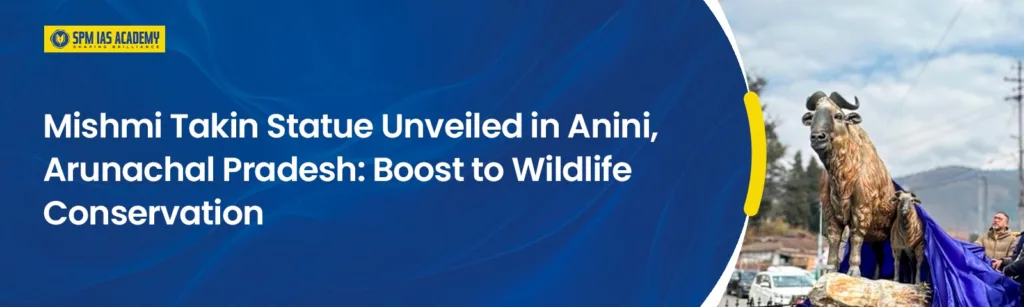
Recently, Arunachal Pradesh unveiled a statue of the endangered Mishmi Takin in the heart of Anini town. The unveiling took place on 29 January by Mopi Mihu, along with Bekir Nyorak and Ringu Ngupok. Significantly, this initiative reflects the state’s commitment to wildlife conservation, indigenous identity, and ecological awareness. It makes it highly relevant for UPSC, APPSC, and State PCS examinations.

About the Mishmi Takin (Budorcas taxicolor taxicolor):
What Is Mishmi Takin?
The Mishmi Takin is a rare and endangered mountain ungulate found in the Eastern Himalayas, particularly in Arunachal Pradesh. It holds deep ecological as well as cultural significance for indigenous communities.
Ecologically, the Mishmi Takin plays a crucial role in maintaining mountain forest ecosystems by aiding seed dispersal and sustaining trophic balance. However, the species faces serious threats due to habitat loss, climate change, and limited geographical range.
Aspirants preparing environment topics can strengthen concepts through UPSC coaching in Assam for better exam-focused guidance.
Key Characteristics of Mishmi Takin:
- Firstly, the Mishmi takin is named after the Mishmi Hills, a mist-covered mountain range with steep ridges and dense forests in the Dibang Valley in Arunachal Pradesh.
- Secondly, the animal has a striking appearance, marked by a black, bulbous nose, a strong and muscular body, and sharply curved horns.
- Moreover, its long, shaggy coat and the tuft of hair under its neck, which looks like a short beard, further highlight its powerful jawline.
- In addition, the Mishmi takin weighs around 300 kg and closely resembles animals like the gnu or the musk ox.
- At the same time, the species remains largely unknown outside the eastern Himalayas, and very few people have ever seen it in the wild.
- However, in Arunachal Pradesh, the animal is well recognised and known by different names among tribal communities.
- For instance, the Idu Mishmi tribe calls it akru, the Miju Mishmi refer to it as khyem, and the Adi community knows it as siben.
What is the Conservation Status of Mishmi Takin?
- As per International Union for Conservation of Nature (IUCN) Red List, Mishmi Takin falls within the Vulnerable category.
- Under the Wildlife (Protection) Act, 1972, Mishmi Takin is in Schedule I.
Due to habitat loss, climate change, and limited geographical range, the Mishmi Takin faces serious conservation challenges.
Distribution of Mishmi Takin:
- Firstly, although the Mishmi takin is confined to Arunachal Pradesh in India, it is also found in parts of China and Myanmar.
- Secondly, China is home to two other subspecies of takin, namely the golden takin (Budorcas taxicolor bedfordi) and the Sichuan takin (Budorcas taxicolor tibetana).
- Moreover, a fourth subspecies, known as the Bhutan takin (Budorcas taxicolor whitei), is found in Bhutan, as the name indicates.
- In addition, the population of the Mishmi takin in China is estimated to be around 3,500 individuals, highlighting its limited and region-specific distribution.
Why Anini and Dibang Valley Matter:
Ecological Significance:
Anini is located in Dibang Valley, one of India’s most biodiversity-rich and least disturbed regions. The area forms part of the Eastern Himalayan biodiversity hotspot.
Cultural Importance:
For local Mishmi communities, the Mishmi Takin holds cultural and symbolic value. Thus, the statue reflects a blend of traditional knowledge and modern conservation awareness.
Significance of Unveiling the Statue of Mishmi Takin:
1. Wildlife Awareness and Conservation:
The statue acts as a public awareness tool, educating citizens and visitors about the importance of protecting endangered species.
2. Cultural Identity and Pride:
By choosing a native species, the initiative strengthens local cultural identity and community pride.
3. Eco-Tourism Promotion:
Such landmarks can promote responsible eco-tourism, drawing attention to Dibang Valley’s unique flora and fauna.
4. Conservation Ethics in Governance:
The event reflects how symbolic actions can complement policy-driven conservation efforts.
Cultural and Mythological Significance of the Mishmi Takin:
- Firstly, the Mishmi takin holds a prominent place in the oral traditions and folklore of Arunachal Pradesh, especially among the Idu Mishmi community.
- Secondly, one popular Idu Mishmi myth explains that all wild animals belong to Ngolon, the mountain spirit, and therefore should not be hunted without respect or reason.
- Moreover, according to the story, both Ngolon and the Mishmi people claimed ownership of the takin, which led to a symbolic tug-of-war.
- In addition, Ngolon held the animal firmly by its horns, causing them to bend, while the people pulled its tail so hard that it snapped.
- As a result, the Mishmi believe that the takin’s curved horns and short tail originated from this struggle.
- Finally, the mountain spirit emerged victorious, and from that moment, the takin came to belong to the mountains rather than to humans.
- Overall, such eco-cultural narratives beautifully connect biodiversity with belief systems, reflecting the deep and respectful relationship between indigenous communities and the wildlife around them.
Students studying biodiversity topics for civil services often explore UPSC coaching in north east India for region-specific insights.
Conclusion:
The unveiling of the Mishmi Takin statue in Anini is more than a symbolic gesture. It represents Arunachal Pradesh’s effort to combine cultural pride with ecological responsibility. By highlighting an endangered species at a public space, the initiative reinforces the importance of biodiversity conservation in the Eastern Himalayas.
For UPSC and APPSC aspirants, this development is a high-value current affairs topic, effectively linking environment, culture, and governance, and is especially useful for mains answers and interviews.
Source:
Frequently Asked Questions:
The Mishmi Takin is a rare mountain ungulate native to the Eastern Himalayas, found mainly in Arunachal Pradesh and parts of China and Myanmar.
The Mishmi Takin statue was unveiled in Anini to promote wildlife conservation, raise ecological awareness, and celebrate the cultural identity linked to Arunachal Pradesh’s state animal.
The Mishmi Takin plays a key role in maintaining Eastern Himalayan mountain ecosystems through seed dispersal. It plays an important role in maintaining ecological balance and biodiversity conservation.
The Mishmi Takin is in the category of Vulnerable on the IUCN Red List. It is under Schedule I of the Wildlife (Protection) Act, 1972.
The Mishmi Takin holds deep cultural significance among indigenous tribes. It features prominently in local myths that emphasise respect for nature and wildlife.