

Why was Mouling National Park, Arunachal Pradesh in the News?
Recently, field gears were distributed to 34 frontline forest staff of Mouling National Park, located in Upper Siang district. This initiative aims to strengthen technical capacity, improve wildlife protection, and enhance forest management. Importantly, equipping frontline personnel improves effective patrolling, monitoring, and conservation outcomes. Moreover, this step reflects lessons drawn from the Pakke Tiger Reserve model. It demonstrates how well-equipped and motivated staff can significantly improve conservation results.
Why are there Needs for Strengthening Frontline Capacity in Mouling National Park?
- Forest protection in rugged and remote terrain requires modern gear and logistical support.
- Adequately equipped staff can conduct regular anti-poaching patrols, monitor illegal logging and encroachment and improve wildlife surveillance and data collection.
- Consequently, such initiatives directly contribute to biodiversity protection and ecosystem resilience.
About Mouling National Park, Arunachal Pradesh:
- Mouling National Park was established in 1982 with the objective of creating a secure habitat for flora and fauna.
- It is the second national park of Arunachal Pradesh, after Namdapha National Park (1972).
- Geographically, the park lies on the right bank of the Siang River and covers an area of approximately 483 sq. km.
- The park derives its name from Mouling Peak, where “Mouling” in the Adi language means red poison or red blood, believed to refer to red latex from a local tree species.
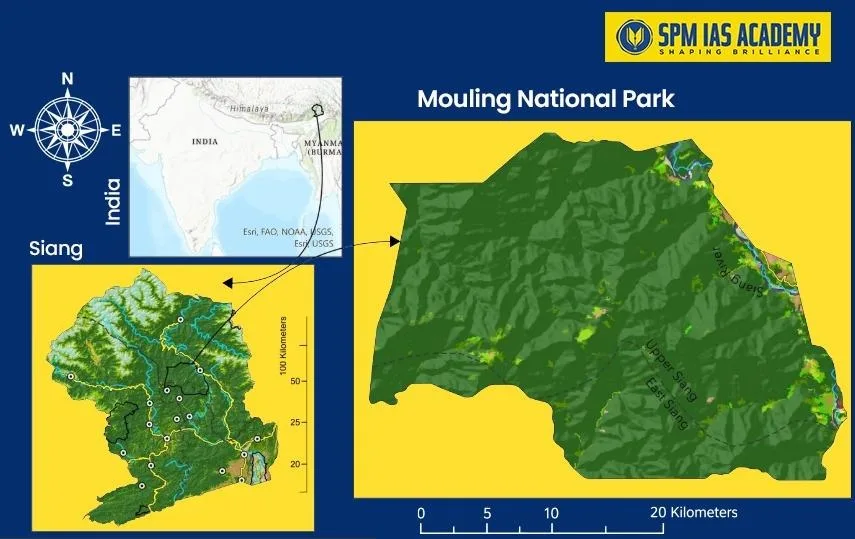
What is the Physiography & Drainage of Mouling National Park?
- Mouling National Park forms the western part of the Dihang-Dibang Biosphere Reserve.
- The terrain is highly rugged, with an altitudinal range from 750 m to 3064 m. Mouling Peak is its highest point.
- The Siyom River flows along the western boundary.
- Additionally, rivers such as Siring, Krobong, Semong, and Subong drain into the Siang River near the eastern boundary.
Which kind of Vegetations & Forest Types the Mouling National Park has?
- Vegetation varies distinctly with altitude. At lower reaches, there are tropical evergreen forests. At the higher altitudes, temperate, alpine, and coniferous forests dominate.
- The park supports rich plant diversity, including Ornamental plants, Foxtail species, Orchids, which are abundant and ecologically significant.
Faunal Diversity of Moulung National Park:
- Mouling National Park serves as an important biodiversity hotspot.
- It hosts several endangered and rare species, such as Takin, Clouded Leopard, Golden Langur, Hornbill species, Monal pheasant, Serow.
- Moreover, the park continues to reveal unrecorded and lesser-known species, indicating high conservation value.
Eco-tourism & Accessibility:
- Seasonal trekking routes connect the park through Bomdo and Ramsing villages, mainly accessible during winter.
- The park contains scenic waterfalls including Dabung Waterfall and Nirbung Waterfall.
- However, tourism remains limited and regulated, ensuring minimal ecological disturbance.
What are the Major Threats to Mouling National Park?
- One of the emerging threats to Mouling National Park is illegal logging. It poses a serious threat, especially in the eastern section, where new road construction has enabled easier access.
- Secondly, hunting and poaching continue to undermine wildlife conservation.
- A major long-term threat arises from the proposed Siang Valley Hydroelectric Project, which involves large dam construction.
- This project could lead to submergence of settlements, forests, and agricultural lands.
- Critically, it threatens habitats of species such as Asiatic Black Bear, Clouded Leopard, Takin, Bharal, Himalayan Goral and Indo-Chinese Goral.
Conclusion:
In conclusion, Mouling National Park stands as a vital ecological asset of Arunachal Pradesh, rich in biodiversity and unique mountain ecosystems. Recent efforts to strengthen frontline forest capacity mark an important step toward improving protection, monitoring, and conservation effectiveness. However, emerging threats such as illegal logging, poaching, and large infrastructure projects underline the need for sustained vigilance and policy support. Therefore, a balanced approach that prioritizes conservation, empowers forest staff, and ensures regulated development is essential to safeguard Mouling National Park for future generations.
Prelims Practice MCQ:
Q. With reference to Mouling National Park, consider the following statements:
- Mouling National Park was established in 1982 to provide a secure habitat for flora and fauna.
- It is the first national park of Arunachal Pradesh.
- The park is located on the right bank of the Siang River.
- The name “Mouling” is derived from the Adi language and refers to red latex from a locally found tree species.
Which of the statements given above are correct?
- 1, 2 and 3 only
- 1, 3 and 4 only
- 2 and 4 only
- 1, 2, 3 and 4
Correct Answer: (b) 1, 3 and 4 only
Mains Practice Question:
“Mouling National Park is an ecologically significant protected area of Arunachal Pradesh, yet it faces growing conservation and developmental challenges.” In this context, discuss the ecological importance of Mouling National Park and examine the major threats it faces. Also highlight the importance of strengthening frontline forest staff capacity in ensuring sustainable conservation.
Source: Arunachal Times
You can also visit our APPSC page for the latest updates, syllabus, and exam-related current affairs.
FAQ:
Mouling National Park is a crucial biodiversity hotspot located on the right bank of the Siang River in Upper Siang district. As part of the Dihang-Dibang Biosphere Reserve, it supports diverse ecosystems ranging from tropical evergreen forests at lower altitudes to temperate, alpine, and coniferous forests at higher elevations. The park provides habitat to several endangered and rare species such as Mouling National Park, Takin, Clouded Leopard, Golden Langur, Serow, and Monal pheasant. Its rugged terrain, rich flora, and presence of unrecorded species make it highly significant for conservation and ecological research in the Eastern Himalayas.
Mouling National Park faces multiple threats that challenge its long-term conservation. Illegal logging has intensified, particularly in the eastern section, due to increased road connectivity. Hunting and poaching further threaten wildlife populations. Additionally, the proposed Siang Valley Hydroelectric Project poses a serious long-term risk, as large dam construction could submerge forests, settlements, and agricultural lands. This would severely impact habitats of threatened species such as the Asiatic Black Bear, Clouded Leopard, Takin, Bharal, and Himalayan Goral. Strengthening frontline forest staff capacity is therefore essential to mitigate these threats effectively.