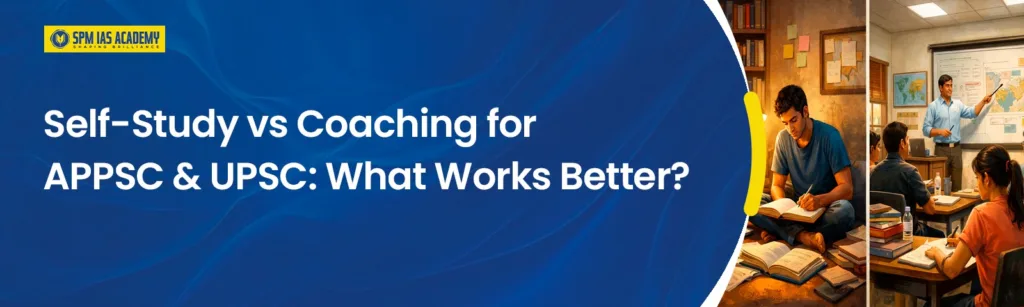
When aspirants begin preparation for civil services examinations, one question always arises first. That question revolves around Self-Study vs Coaching. Every year, thousands of candidates preparing for APPSC and UPSC face this dilemma. Some believe disciplined self-study guarantees success, while others trust structured coaching for direction and consistency. Therefore, understanding Self-Study vs Coaching becomes essential before making a serious commitment.
Moreover, the decision never remains the same for every aspirant. Personal learning habits, background knowledge, financial situation, and time availability always influence this choice. Hence, this detailed guide explains Self-Study and taking Coaching for APPSC and UPSC in a clear, practical, and balanced manner.
Understanding UPSC and APPSC and What It Takes to Succeed

Before comparing Self-Study vs Coaching, candidates must understand the nature of civil services examinations. UPSC Civil Services Examination stands among the toughest competitive exams in the country. Similarly, APPSC examinations demand deep conceptual clarity, analytical ability, and consistent answer-writing practice.
UPSC syllabus covers history, geography, polity, economy, environment, ethics, science, and current affairs. Meanwhile, APPSC syllabus overlaps significantly with UPSC but also includes state-specific components. Therefore, candidates require strong fundamentals, smart revision, time management, and exam-oriented strategy. Consequently, the debate of Self-Study vs Coaching becomes highly relevant.
Self-Study for UPSC and APPSC
Self-study allows aspirants to prepare independently by relying on books, notes, online resources, and test series. Over the years, self-study has gained popularity due to digital platforms, online lectures, and freely available study material. Therefore, many aspirants now consider Self-Study vs Coaching seriously before enrolling anywhere.
Self-study promotes responsibility, discipline, and deeper understanding when done correctly. Moreover, candidates can customize their preparation based on strengths and weaknesses.
Pros of Self-Study for UPSC and APPSC
Flexible Schedule
The biggest advantage of self-study vs. coaching for UPSC lies in complete flexibility. Aspirants can design a daily timetable based on their energy levels, responsibilities, and subject difficulty. Moreover, candidates can modify their schedule whenever required and spend extra time on weaker areas without pressure from fixed class timings. As a result, preparation becomes more comfortable and sustainable over a long period.
Cost-Effective Preparation
Cost plays a crucial role in self-study versus coaching decisions. Coaching fees for civil services preparation often remain unaffordable, especially in well-known institutes. Self-study removes this financial burden completely. Candidates can selectively invest in standard books, online materials, current affairs resources, and mock tests. Therefore, aspirants can prepare effectively without financial stress.
Personalized Learning Style
Self-study allows aspirants to tailor their preparation according to personal learning preferences. Some candidates understand concepts better through reading, while others prefer video lectures or note-taking. If you compare Self-Study and Coaching, self-study gives full freedom to choose methods that work best. Consequently, candidates develop stronger conceptual clarity and retain information for longer durations.
No Commuting Hassle
Another major advantage of self-study is the elimination of daily travel. Commuting to coaching centers consumes time, energy, and mental focus, especially in large cities. Self-study saves these resources completely. Therefore, aspirants can utilize the extra time for revision, answer writing, or current affairs analysis, which directly improves preparation quality.
Cons of Self-Study for UPSC and APPSC
Lack of Proper Guidance
The most significant drawback in self study for UPSC is the absence of expert guidance. Aspirants often struggle to understand exam demands, prioritize important topics, and frame an effective preparation strategy. Without a mentor, candidates may waste time on less relevant areas or follow inefficient study plans.
Limited Peer Interaction
Self-study often isolates aspirants from a learning community. Without classmates or study groups, candidates miss discussions, idea exchange, and exposure to different viewpoints. As a result, preparation may lack exam-oriented depth, which plays an important role in UPSC success.
Discipline Challenges
UPSC preparation requires consistency over months and sometimes years. In self-study, aspirants do not face external pressure to maintain regular study hours. Therefore, motivation may fluctuate, especially during setbacks. This challenge makes discipline one of the weakest aspects in Self-Study.
Resource Confusion
The availability of countless books, websites, and online platforms creates confusion. Aspirants often struggle to choose the right resources. A wrong selection may delay preparation and reduce confidence. Hence, resource overload remains a serious issue in self-study.
Coaching for UPSC and APPSC
The best coaching institute always provides structured guidance, planned syllabus coverage, and expert mentorship. Coaching also offers regular tests, peer interaction, and doubt-solving support. Therefore, many aspirants prefer coaching while comparing Self-Study vs Coaching.
Moreover, coaching institutes help aspirants stay aligned with exam demands and evolving trends.
Pros of Coaching for UPSC and APPSC
Structured Learning Approach
One of the strongest advantages of coaching in the comparison is structured preparation. A best coaching institute will always divide the vast UPSC syllabus into manageable segments and follow a planned timeline. As a result, aspirants cover all topics systematically without missing important areas.
Expert Guidance and Mentorship
A coaching institute with a perfect working system will always provide access to experienced faculty who understand exam trends, syllabus demands, and answer-writing techniques. Faculty guidance helps aspirants avoid common mistakes and adopt effective strategies. Therefore, coaching reduces uncertainty and boosts confidence.
Mock Tests and Study Material
A best coaching institute will always offer regular mock tests and curated study material. These mock tests help aspirants assess their preparation level and improve time management. Additionally, ready-made study material saves time that aspirants would otherwise spend searching for resources.
Peer Learning Environment
The classroom environment encourages interaction with fellow aspirants. Group discussions, doubt-clearing sessions, and peer competition enhance understanding and motivation. Hence, peer learning remains a major strength in the entire preparation.
Cons of Coaching for UPSC and APPSC
High Cost
High fees remain the biggest disadvantage of coaching when comparing Self-Study vs Coaching. Many reputed institutes charge amounts that create financial pressure on aspirants and families. This stress sometimes affects focus and mental well-being.
Fixed Schedules
Many coaching institutes follow fixed schedules that may not suit every aspirant. Some candidates struggle to match the pace of classes, while others feel restricted. Therefore, rigid timing becomes a limitation for many learners.
Limited Individual Attention
Some coaching institutes follow a standard teaching method for all students. However, every aspirant has different strengths and weaknesses. When coaching fails to offer personalized attention, candidates may find it difficult to address individual learning needs.
Overcrowded Classes
Popular coaching centers often accommodate large batches. In such environments, faculty cannot provide individual attention to every student. As a result, doubts may remain unresolved, especially for weaker aspirants.
Self-Study vs Coaching for UPSC: A Clear Comparison
Here is a clear comparison of Coaching and self study
| Aspect | Self-Study | Coaching |
| Cost | Cost-effective | Expensive |
| Flexibility | Highly flexible | Rigid schedules |
| Guidance | Limited or none | Expert Guidance |
| Study Material | Requires self-research | Provided by institutes |
| Motivation | Self-driven | External pressure and peer competition |
| Time Management | Self-regulated | Class schedules help maintain routine |
Thus, Self-Study and Coaching depends entirely on individual needs.
Is UPSC Coaching Worth It?
While comparing Self-Study vs Coaching, many aspirants ask whether coaching truly adds value. Coaching becomes useful for beginners, working professionals, and aspirants lacking direction. Meanwhile, disciplined learners with clarity may succeed through self-study.
Therefore, candidates must evaluate their background honestly before choosing.
Role of Online Coaching in UPSC and APPSC Preparation
In recent years, online coaching has emerged as a strong middle path in the debate of Self-Study vs Coaching. Many aspirants now prefer online learning because it combines flexibility with structured guidance. Online coaching allows candidates to attend classes from anywhere while still following a planned syllabus and exam-oriented strategy.
Moreover, online coaching suits aspirants who manage college, jobs, or personal responsibilities alongside preparation. Candidates can revisit recorded lectures, revise difficult topics multiple times, and learn at their own pace. Therefore, online coaching reduces the pressure of rigid schedules while still offering expert support.
Another important advantage lies in accessibility. Aspirants from smaller towns and rural areas often lack quality offline coaching options. Online coaching bridges this gap by providing experienced faculty, updated study material, and regular mock tests directly to learners. As a result, aspirants gain equal preparation opportunities regardless of location.
Additionally, online coaching supports better time management. Candidates save travel time, reduce fatigue, and allocate more hours to revision and answer writing. In the context of Self-Study vs Coaching, online platforms help aspirants balance independence with guided learning.
However, in our SPM IAS Academy, we provide the best quality of learning with the online mode where aspirants can attend the classes without any trouble and also they get recorded lectures for further revision. Hence, aspirants must remain disciplined while using online coaching. Without self-control, even the best online resources may not deliver results. Therefore, aspirants should actively follow schedules, attempt mock tests, and revise regularly to gain maximum benefit.
Why SPM IAS Academy Offers a Balanced Solution
When aspirants look for quality UPSC coaching and UPSC online coaching, SPM IAS Academy emerges as a reliable option. SPM IAS Academy understands the challenges aspirants face in Self-Study vs Coaching decisions and offers a balanced approach.
Key Strengths of SPM IAS Academy
- We offer structured UPSC and APPSC courses aligned with the syllabus
- We have experienced faculty with exam-oriented teaching
- We have an affordable fee structure compared to major institutes
- We always keep a strong focus on answer writing and current affairs
- Moreover, we have UPSC and APPSC online coaching options for flexible learners
Moreover, SPM IAS Academy supports aspirants who prefer a mix of self-study and guided mentorship. Therefore, aspirants receive direction without losing flexibility.
Visit these to get more updates :
- APPSC COACHING IN ARUNACHAL PRADESH – SPM IAS ACADEMY
- UPSC ONLINE COACHING 2026 BY SPM IAS ACADEMY
- NORTHEAST’S TOP UPSC COACHING IN GUWAHATI
Conclusion: Final Verdict
The debate of Self-Study vs Coaching does not have a universal answer. Self-study suits disciplined, self-motivated aspirants. Coaching suits candidates who need structure and guidance. Therefore, aspirants must evaluate personal strengths, weaknesses, and resources.
Ultimately, success depends on consistency, clarity, and commitment not just only comparing Self-Study vs Coaching.
Frequently Asked Questions
UPSC coaching proves worth it for aspirants who require structured guidance and a clear preparation roadmap. Coaching helps candidates understand the vast syllabus, identify important topics, and follow a disciplined study schedule. Moreover, regular mock tests, answer-writing practice, and mentor feedback help aspirants track their progress and correct mistakes early. For beginners or candidates with limited guidance, coaching reduces confusion and saves valuable time during preparation.
Yes, UPSC can be cracked through self-study alone if preparation is carried out with discipline, consistency, and proper planning. Many toppers have relied primarily on self-study by using standard books, NCERTs, government reports, and previous year questions. Self-study allows aspirants to move at their own pace and focus more on weak areas. However, success through self-study requires strong self-motivation, regular revision, and continuous self-evaluation through mock tests.
For beginners, coaching usually works better because initial clarity about the syllabus, exam pattern, and preparation strategy often remains limited. Coaching introduces aspirants to the right resources, helps them avoid unnecessary materials, and builds a strong foundation. Beginners also benefit from peer interaction and guided timelines. Once conceptual clarity develops, self-study can then be used effectively alongside coaching.
Coaching having APPSC specific courses plays an important role in APPSC preparation by offering state-specific guidance that self-study alone may not always cover effectively. Our SPM IAS Academy provides focused material on state history, polity, economy, and current affairs. Additionally, regular test series, answer-writing practice, and interview guidance help aspirants align their preparation with the APPSC exam pattern. This structured support improves accuracy and confidence over time.
The main difference in Self-Study vs Coaching lies in flexibility versus structure. Self-study offers complete control over time, resources, and pace, making it ideal for disciplined aspirants. Coaching, on the other hand, provides structured guidance, expert mentorship, and regular evaluation, which helps reduce uncertainty. While self-study builds independence, coaching ensures direction. Many successful aspirants combine both approaches to balance freedom with guidance.