
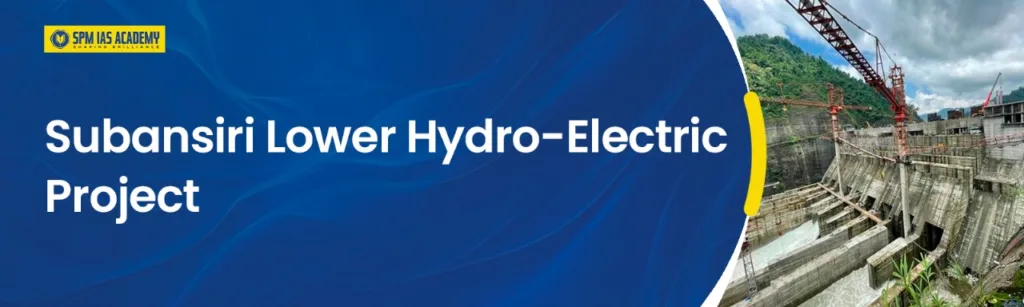
Why in the news?
Recently, NHPC Limited has started commercial operations of the second 250 MW unit of the Subansiri Lower Hydroelectric Project (SLHEP). As a result, the project has moved one step closer to full-scale power generation.
Earlier, the 250 MW Unit-2 was successfully test-synchronised with thenational grid on2 December 2025. Following this, commercial power supply is set to begin in December 2025.
Meanwhile, the remaining units of the Subansiri Lower Hydroelectric Project are scheduled to be commissioned gradually in 2026-27, thereby progressively increasing electricity generation from the project.
Key Features of the Subansiri Lower Hydroelectric Project (SLHEP):
- To begin with, the installed capacity of the project stands at 2,000 MW, configured as eight units of 250 MW each.
- Moreover, the project follows a run-of-the-river design with small pondage, which allows power generation with limited water storage and reduced environmental impact.
- In terms of output, SLHEP is expected to generate around 7,422 million units of renewable electricity annually, thereby strengthening the clean energy supply.
- Geographically, the project is located on the Subansiri River, a major tributary of the Brahmaputra, making it strategically important for Northeast India.
- Notably, it is the largest dam in Northeast India, constructed as a concrete gravity dam with a height of 116 metres.
- Furthermore, the project has a gross reservoir storage capacity of 1,365 million cubic metres.
- Importantly, it also provides a flood cushion of 442 million cubic metres, which will help in moderating monsoon floods downstream.
Power Distribution and Regional Benefits of SLHEP:
- To begin with, electricity generated from the project will be supplied to 16 beneficiary States across India, supporting national power distribution.
- Additionally, Arunachal Pradesh and Assam, as host states, will receive free power allocation, ensuring direct local benefits.
- Most importantly, the Northeast region will get 1,000 MW of electricity, which will strengthen regional energy security, support industrial growth, and boost economic development.
What are the Strategic and Economic Significance of SLHEP?
- Firstly, it will enhance India’s renewable energy capacity and support climate commitments.
- Secondly, it will contribute to regional development through employment, infrastructure, and revenue generation.
- Thirdly, it aims to strengthen grid stability and power availability in the Northeast.
Environmental and Seismic Concerns of SLHEP:
The Subansiri Lower Hydroelectric Project is located in a seismically active and ecologically sensitive Himalayan region. It raises important environmental and safety concerns.
Therefore, the project underlines the need for a robust structural design, supported by continuous surveillance and real-time monitoring systems.
Moreover, regular dam safety audits are essential. These audits must focus on structural health, slope stability, and hydrological behaviour to ensure long-term safety and sustainability.
Disaster Management Dimension:
Himalayan rivers are highly prone to flash floods, landslides, and extreme rainfall events, which significantly increase disaster risk.
Therefore, past regional disasters highlight the need to integrate disaster risk reduction (DRR) into dam operations.
Moreover, there is a strong requirement for advanced early warning systems for downstream areas, along with coordinated response mechanisms involving State Disaster Management Authorities.
Finally, strengthening community awareness, preparedness, and evacuation planning is essential to minimise loss of life and property.
Way Forward:
- There is a need to adopt state-of-the-art instrumentation for accurate and real-time data collection and monitoring.
- Additionally, downstream alert and communication systems must be further strengthened to ensure timely warnings and swift responses.
- At the same time, energy security should be balanced with ecological sustainability through adaptive and science-based management practices.
- Finally, periodic review and upgradation of safety protocols is essential to address emerging climate-related risks and ensure long-term resilience.
Conclusion:
Overall, the Subansiri Lower Hydroelectric Project (SLHEP) stands out as a landmark infrastructure project for Arunachal Pradesh and Northeast India. It combines renewable energy generation, flood moderation, and regional development. While it strengthens energy security, grid stability, and economic growth, its location in a seismically active Himalayan region also highlights the importance of environmental safeguards, disaster risk reduction, and continuous monitoring. For APPSC and Arunachal Pradesh current affairs, SLHEP is a high-value example of how sustainable hydropower development, climate commitments, and disaster management must move forward together.
Mains Practice Question:
“Large hydropower projects in the Himalayan region present a complex challenge of balancing energy security, regional development, and ecological safety.” In the context of the Subansiri Lower Hydroelectric Project (SLHEP), examine the strategic and economic significance of large hydropower projects for India’s renewable energy transition.
Source: Arunachal Times
The Subansiri Lower Hydroelectric Project (SLHEP) is a 2,000 MW run-of-the-river hydropower project by NHPC Limited on the Subansiri River. It is the largest hydropower project in Northeast India and boosts renewable energy, grid stability, and regional power security.
SLHEP is located in a seismically active Himalayan region, making it vulnerable to earthquakes, flash floods, landslides, and extreme rainfall. Hence, robust dam design, real-time monitoring, dam safety audits, early warning systems, and disaster-risk reduction measures are essential for long-term safety.