

The UPSC Scribe Facility Rules play a very important role in supporting candidates with disabilities during the Civil Services Examination. The Union Public Service Commission provides several disability support services to ensure equal opportunity for Persons with Benchmark Disability (PwBD). These services follow the core principle of the Indian government, which focuses on fairness and inclusion for every candidate.
As the UPSC Civil Services Preliminary Examination approaches, PwBD candidates must clearly understand all the support services available to them. Therefore, knowing the UPSC Scribe Facility Rules and related disability support services becomes essential for smooth exam preparation and participation.
UPSC Prelims Exam Disability Support Services for PwBD Candidates
The UPSC clearly mentions UPSC Prelims Exam Disability Support Services in its official notification. These services ensure that PwBD candidates receive not only reservation benefits but also proper assistance during the examination. As a result, candidates with disabilities can compete on equal terms with other aspirants.
The UPSC provides multiple facilities such as reservation, age relaxation, attempt relaxation, compensatory time, and scribe support. Together, these measures strengthen the idea of equal access to the civil services examination.
Disability Quota in the UPSC Exam
The UPSC Civil Services Examination provides a 4% reservation for Persons with Benchmark Disabilities (PwBD) under the Rights of Persons with Disabilities Act, 2016. This reservation applies across all stages of the examination process. Therefore, PwBD candidates receive fair representation from the prelims stage to final selection.
This reservation covers disability categories such as blindness, low vision, hearing impairment, locomotor disability, and other conditions listed under the Act. Along with reservation, the UPSC also offers special facilities like fee exemption, extra time, scribe facility, and relaxed eligibility rules.
UPSC Relaxations for PwBD Candidates
1. Relaxation in Number of Attempts
Every general candidate can attempt the Civil Services Examination six times. However, under the UPSC Scribe Facility Rules and PwBD provisions, eligible PwBD candidates receive additional relaxation in attempts based on their category.
| Category | Number of Attempts |
| General / EWS | 9 Attempts |
| OBC | 9 Attempts |
| SC/ST | Unlimited Attempts |
This relaxation allows PwBD candidates more chances to improve their performance and succeed in the examination.
2. Age Relaxation for PwBD Candidates
The UPSC also provides age relaxation to PwBD candidates depending on their category. This relaxation helps candidates prepare without pressure related to age limits.
| Category | Maximum Age Limit |
| General / EWS | 10 Years Relaxation (Up to 42 Years) |
| OBC | Combined OBC + PwBD Relaxation |
| SC/ST | Combined SC/ST + PwBD Relaxation |
Compensatory Time Under UPSC Scribe Facility Rules
The UPSC Scribe Facility Rules allow compensatory time for PwBD candidates who face difficulty in writing. Candidates with blindness, cerebral palsy, or locomotor disability affecting both arms receive 20 minutes of extra time per hour during the examination.
For other disability categories, candidates must submit a certificate from the Chief Medical Officer, Civil Surgeon, or Medical Superintendent of a government healthcare institution. This certificate must confirm physical difficulty in writing and follow the prescribed format in Appendix V.
Candidates with disabilities below 40% but facing writing difficulty can also claim extra time. However, they must submit a medical certificate as per Appendix VII.
Get structured guidance with trusted UPSC coaching in north east India for serious aspirants.
Scribe Facility for Persons with Benchmark Disability (PwBD)
Under the UPSC Scribe Facility Rules, candidates with blindness, cerebral palsy, or locomotor disability affecting both arms can use a scribe. Candidates from other disability categories listed under Section 2(r) of the RPwD Act, 2016, can also request a scribe by submitting a valid medical certificate.
This certificate must confirm the candidate’s inability to write and must come from a government medical authority.
Eligibility Rules for a Scribe
- Candidates can choose their own scribe or request one from the UPSC.
- Candidates must provide scribe details during the online application.
- The scribe must have at least a high school pass.
- The scribe must not hold a degree higher than a bachelor’s degree.
These rules ensure fairness and prevent misuse of the scribe facility.
PwBD Categories Under UPSC Notification
According to the official UPSC notification, PwBD candidates fall under five categories:
- PwBD 1: Blindness and low vision
- PwBD 2: Deaf and hearing impairment
- PwBD 3: Locomotor disability such as cerebral palsy, leprosy cured, dwarfism, muscular dystrophy, acid attack victims
- PwBD 4: Mental illness, autism, intellectual disability, specific learning disability
- PwBD 5: Multiple disabilities, including deaf-blindness
Eligibility Under UPSC Prelims Exam Disability Support Services
Here is the eligibility criteria explained under scribe facility
| Categories of Disability | Subcategories |
| Locomotor Disability (LD) | One Arm (OA)One Leg (OL) Both Arms (BA) One Arm One Leg (OAL)Both Legs and Arms (BLA) Both Legs and One Arm (BLOA)Both Legs (BL)Both Arms and One Leg (BAOL)Spinal Deformity (SD)Spinal Injury (SI)Cerebral Palsy (CP)Leprosy Cured (LC)Dwarfism (Dw)Acid Attack Victims (AAV)Muscular Dystrophy (MDy) |
| Visual Impairment (VI) | Low Vision (LV)Blind (B) |
| Hearing Impairment (HI) | Deaf (D)Hard of Hearing (HH) |
| Multiple Disabilities from only the above three categories (MD) | Multiple Disabilities (MD) |
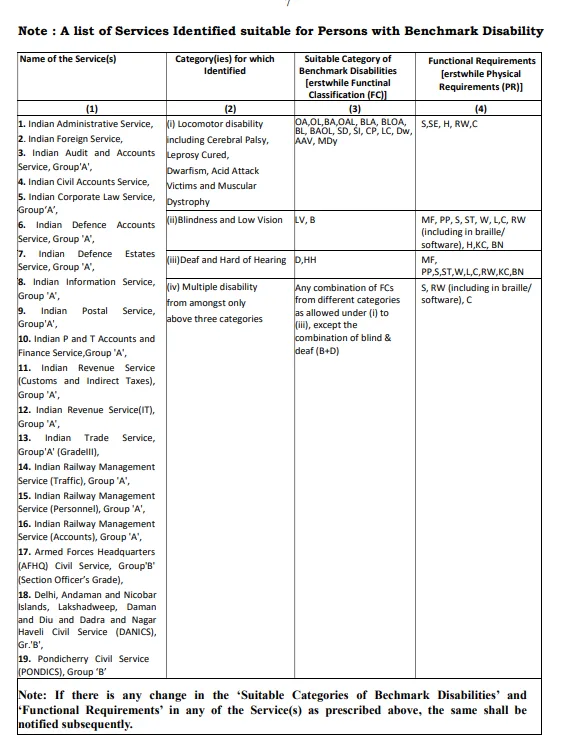
Services Identified as Suitable for PwBD Candidates
The UPSC identifies services suitable for PwBD candidates based on disability type and functional requirements.
| Service Name | Disability Categories | Functional Requirements |
| Indian Administrative Service (IAS) | Locomotor disability, Cerebral Palsy, Acid Attack Victims, Muscular Dystrophy | S, SE, H, RW, C |
| Indian Foreign Service (IFS) | Blindness, Low Vision | MF, PP, S, ST, W, L, C, RW, KC, BN |
| Indian Audit and Accounts Service, Group ‘A’ | Locomotor disability, Low Vision | S, SE, H, RW, C |
| Indian Corporate Law Service, Group ‘A’ | Deaf, Hard of Hearing | D, HH |
| Indian Defence Accounts Service, Group ‘A’ | Multiple Disabilities (Locomotor, Blindness, Hearing Impairment) | S, RW (Braille/software), C |
| Indian Information Service, Group ‘A’ | Locomotor Disability, Low Vision, Deaf, Hard of Hearing | S, RW, KC, BN |
| Indian Postal Service, Group ‘A’ | Low Vision, Hearing Impairment | MF, PP, S, ST, W, RW, L |
| Indian Railway Management Service, Group ‘A’ | Locomotor Disability | S, SE, RW |
| Delhi, Andaman & Nicobar Islands Civil Service | Locomotor Disability, Low Vision, Deaf, Hard of Hearing | S, RW, L, C |
| Pondicherry Civil Service (PONDICS), Group ‘B’ | Multiple Disabilities | RW (Braille/software), S, SE, C |
How to Apply for UPSC Prelims Exam Disability Support Services
Candidates must apply for disability support services during the online registration process. They must upload valid medical certificates as proof of disability. Candidates who need a scribe or compensatory time must clearly mention their requirement while filling out the form. UPSC provides complete instructions in the official notification.
Explore UPSC Batch Highlights to see mentorship quality, test series support, and classroom learning benefits.
Importance of UPSC Scribe Facility Rules
The UPSC Scribe Facility Rules ensure that PwBD candidates face no unnecessary barriers during the examination. These services promote confidence, fairness, and equal opportunity. As a result, PwBD candidates can focus on performance instead of physical limitations.
For a step-by-step strategy, read our UPSC Exam Preparation guide to build strong basics early.
Final Conclusion
The UPSC Scribe Facility Rules 2026 reflect the UPSC’s strong commitment to inclusion and equal opportunity. Through reservation, age relaxation, extra attempts, compensatory time, and scribe support, PwBD candidates receive a fair chance to compete in the Civil Services Examination. Therefore, understanding and correctly using these facilities becomes essential for PwBD aspirants. With proper awareness and correct documentation, candidates can appear in the UPSC exam confidently and without difficulty.
Serious aspirants can join UPSC & APSC Coaching in Guwahati for expert guidance and results.
Frequently Asked Questions:
Yes, the UPSC provides a 4% reservation for Persons with Benchmark Disabilities (PwBD) under the Rights of Persons with Disabilities Act, 2016. This reservation applies at every stage of the Civil Services Examination, including Prelims, Mains, and Interview. The purpose of this reservation is to ensure equal opportunity for candidates with disabilities so that physical limitations do not stop them from competing fairly. Along with reservations, the UPSC also provides extra support such as age relaxation, additional attempts, scribe facility, and compensatory time. Therefore, PwBD candidates receive both representation and practical assistance during the examination process.
The UPSC divides Persons with Benchmark Disabilities (PwBD) into five clear categories based on the type of disability. These categories help UPSC decide eligibility for reservation, scribe facility, and other support services. The five categories include blindness and low vision, deafness and hearing impairment; locomotor disability, such as cerebral palsy, muscular dystrophy, dwarfism, leprosy cured, and acid attack victims; mental illness or intellectual disability, including autism and learning disability; and multiple disabilities that combine two or more of these conditions, including deaf-blindness. By creating these categories, the UPSC ensures that support services reach candidates according to their actual needs.
Candidates who suffer from blindness or low vision fall under the visually handicapped category in UPSC. These candidates must have a valid medical certificate issued by a government medical authority confirming their condition. Eligible visually handicapped candidates can claim benefits such as 4% reservation, scribe facility, and compensatory time during the examination. Moreover, candidates who face difficulty in writing due to visual impairment can also receive extra time per hour as per UPSC rules. This support allows visually handicapped candidates to focus on answering questions instead of struggling with physical barriers.
The number of attempts for PwBD candidates depends on their category. PwBD candidates from the General and OBC categories can attempt the Civil Services Examination up to 9 times, provided they meet the age limit criteria. On the other hand, PwBD candidates belonging to SC and ST categories can attempt the exam an unlimited number of times, subject only to age limits. This relaxation gives PwBD candidates more opportunities to improve their preparation and performance. As a result, candidates get a fair chance to succeed without pressure caused by limited attempts.