
Sati Joymoti was an Ahom princess of 17th-century Assam who endured 14 days of brutal torture without revealing her husband’s whereabouts to his enemies. Her courage saved the Ahom dynasty, changed the course of Assam’s history, and earned her a place among India’s greatest unsung heroes. Her story is highly relevant for UPSC and APSC aspirants studying Assam’s medieval history.
The Historical Background: The Ahom Kingdom in Crisis
The Ahom kingdom ruled Assam for nearly 600 years, from the 13th to the 19th century. However, in the latter half of the 17th century, the kingdom entered a period of deep political instability. Incompetent rulers sat on the throne, and powerful nobles began to exploit the situation for personal gain.
The Ahom Administrative System
The Ahom king, known as Swargadeo, held the throne but governed with the help of three Gohains — powerful nobles who controlled separate provinces. The king was required to consult them on all matters of politics, war, and administration. As the kingdom expanded, two additional offices were created: the Bar Barua and the Barphukan.
Crucially, only those from the royal bloodline could ascend the throne. Additionally, the candidate had to be physically unblemished. Even a scar could disqualify a prince from kingship. This rule, though meant to uphold tradition, was later twisted to serve corrupt political ambitions.
Lora Roja and the Conspiracy of Laluksula Borphukan
During the reign of Swargadeo Sulikpha — popularly called Lora Roja, meaning “boy king” — a powerful Barphukan named Laluksula took effective control of the kingdom. Sulikpha was a minor, and Laluksula used him as a puppet to consolidate his own power.
To remove all threats to his authority, Laluksula launched a systematic conspiracy. He ordered the physical mutilation of all potential claimants to the Ahom throne between 1679 and 1681. His men would slit ears, slice limbs, or blind princes — deliberately creating physical defects that would disqualify them from kingship. This was an act unprecedented in Ahom history and shocked the entire kingdom.
Who Was Joymoti Konwari? Life and Early Years
Joymoti Konwari was born in the mid-17th century in Madurigaon, Sivasagar, Assam. Her father was Laithepena Borgohain and her mother was Chandradaru. She grew up in a family deeply connected to Ahom nobility and values.
She married Prince Gadapani, also known as Gadadhar Singha, a brave and resourceful member of the royal family. Together, they had sons named Lai and Lechai. Gadapani was widely seen as the most capable candidate to lead the Ahom kingdom out of its political crisis, which is precisely why Laluksula viewed him as a dangerous threat.
Gadadhar Singha’s Escape to the Naga Hills
When Joymoti learned of Laluksula’s plan to mutilate her husband and their sons, she immediately urged Gadadhar to leave. Gadadhar initially hesitated, feeling that fleeing would be an act of cowardice. However, Joymoti convinced him otherwise. She argued that only he could save the Ahom kingdom and protect its people from Laluksula’s tyranny.
Convinced by his wife’s wisdom, Gadadhar left his home and sought refuge in the Naga Hills under a secret identity. His escape alarmed Laluksula’s court. The Barphukan immediately sent troops to search every corner of the kingdom. When they found no trace of the prince, they turned to the one person who might know his location — his wife, Joymoti.
The Torture at Jerenga Pathar: 14 Days of Unbreakable Courage
Laluksula summoned Joymoti to the royal court. She faced interrogation by the king’s generals. Each time they asked her about Gadadhar’s whereabouts, she refused to answer. Her reply was always a firm and clear “No.”
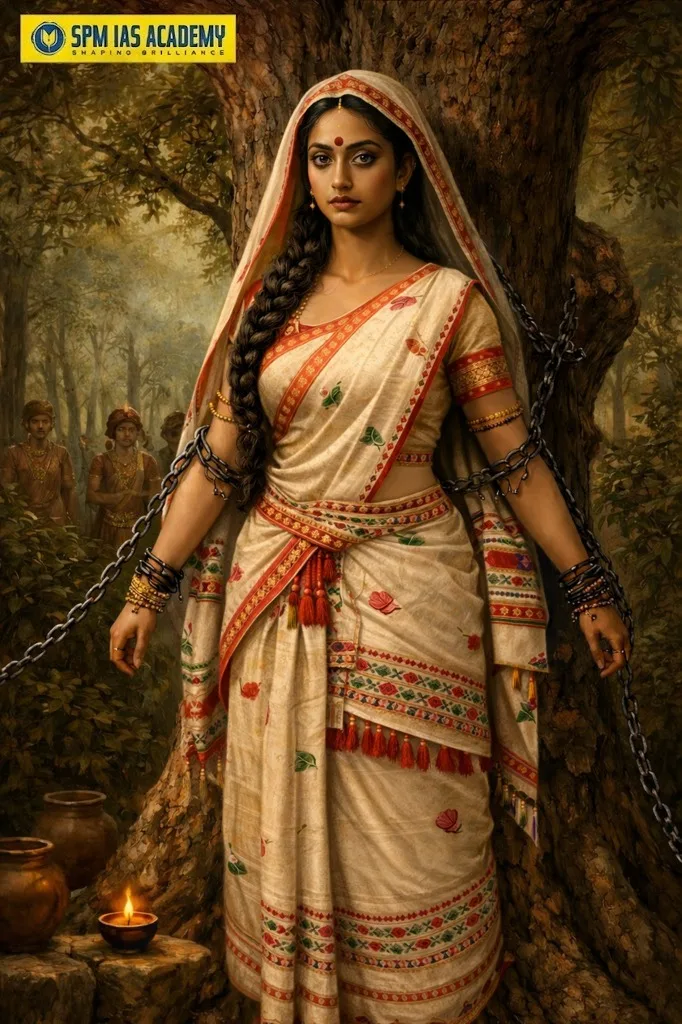
Furious at her silence, Laluksula ordered the royal executioners — the Chaudangs — to take Joymoti to an open field called Jerenga Pathar in Sivasagar. There, they tied her to a thorny tree known as Jerenga, which gives the field its name. The Chaudangs whipped her repeatedly, asking after each lash whether she would reveal Gadadhar’s location. Each time, Joymoti said nothing.
The Barbaric Methods Used to Break Her Spirit
The torture Joymoti endured was horrific by any standard. The executioners poured boiling water over her skin. They beat her with molten iron rods. They rubbed itch-inducing plant leaves over her wounds. According to some historians, Joymoti was pregnant with her fourth child at the time. When physical pain failed to extract any information, Laluksula escalated to mental torture — he forced Joymoti to watch her young daughter being killed in front of her eyes.
Even then, Joymoti did not speak. She endured all of this for 14 continuous days and nights. The words she reportedly repeated were:
“Oh Lord… Oh, my brave Husband… Hail my Motherland.”
Gadadhar’s Nighttime Visit and His Promise
According to legend, Gadadhar eventually heard about the atrocities his wife was enduring. One night, when the guards were absent, he secretly came to see her. He could not bear the sight of her suffering and begged her to surrender. However, Joymoti refused. She remained firm in her decision to protect her husband and the Ahom kingdom. Gadadhar controlled his grief, promised her that her sacrifices would not go in vain, and returned to the Naga Hills to gather his forces.
Why is Joymoti called Sati?
On 27 March 1680, after 14 days of relentless torture, Joymoti Konwari took her last breath. She died without uttering a single word about her husband’s location. In recognition of her supreme sacrifice and devotion — comparable to the Hindu goddess Mata Sati — she was posthumously honoured with the title “Sati Joymoti.”
Her death was not in vain. After some time, Gadadhar returned to Assam with a well-trained army. He defeated Sulikpha and Laluksula, and ascended the throne as Swargadeo Gadadhar Singha. He then established the Tungkhungia dynasty, which ruled Assam until the Yandaboo Treaty of 1826.
Gadadhar Singha’s Rise and Victory Over the Mughals
Gadadhar Singha went on to become one of the most powerful rulers of Assam. He successfully defeated the Mughal Emperor Aurangzeb’s forces and recaptured lower Assam and Guwahati. His victories were instrumental in preserving Assam’s independence during a period when Mughal expansion threatened most of the subcontinent.
How Rudra Singha Honoured the Memory of Sati Joymoti
Gadadhar Singha and Joymoti’s eldest son, Lai, later became the powerful king Swargadeo Rudra Singha (1696-1714). He built several monuments to honour his mother’s sacrifice:
- Joysagar Tank (1697): Built at Sibsagar, this is believed to be the largest man-made lake in India. It covers 318 acres of land, with 155 acres filled with fresh water. A 2 km earthen water pipeline once connected it to the Rangpur Palace.
- Fakuwa Dol / Joy Dol (1703-04): A pyramid-shaped temple built on the banks of Joysagar. Rudra Singha placed a golden idol of Joymoti inside this temple. The structure was built as a grave and monument to his mother.
These monuments still stand in Sivasagar today and serve as lasting symbols of the Ahom dynasty’s glory and Joymoti’s unbreakable courage.
Joymoti’s Cultural Impact: Films, Literature, and Awards
Joymoti’s story has deeply influenced Assamese culture, art, and literature across centuries. Here is how her legacy lives on:
India’s First Assamese Film: Joymoti (1935)
In 1935, the visionary filmmaker and cultural icon Jyoti Prasad Agarwala (also known as Roopkunwor) directed the first-ever Assamese feature film, titled Joymoti. The role of Joymoti was played by the celebrated Assamese actress Aideu Handique. The film brought Joymoti’s story to a wider audience and remains a landmark in Assamese cultural history.
A second film of the same name was released in 2006 by Manju Borah, further cementing Joymoti’s place in popular memory.
Literature and Poetry in Her Honour
The celebrated 19th-century Assamese writer Lakshminath Bezbaruah depicted her life in the drama Joymoti Kuwori. Early 20th-century literary figures such as Padmanath Gohain Baruah also transformed her story from a simple historical account into a symbol of female courage and moral victory over military force.
Today, her story continues to inspire poems, folktales, art, and music across Assam.
Sati Joymoti Divas
Assam observes Sati Joymoti Divas every year on 27 March — the anniversary of her death — as a day of commemoration and tribute. Additionally, the Government of Assam has instituted an annual award in her name, presented to women who show excellence in their chosen fields. These recognitions reflect how deeply Joymoti’s spirit remains woven into Assam’s identity.
The Broader Significance of Joymoti’s Story for Modern India
Joymoti’s story carries lessons that extend far beyond Assam’s borders.
- First, it highlights the critical role that women have played in shaping Indian history — a role that mainstream textbooks have often overlooked.
- Second, it demonstrates that individual courage can alter the course of a nation’s history.
- Third, her story serves as a reminder that patriotism does not always come in the form of a soldier on a battlefield. Sometimes, it lives in the silent, unwavering resistance of a woman tied to a tree.
For UPSC Essay and GS Paper IV (Ethics), Joymoti’s story provides a powerful example of moral courage, duty, and sacrifice. Her life shows how personal ethics and national interest can align in the most extraordinary ways.
Conclusion:
Sati Joymoti stands as one of the most courageous figures in Indian history. She faced unimaginable pain, yet she never broke. She protected her husband, saved the Ahom dynasty, and ultimately changed the course of Assam’s history. Her sacrifice directly enabled Gadadhar Singha to reclaim the throne, defeat the Mughals, and restore dignity to the Ahom people.
As UPSC and APSC aspirants, we study history not just to pass examinations but to understand the values that built our civilization. Joymoti’s story teaches us that true strength lies not in weapons or armies, but in conviction, love, and an unshakeable commitment to one’s principles.
On every 27th of March, Assam pauses to remember her. And rightly so — because some sacrifices are too great, and some stories are too important, to ever be forgotten.
Source:
FAQ:
Sati Joymoti was a 17th-century Ahom princess who showed extraordinary courage during a political crisis in Assam. She endured 14 days of brutal torture but refused to reveal her husband’s location. As a result, she protected the Ahom dynasty and helped change the course of Assam’s history.
Sati Joymoti sacrificed her life to protect her husband, Prince Gadapani, from enemies. Despite extreme physical and mental torture, she did not disclose his whereabouts. Consequently, her sacrifice enabled Gadapani to later reclaim the throne and restore stability in the Ahom kingdom.
Sati Joymoti’s sacrifice directly influenced the survival of the Ahom dynasty. After her death, Gadadhar Singha returned, defeated his enemies, and established a strong rule. Therefore, her courage played a crucial role in preserving Assam’s political and cultural identity.
Assam remembers Sati Joymoti through cultural, historical, and official recognitions. For instance, the state observes Sati Joymoti Divas every year on 27 March. Additionally, monuments like Joysagar Tank and Joy Dol stand as lasting tributes to her sacrifice.