

Why in the news?
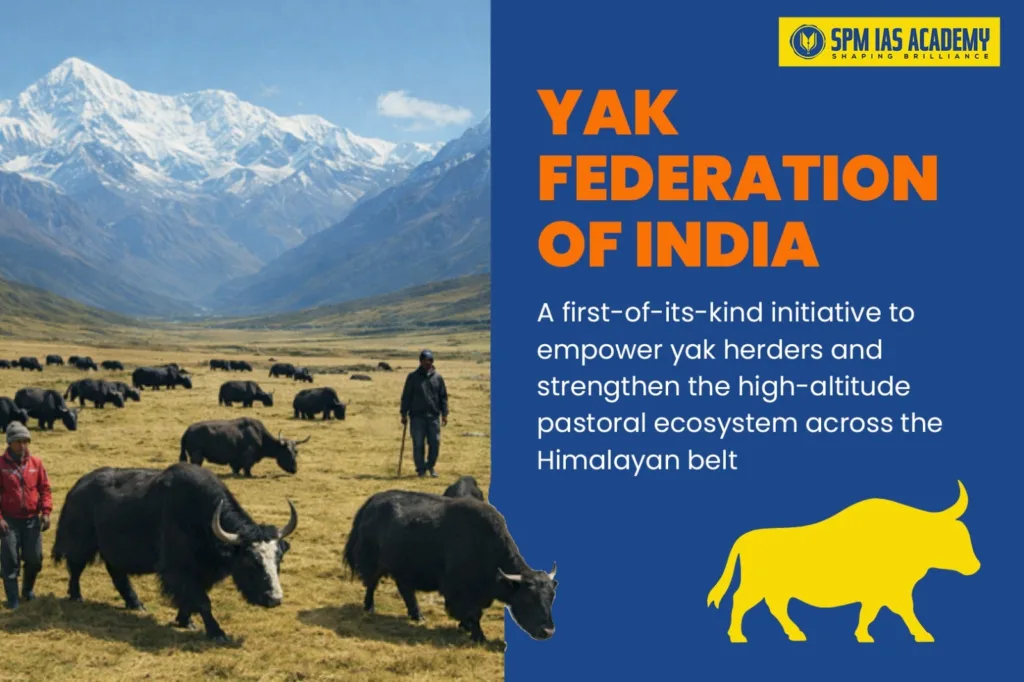
Recently, the Chief Minister of Arunachal Pradesh announced the launch of the Yak Federation of India (YFI). In this context, it is being recognised as a first-of-its-kind initiative aimed at empowering yak herders. Moreover, the federation seeks to strengthen and sustain the high-altitude pastoral ecosystem across the Himalayan region.
What are the key objectives?
- To begin with, it aims to serve as a collective platform that unites yak herders across the Himalayan region.
- Moreover, it seeks to promote sustainable livelihoods, preserve traditional culture, and improve policy coordination.
- In addition, the federation will act as a bridge between yak herders, government bodies, and other stakeholders to ensure their welfare.
- Finally, it encourages collaborative action and strong policy interventions for the long-term development of yak-based economies.
What is the significance?
- To begin with, the initiative marks a major step towards preserving traditional practices while improving livelihood security in high-altitude regions.
- Moreover, it strengthens the yak-rearing ecosystem, which is central to the Himalayan economy, culture, and identity.
- Finally, it aims to revitalise traditional pastoral systems by adapting them to modern challenges such as climate change and shrinking grazing lands.
About Yak (Bos grunniens):
- To begin with, the yak is a domesticated bovine species native to the Himalayan region and the Tibetan Plateau. It is uniquely adapted to extreme cold, thin air, and low-oxygen conditions. Therefore, it is often called the “lifeline of the highlands.”
- Moreover, yaks provide essential resources such as milk, butter, wool, meat, and transport in rugged, high-altitude areas where other livestock cannot survive.
- Finally, beyond its economic value, the yak plays a vital ecological and cultural role in sustaining livelihoods and traditions across the trans-Himalayan belt.
Yak and Arunachal Pradesh:
To begin with, in Arunachal Pradesh, especially among the Brokpa and Monpa tribes, yak herding is more than just an occupation. Instead, it represents a deep-rooted cultural heritage passed down through generations. Moreover, yak-based livelihoods form the socio-economic backbone of highland communities and continue to sustain their traditional way of life.
Additional information:
To begin with, the yak has two recognised scientific names – the wild yak (Bos mutus) and the domesticated yak (Bos grunniens). Wild yaks mainly inhabit alpine tundra regions at very high altitudes, ranging between 5,000 and 7,000 metres.
Moreover, they are well adapted to harsh environments such as alpine meadows, alpine steppes, and desert steppes.
In terms of geographic distribution, yaks are found across the Himalayan region, the Tibetan Plateau, Mongolia, and parts of South-Central Asia. In India, they are primarily found in Arunachal Pradesh, Sikkim, Himachal Pradesh, Uttarakhand, and the Union Territories of Jammu & Kashmir and Ladakh.
Finally, from a conservation perspective, the wild yak (Bos mutus) is classified as Vulnerable on the International Union for Conservation of Nature Red List. In addition, it is listed under Schedule I of the Wildlife Protection Act, 1972, and is included in Appendix I of the Convention on International Trade in Endangered Species of Wild Fauna and Flora, highlighting the need for strict protection.
Conclusion:
In conclusion, the launch of the Yak Federation of India marks an important step towards safeguarding the livelihoods, culture, and ecological systems of high-altitude Himalayan regions. It empowers yak herders through collective representation. It will also provide policy support. Moreover, it will strengthen traditional pastoral practices in the face of climate change and socio-economic challenges. Therefore, by promoting sustainable development, cultural preservation, and ecological balance, the federation has the potential to ensure a resilient future for yak-based communities across the Himalayas.
Prelims MCQ
Q. Consider the following statements about Yak species:
- Bos grunniens refers to the domesticated yak.
- Wild yaks inhabit altitudes above 5,000 metres.
- Wild yak (Bos mutus) is listed as Vulnerable under IUCN.
- Yak is naturally found only in Arunachal Pradesh in India.
Which of the statements are correct?
- 1, 2 and 3 only
- 2 and 4 only
- 1 and 3 only
- 1, 2, 3 and 4
FAQ:
The Yak Federation of India is a national-level platform launched to unite yak herders across the Himalayan region. It was launched to support sustainable livelihoods, preserve traditional yak-rearing practices, and strengthen policy coordination for the welfare of high-altitude pastoral communities.
The Yak Federation of India will help yak herders by improving access to government support. It will encourage community participation and promote climate-resilient pastoral practices. At the same time, it aims to protect the fragile Himalayan ecosystem by strengthening sustainable yak-based economies and traditional land-use systems.