

The proposed India–EU Free Trade Agreement (FTA) can transform Assam’s tea exports. The agreement aims to reduce tariffs, remove non-tariff barriers, and improve regulatory cooperation. The European Union is a high-value and regulation-intensive market with strong demand for agri-products like tea. For Assam, this FTA offers major opportunities but also serious compliance challenges. This topic is highly important for UPSC and APSC under International Trade, Agriculture, and Regional Economy.
Issues like India–EU FTA are well covered in UPSC coaching in north east India with a strong regional focus.
What is the India–EU FTA?
The India–EU FTA has been called the mother of All Deals.
- Firstly, the India–EU FTA aims to deepen trade and economic relations between India and the European Union. It aims to create a more structured and mutually beneficial trade framework.
- Secondly, it focuses on reducing tariffs on goods, thereby making exports and imports more competitive for both sides.
- Moreover, it seeks to address non-tariff barriers, such as complex standards and regulatory requirements that often restrict smooth trade flows.
- In addition, the agreement promotes regulatory cooperation, ensuring better alignment of standards, rules, and compliance mechanisms.
- Furthermore, it aims to improve market access, allowing businesses from both India and the EU to expand their presence more easily.
- Importantly, the European Union remains one of India’s largest trading partners. Their partnership offers a stable and premium market, especially for high-quality agricultural and value-added exports.
Significance of the EU Market for Indian Tea:
India exports around 19–21 million kg of tea annually to the EU.
Germany and Poland act as major entry and redistribution hubs for Indian tea in Europe. Therefore, access to the EU market directly influences tea-exporting states like Assam.
Duty elimination under the FTA, especially for green tea packs and value-added products, can improve price competitiveness.
Opportunities for Assam Tea under India–EU FTA:
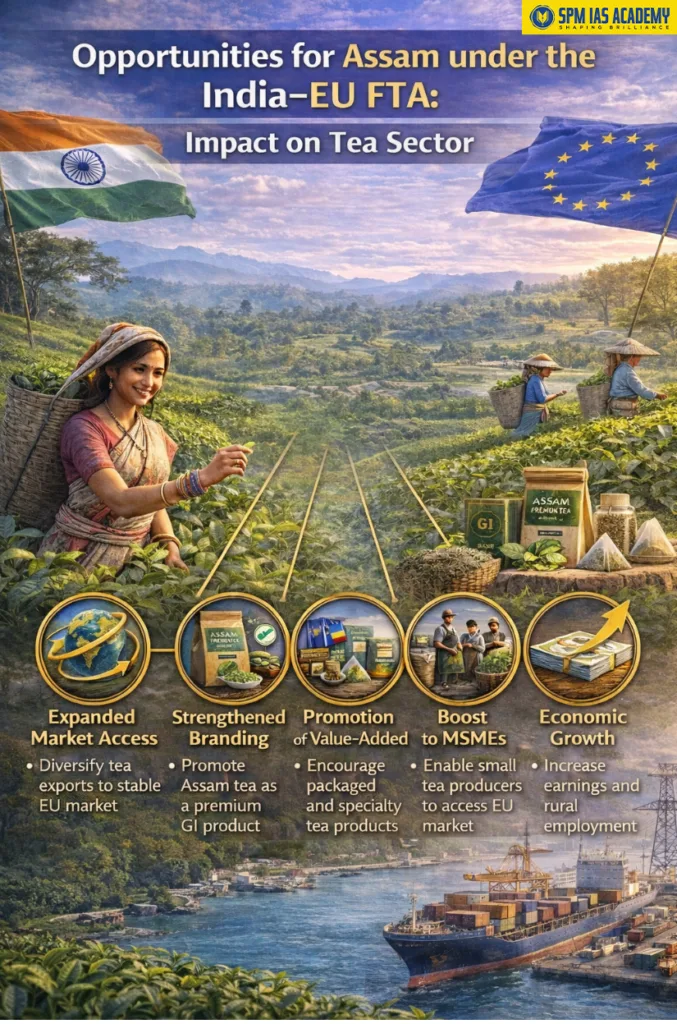
Assam produces globally recognised tea with a strong brand identity and Geographical Indication (GI) status, giving it a competitive advantage in international markets.
1. Expansion of Market Access:
- To begin with, geopolitical disruptions have affected traditional tea markets such as Russia and Iran. Therefore, the European Union offers a stable and high-value alternative market for Assam tea exports.
- As a result, Assam can diversify its export destinations and reduce dependence on a few countries. Consequently, this diversification lowers concentration risk and strengthens long-term export resilience.
2. Branding as a Premium GI Product:
- Moreover, Assam tea enjoys Geographical Indication (GI) recognition, which enhances its authenticity and global reputation. Importantly, the EU market highly values origin-based and specialty products.
- Thus, the FTA can strengthen branding of Assam tea. In turn, stronger branding can increase export value per kilogram, leading to higher earnings for producers.
3. Boost to Value-Added and Packaged Tea:
- Furthermore, the EU market prefers packaged and branded tea over bulk exports.
- With potential duty reductions under the FTA, producers can focus on value-added tea products, specialty green and orthodox tea.
- Consequently, this shift from bulk to branded exports can increase profit margins and enhance competitiveness in premium segments.
Key Challenges under EU Regulations:
- Firstly, the European Union follows strict regulatory standards, which exporters must carefully comply with before entering the market.
- To begin with, exporters must adhere to Maximum Residue Limits (MRLs), ensuring that pesticide levels remain within permitted limits.
- Moreover, they must comply with stringent food safety standards, which require high-quality processing and hygiene practices.
- In addition, the EU mandates strong traceability requirements, meaning producers must track the origin and movement of tea throughout the supply chain.
- Furthermore, exporters must follow detailed packaging and labelling norms, including clear product information and compliance with EU guidelines.
- Importantly, sustainability and human rights due diligence have become key requirements, pushing producers to adopt ethical and environmentally responsible practices.
- Consequently, these compliance requirements increase operational costs, especially for small and medium tea producers who may lack financial and technical resources.
The MRL Issue and Its Impact:
- Firstly, the European Union has introduced new pesticide residue regulations, tightening standards for agricultural imports.
- Specifically, the Maximum Residue Level (MRL) for thiamethoxam and clothianidin will be reduced to 0.05 ppm from March 7.
- Similarly, the MRL for thiacloprid will also be reduced to 0.05 ppm from May.
- As a result, these regulatory changes directly impact Assam’s tea industry, since producers must adjust pesticide usage and cultivation practices to meet the stricter EU standards.
Why It Is a Concern:
Assam tea plantations rely on these chemicals for pest control. However, there are no widely accepted alternatives.
The Tocklai Tea Research Institute has identified some alternatives like chlorfenapyr and tolfenpyrad. Yet, adoption requires time and investment.
If exporters fail to meet MRL norms, shipments may face rejection.
Policy and Institutional Gaps:
Assam faces structural challenges in meeting stringent EU regulatory standards, which affects its export readiness.
- To begin with, there is a shortage of NABL-accredited testing laboratories, limiting timely and reliable residue testing.
- Moreover, the state has limited certification infrastructure, which makes it difficult for producers to obtain internationally recognised quality certifications.
- In addition, traceability systems remain weak, reducing the ability to track products across the supply chain as required by EU regulations.
- Furthermore, insufficient cold-chain and logistics support creates additional hurdles in maintaining product quality during transportation.
Consequently, these institutional gaps increase compliance costs and reduce the overall export competitiveness of Assam’s tea industry.
Way Forward for Assam:
To benefit from the India–EU FTA, Assam must adopt a proactive strategy.
1. Strengthen Testing Infrastructure:
The state must establish more NABL-accredited labs. As a result, faster testing will reduce dependency on out-of-state facilities.
2. Improve Traceability and Certification:
Digital tracking systems can ensure farm-to-export transparency. This step will enhance buyer confidence.
3. Align Domestic Schemes with FTA Commitments:
State policies must align with international trade commitments. Capacity building programs should support small tea growers.
4. Promote Sustainable and Ethical Production:
The EU market values sustainability. Assam must promote reduced chemical use, ethical labour standards and environment-friendly practices. Overall, this approach will improve long-term competitiveness.
Broader Economic Impact for Assam:
- Firstly, the India–EU FTA can increase foreign exchange earnings. Improved market access to the European Union may expand export volumes and value.
- Moreover, it can boost rural employment, particularly in tea plantations and related agro-processing sectors that employ a large workforce.
- In addition, the agreement can encourage value addition, promoting packaged, branded, and specialty tea products instead of bulk exports.
- Furthermore, it can strengthen MSME participation, enabling small and medium enterprises to access international markets with better trade conditions.
- Consequently, the FTA can improve Assam’s global trade integration, positioning the state as a stronger player in international agricultural exports.
However, the overall success of these benefits depends on regulatory preparedness, including compliance with EU standards and strengthening institutional support systems.
For aspirants studying international trade topics, UPSC coaching in Assam helps link global agreements with local economies.
Conclusion: India-EU FTA as a Game Changer for Assam Tea
The India–EU FTA offers major opportunities for Assam’s tea industry. Duty elimination and market access can boost premium and value-added exports. However, strict EU regulations, especially on MRL limits, pose significant challenges.
Assam must strengthen testing infrastructure, improve traceability systems, and promote sustainable tea production. With regulatory preparedness and institutional support, the FTA can become a true game changer for Assam’s tea exports.
Source:
Frequently Asked Questions:
The India–EU FTA can improve Assam tea exports by reducing tariffs, improving market access, and promoting value-added and packaged tea products in the European Union market.
The European Union is a high-value and regulation-intensive market with strong demand for premium and GI-certified Assam tea. Access to the EU helps diversify exports and increase export value per kilogram.
Assam tea exporters must comply with strict EU regulations. These regulations include Maximum Residue Limits (MRLs), food safety standards, traceability requirements, sustainability norms, and packaging guidelines.
The EU’s reduction of MRL limits for pesticides like thiamethoxam, clothianidin, and thiacloprid directly impacts Assam tea producers. It requires adjustments in pest management practices to avoid export rejections.

Behind every article at SPM IAS Academy is a team of skilled content writers and subject experts committed to making preparation easier for aspirants. From answering common doubts to breaking down complex issues and current affairs, we create content that is accurate, easy to understand, and directly useful for UPSC, APSC, and other competitive exams.