
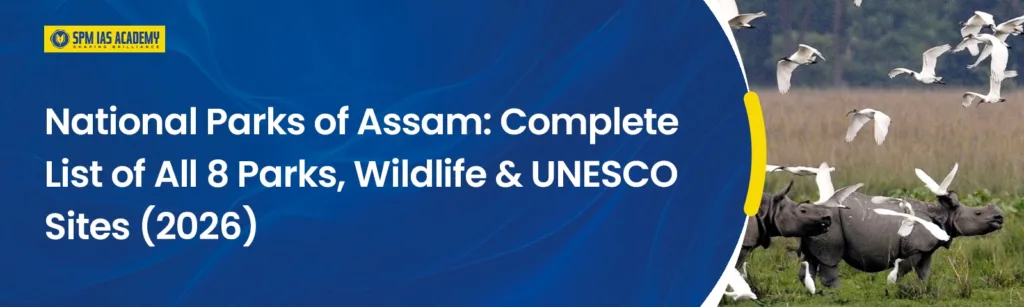
National Parks in Assam are among the most important biodiversity hotspots of India. Assam lies in the Eastern Himalayan and Indo-Burma biodiversity region and has rich forests, grasslands, wetlands, river systems and floodplains. Therefore, the state supports rare species such as the one-horned rhinoceros, Royal Bengal tiger, Asian elephant, golden langur, hoolock gibbon, wild water buffalo, Bengal florican and many migratory birds.
For UPSC, APSC and other State PCS exams, National Parks in Assam are important for Prelims, Mains and interview. Questions can come from location, year of notification, rivers, species, UNESCO status, Ramsar sites, tiger reserves, biosphere reserves and recent current affairs.

How Many National Parks Are There in Assam?
As per the latest development, Assam has 8 national parks. Recently, the Assam Government declared Sikhna Jwhwlao as the 8th National Park on 5 March 2025. Therefore, there are 8 National Parks in Assam: Kaziranga, Manas, Nameri, Dibru-Saikhowa, Orang, Dehing Patkai, Raimona and Sikhna Jwhwlao National Park.
What is National Park?
A National Park is a legally protected area created to conserve wildlife, forests, landscapes and ecological systems. In India, national parks are notified under the Wild Life (Protection) Act, 1972.
A national park gives stronger protection than a general forest area. Human activities such as hunting, grazing, commercial exploitation and private rights are highly restricted. The main objective is biodiversity conservation.
For exam purposes, remember these points:
- A national park protects wildlife and its habitat.
- It is notified under the Wild Life (Protection) Act, 1972.
- It usually has stricter protection than a wildlife sanctuary.
- Boundary changes require legal procedure.
- Conservation, research, tourism and education are major objectives.
Thus, National Parks in Assam are not only tourist destinations. They are ecological security zones for the state.
Complete List of National Parks in Assam
Here is the updated list of National Parks in Assam for APSC and UPSC preparation.
| No. | National Park | Important Location / District | Key Importance |
| 1 | Kaziranga National Park | Golaghat, Nagaon, Sonitpur, Biswanath/Karbi Anglong region | UNESCO World Heritage Site, one-horned rhinoceros, tiger reserve |
| 2 | Manas National Park | Baksa, Chirang, Kokrajhar region | UNESCO World Heritage Site, tiger reserve, biosphere reserve |
| 3 | Nameri National Park | Sonitpur | Elephant habitat, birds, Jia Bhoroli river |
| 4 | Dibru-Saikhowa National Park | Dibrugarh and Tinsukia | Riverine ecosystem, feral horses, wetland biodiversity |
| 5 | Orang National Park and Tiger Reserve | Darrang, Udalguri and Sonitpur region | Mini Kaziranga, rhino and tiger habitat |
| 6 | Dehing Patkai National Park | Dibrugarh and Tinsukia | Rainforest ecosystem, known as Amazon of the East |
| 7 | Raimona National Park | Kokrajhar | Golden langur habitat, Indo-Bhutan landscape |
| 8 | Sikhna Jwhwlao National Park | Kokrajhar and Chirang | Assam’s 8th national park, ecological corridor near Indo-Bhutan border |
Kaziranga National Park
- Kaziranga National Park is located in Assam across the Brahmaputra floodplain and is mainly spread over Golaghat, Nagaon, Sonitpur and Biswanath districts. It is famous for its tall grasslands, wetlands and tropical forests.
- On 1st June, 1905, Kaziranga Proposed Reserve Forest was created. Later in 1950, Kaziranga Game Sanctuary was renamed as Kaziranga Wildlife Sanctuary.
- In 1974, Kaziranga was declared as a National Park.
- Moreover, in 1985, UNESCO declared Kaziranga as World Heritage Site for its outstanding natural value and rich biodiversity. It is one of India’s most successful wildlife conservation areas.
- Kaziranga is best known for the one-horned rhinoceros. It shelters a major share of the world’s Indian one-horned rhinoceros population, along with elephants, wild water buffalo, swamp deer and many bird species.
- Furthermore, it is also a Tiger Reserve. Kaziranga was declared a Tiger Reserve in 2006 and notified in 2007. It plays an important role in conserving the Royal Bengal Tiger in Assam.
Manas National Park
- Manas was first declared a Wildlife Sanctuary in 1928. Later, it became one of Assam’s most important protected areas because of its rich forests, grasslands and rare wildlife.
- It was declared a Tiger Reserve in 2008 under Project Tiger.
- UNESCO declared Manas a Natural World Heritage Site in 1985 for its outstanding biodiversity and natural beauty. However, it was placed on the World Heritage in Danger list in 1992 due to insurgency, poaching and habitat damage.
- Manas was declared a Biosphere Reserve in 1989 and a National Park on 7 September 1990. This strengthened its legal protection and conservation importance.
- UNESCO removed Manas from the World Heritage in Danger list in 2011 after major conservation recovery. Today, it is known as a National Park, Tiger Reserve, Elephant Reserve, Biosphere Reserve and UNESCO World Heritage Site.
Nameri National Park
- Nameri National Park is located in Sonitpur district of Assam, along the foothills of Arunachal Pradesh. The Jia Bhoroli River flows along its southern boundary and supports its riverine ecosystem.
- Nameri was declared a reserved forest in 1978.
- Later, Nameri was declared a Wildlife Sanctuary in 1985. Later, it was upgraded to a National Park in 1998, which gave stronger legal protection to its forests, grasslands and wildlife habitats.
- It was declared a Tiger Reserve in 2000. Today, Nameri is one of the four Tiger Reserves in Assam, along with Manas, Kaziranga and Orang.
- Nameri is famous for rich biodiversity. It shelters tigers, elephants, leopards, Himalayan black bears, hornbills and the rare White-winged Wood Duck.
- It is important for conservation and eco-tourism. Moreover, its location near Arunachal Pradesh makes it significant for wildlife corridors, riverine biodiversity, birdwatching and Eastern Himalayan ecosystem protection.
Dibru-Saikhowa National Park
- Dibru-Saikhowa National Park is located in Dibrugarh and Tinsukia districts of Assam. It lies between the Brahmaputra and Lohit rivers in the north and the Dibru River in the south, making it an important riverine and wetland ecosystem.
- Dibru-Saikhowa National Park was declared as Dibru Reserve forest in 1890. In 1929, Saikhowa Reserve Forest was declared.
- In 1986, the government preliminarily declared 650 sq. km of the area as a wildlife sanctuary. However, after final notification, it declared 340 sq. km as Dibru-Saikhowa Wildlife Sanctuary in 1995.
- Later, in July 1997, the government included this area in the larger Dibru-Saikhowa Biosphere Reserve. The biosphere reserve covers about 765 sq. km, including the core sanctuary area and surrounding buffer region.
- Dibru-Saikhowa became a National Park in 1999. Its core national park area covers about 340 sq. km, while the surrounding biosphere reserve includes a larger buffer zone.
- It is famous for wetlands, grasslands, swamp forests and riverine forests. Moreover, it contains the largest Salix swamp forest in Northeast India and supports both Indian and Malayan biogeographic elements.
- It is important for rare wildlife and birds. The park is known for the white-winged wood duck, feral horses, wild buffalo, elephants, Gangetic dolphins, migratory birds and rich aquatic biodiversity.
Orang National Park and Tiger Reserve
- Orang National Park and Tiger Reserve is located on the northern bank of the Brahmaputra River in Assam, mainly across Darrang and Sonitpur districts. It protects alluvial grasslands, wetlands and riverine forests.
- Orang was first notified as a Wildlife Sanctuary in 1985. Later, it was declared a National Park in 1999, giving stronger legal protection to its wildlife and habitat.
- It was declared a Tiger Reserve in 2016. The tiger reserve includes a core area of 79.28 sq. km and a buffer area of 413.18 sq. km, making it important for tiger conservation in Assam.
- Orang National Park is often called “Mini Kaziranga” because it supports the greater one-horned rhinoceros, Royal Bengal tiger, elephant, wild water buffalo, pygmy hog and rich grassland biodiversity.
- It is the only stronghold of the rhinoceros on the north bank of the Brahmaputra. Moreover, rivers such as Pachnoi, Belsiri and Dhansiri influence its floodplain ecosystem before joining the Brahmaputra.
Raimona National Park
- Raimona National Park is located in Kokrajhar district of the Bodoland Territorial Region in western Assam. It lies in the southern foothills of the Eastern Himalaya and forms part of a large transboundary conservation landscape with Bhutan’s Phibsoo Wildlife Sanctuary and West Bengal’s Buxa Tiger Reserve.
- It was declared a National Park on 5 June 2021, on the occasion of World Environment Day, and the official gazette notification was issued by the Assam Government on 9 June 2021. It became Assam’s 6th National Park.
- Raimona covers about 422 sq. km and was earlier part of the Ripu Reserve Forest. Its landscape includes forests, grasslands, rivers and hill ecosystems, making it important for western Assam’s biodiversity.
- It is especially important for the golden langur, an endangered primate species found in Assam and Bhutan. Moreover, the park supports elephants, tigers, clouded leopards, hornbills, butterflies and several other wildlife species.
Dehing Patkai National Park
- Dehing Patkai National Park is the 7th national park in Assam which is located in Dibrugarh and Tinsukia districts of Assam. It covers about 231.65 sq. km of tropical lowland rainforest and forms part of the larger Dehing Patkai landscape.
- It was declared a Wildlife Sanctuary on 13 June 2004. Later, the Assam Government upgraded it into a National Park on 13 December 2020, and the Forest Department officially notified it as a National Park on 9 June 2021.
- Dehing Patkai is known as the “Amazon of the East.” It protects one of India’s important stretches of tropical lowland rainforest and has a dipterocarp-dominated forest ecosystem.
- It supports rich biodiversity, including elephants, tigers, clouded leopards, hoolock gibbons, slow loris, hornbills, rare birds, reptiles and many butterfly species. Therefore, it is highly important for Assam’s rainforest conservation.
Sikhna Jwhwlao National Park
- Sikhna Jwhwlao National Park is located in Kokrajhar and Chirang districts of the Bodoland Territorial Region in Assam. It covers about 316.29 sq. km and strengthens the protected-area network of western Assam.
- The Assam Government officially notified it as a National Park on 5 March 2025 under the Wild Life (Protection) Act, 1972.
- It is Assam’s 8th National Park and the 3rd National Park in the Bodoland Territorial Region, after Manas and Raimona.
- It is ecologically important because it forms part of the Greater Manas landscape. Moreover, it helps to connect protected forest areas near the Indo-Bhutan region and supports wildlife movement.
- The park supports rich biodiversity, including golden langur, elephant, tiger, rhinoceros and several bird and butterfly species.
What is Protected Areas Network in Assam?
The protected areas network in Assam includes national parks, wildlife sanctuaries, tiger reserves, elephant reserves and biosphere reserves. The Assam State Biodiversity Board describes the protected area network as including national parks, wildlife sanctuaries, proposed wildlife sanctuaries, tiger reserves, elephant reserves and biosphere reserves.
This network protects different ecosystems:
- Brahmaputra floodplains
- Riverine grasslands
- Tropical rainforests
- Wetlands
- Himalayan foothill forests
- Elephant corridors
- Rhino and tiger habitats
The protected areas network in Assam is important because Assam faces floods, erosion, encroachment, poaching, climate change, invasive species and human-wildlife conflict. Therefore, protected areas act as ecological shields.
What Are the Major Challenges Faced by National Parks in Assam?
Although National Parks in Assam are rich in biodiversity, they face several challenges.
- Floods and erosion: Parks like Kaziranga and Dibru-Saikhowa face annual flood impacts.
- Human-wildlife conflict: Elephants, rhinos and tigers often move outside park boundaries.
- Habitat fragmentation: Roads, settlements and land-use change affect wildlife corridors.
- Poaching: Rhino poaching has reduced, but protection must continue.
- Climate change: Changing rainfall and river behaviour affect wetlands and grasslands.
- Invasive species: Some habitats face pressure from invasive plants.
- Tourism pressure: Unregulated tourism can disturb wildlife.
Therefore, Assam needs science-based conservation, local community participation, better patrolling, habitat restoration and responsible eco-tourism.
Wildlife Sanctuaries in Assam with Location
Assam’s Protected Area Network includes 17 Wildlife Sanctuaries and 3 proposed Wildlife Sanctuaries, according to the Assam State Biodiversity Board. The Assam Forest Department also lists these 17 notified sanctuaries on its official wildlife sanctuary page.
| No. | Wildlife Sanctuary in Assam | Location / District |
| 1 | Garampani Wildlife Sanctuary | Karbi Anglong |
| 2 | Laokhowa Wildlife Sanctuary | Nagaon |
| 3 | Bornadi Wildlife Sanctuary | Udalguri / Baksa region |
| 4 | Chakrasila Wildlife Sanctuary | Kokrajhar / Dhubri region |
| 5 | Burachapori Wildlife Sanctuary | Sonitpur |
| 6 | Panidehing Wildlife Sanctuary | Sivasagar |
| 7 | Hollongapar Gibbon Wildlife Sanctuary | Jorhat |
| 8 | Pobitora Wildlife Sanctuary | Morigaon |
| 9 | Sonai Rupai Wildlife Sanctuary | Sonitpur |
| 10 | Bherjan-Borajan-Padumoni Wildlife Sanctuary | Tinsukia |
| 11 | East Karbi Anglong Wildlife Sanctuary | Karbi Anglong |
| 12 | Nambor Wildlife Sanctuary | Karbi Anglong |
| 13 | Marat Longri Wildlife Sanctuary | Karbi Anglong |
| 14 | Nambor-Doigrung Wildlife Sanctuary | Golaghat |
| 15 | Amchang Wildlife Sanctuary | Kamrup Metropolitan / Guwahati |
| 16 | Borail Wildlife Sanctuary | Cachar / Barak Valley region |
| 17 | Deepar Beel Wildlife Sanctuary | Kamrup Metropolitan / Guwahati |
Tiger Reserves in Assam
Assam has four Tiger Reserves – Kaziranga (2007), Manas (2008), Nameri (2000) and Orang (2016). These reserves play a major role in protecting the Royal Bengal Tiger in the Brahmaputra Valley and Eastern Himalayan landscape.
- Kaziranga Tiger Reserve is Assam’s most famous tiger habitat. It became a tiger reserve in 2007. It is also a UNESCO World Heritage Site and supports one-horned rhinoceros, elephants, wild buffalo, swamp deer and rich wetland biodiversity.
- Manas Tiger Reserve is located near the Bhutan border. It was notified as Tiger reserve in 2008. Moreover, it is a UNESCO World Heritage Site, Biosphere Reserve and an important transboundary conservation landscape.
- Nameri Tiger Reserve lies in northern Assam near the Jia Bhoroli river. It protects forest, riverine and elephant habitats and forms an important part of Assam’s wildlife corridor network.
- Orang Tiger Reserve is located on the northern bank of the Brahmaputra. People also call it “Mini Kaziranga” because it supports rhinos, tigers, elephants and grassland species.
- These Tiger Reserves strengthen Assam’s protected area network. They conserve tigers along with prey species, grasslands, wetlands, forests and riverine ecosystems.
Elephant Reserves in Assam
Assam has 5 Elephant Reserves as part of its protected area network. These reserves help to conserve the Asian elephant and its natural corridors across forests, grasslands and riverine landscapes.
- Chirang-Ripu Elephant Reserve covers parts of Kokrajhar, Chirang, Baksa and Udalguri districts. It spreads over about 2,600 sq. km and forms an important elephant habitat in western Assam.
- Sonitpur Elephant Reserve lies in Sonitpur district and covers about 1,420 sq. km. Moreover, it connects Assam’s elephant habitat with the adjoining foothill forests of Arunachal Pradesh.
- Dihing Patkai Elephant Reserve is located in Dibrugarh and Tinsukia districts. It covers about 937 sq. km and protects rainforest-based elephant habitat in Upper Assam.
- Kaziranga-Karbi Anglong Elephant Reserve covers parts of Sonitpur, Nagaon, Golaghat and Karbi Anglong districts. It is the largest elephant reserve in Assam, with an area of about 3,270 sq. km.
- Dhansiri-Lungding Elephant Reserve spreads across Karbi Anglong, Nagaon and North Cachar Hills/Dima Hasao areas. It covers about 2,740 sq. km and acts as a key elephant corridor towards Nagaland.
Together, these Elephant Reserves strengthen Assam’s protected areas network. They support elephant movement between forests, reduce habitat isolation and protect important wildlife corridors.
The only Ramsar Site in Assam – Deepor Beel
- Assam has one Ramsar Site – Deepor Beel, also spelt Dipor Bil. It is the only wetland in Assam recognised under the Ramsar Convention.
- Deepor Beel is located in Guwahati, on the south-western side of the city in Kamrup Metropolitan district. It is a freshwater lake and one of Assam’s most important urban wetlands.
- The Ramsar Convention listed Deepor Beel in November 2002 because of its biological and environmental importance. Therefore, it is recognised as a wetland of international importance.
- Deepor Beel covers around 40.14 sq. km as a Ramsar site. It is also connected with the Brahmaputra floodplain system and plays an important role in maintaining ecological balance.
- Moreover, Deepor Beel supports rich biodiversity. It provides habitat for resident and migratory birds, fish species, aquatic plants and other wetland life.
- It also acts as a natural water storage system for Guwahati. During heavy rainfall, the wetland helps absorb excess water and reduces the risk of urban flooding.
- In addition, Deepor Beel supports local livelihoods. Many nearby communities depend on the wetland for fishing and other ecosystem services.
- However, Deepor Beel faces serious threats such as encroachment, waste dumping, pollution, railway-line pressure, invasive species and shrinking wetland area.
- Recently, environmental concerns around Deepor Beel increased. The National Green Tribunal asked key authorities to respond to reports of degradation, illegal dumping and shrinking wetland area.
- Therefore, Assam needs stronger wetland conservation measures through scientific monitoring, waste management, community participation, eco-restoration and strict control over encroachment.
Conclusion
National Parks in Assam represent the ecological strength of the state. They protect rare species, river systems, forests, grasslands and wetlands. As of the latest notification, Assam has 8 national parks, with Sikhna Jwhwlao being the latest addition.
For UPSC, APSC and State PCS aspirants, this topic is highly important. It connects static geography with current affairs, conservation policies and Assam-specific development. Therefore, aspirants should study National Parks in Assam with maps, species, districts, legal status and recent updates.
Also Read:
| Article |
| Assam’s Biodiversity and Wildlife for APSC Guide |
| National Parks in India 2025: Wildlife & Eco-Tourism Spots |
Source:

Behind every article at SPM IAS Academy is a team of skilled content writers and subject experts committed to making preparation easier for aspirants. From answering common doubts to breaking down complex issues and current affairs, we create content that is accurate, easy to understand, and directly useful for UPSC, APSC, and other competitive exams.