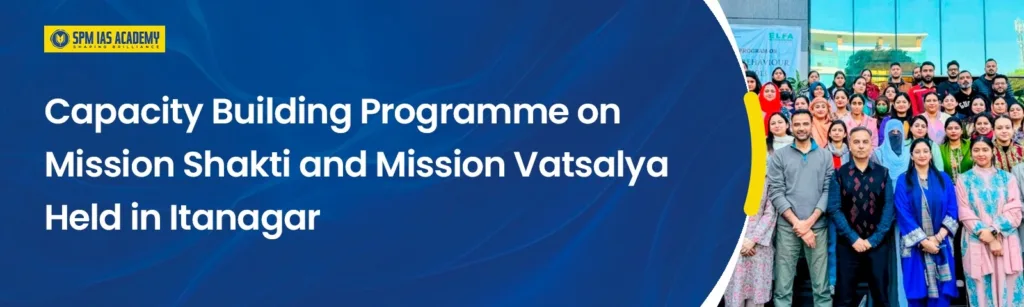
The Government of Arunachal Pradesh organised a state-level capacity building programme on Mission Shakti and Mission Vatsalya. It aims to enhance the skills and operational readiness of field-level functionaries. The programme was held in Itanagar and aimed to ensure accurate data entry, timely reporting, and effective use of digital portals related to women and child development. This initiative is significant for UPSC and APPSC Mains, particularly under APPSC GS I and GS Paper II (Governance and Social Justice).
Organising Authority and Participants:
Who Organised the Programme?
The programme was organised by the State Sankalp Hub for Empowerment of Women under the Women and Child Development Department (WCD).
Who Participated?
- District-level functionaries of Mission Shakti and Mission Vatsalya.
- Officials from District Child Protection Units (DCPUs).
- Representatives of One-Stop Centres (OSCs).
- Resource persons from women and child development sectors.
What are the Objectives of the Capacity Building Programme:
The programme was designed with the following objectives:
- Firstly, to ensure smooth functioning of Mission Shakti and Mission Vatsalya portals.
- Secondly, to improve accuracy and timeliness of data entry.
- Thirdly, to strengthen monitoring and reporting mechanisms.
- Moreover, it aims to enhance the operational capacity of district-level institutions.
Thus, the initiative focused on connecting the gap between policy design and field-level implementation.
Focus Areas of the Capacity Building Programme:
Digital Portals and Dashboards:
Participants received detailed presentations and hands-on demonstrations on the proper use of portals and dashboards related to Mission Shakti and Mission Vatsalya. Special emphasis was placed on scheme-wise data entry, avoiding common errors and ensuring real-time reporting.
Mission Vatsalya Presentation:
A dedicated session on Mission Vatsalya was delivered by officials from State Child Protection Society (SCPS). Moreover, the session covered delivery of child protection services, step-by-step usage of the Mission Vatsalya portal and Integration of CARA’s CARINGS portal with Mission Vatsalya.
Role of CARINGS and Digital Integration:
What Is CARINGS?
The CARINGS portal (Child Adoption Resource Information and Guidance System) is a digital platform for adoption-related services.
Integration with Mission Vatsalya:
Officials explained how CARINGS has been integrated into the Mission Vatsalya portal. It aims to ensure seamless data flow, centralised child protection records and improved monitoring and transparency.
This integration reflects the government’s push toward digital governance in social sector schemes.
Addressing Challenges in Field Implementation:
Common Data Entry Issues:
Resource persons highlighted frequent mistakes observed during data entry, such as incomplete records, delayed uploads and incorrect beneficiary details.
Participants were guided on corrective measures and best practices to ensure error-free submissions.
Importance of Timely Reporting:
It was emphasised that delays or inaccuracies in digital reporting directly affect scheme performance. Therefore, timely and accurate data entry was described as essential for reflecting ground realities at the policy level.
Legal and Institutional Framework Discussed:
Officials from the WCD department also discussed key legal provisions, including:
- Sexual Harassment of Women at Workplace (Prevention, Prohibition and Redressal) Act, 2013.
- Role of She-Box portal in grievance redressal.
Technical sessions encouraged participants to seek clarifications and share suggestions for improving portal usage and service delivery.
What is Mission Shakti?
Mission Shakti is a One-Stop Centre scheme aiming to provide integrated support and assistance under one roof to women affected by violence and distress in public and private spaces.
The government has been implementing this scheme since 1st April, 2015. It covers a range of services such as medical aid, legal aid and advice, temporary shelter, police assistance, psycho-social counselling.
Moreover, this scheme has two sub-schemes viz. Sambal and Samarthya. The Sambal sub scheme is for safety and security of women. It also covers other schemes such as One Stop Centre (OSC), Women Helpline (WHL), Beti Bachao Beti Padhao (BBBP), a component of Nari Adalat.
On the other hand, Samarthya sub scheme aims for the empowerment of women. Therefore, it covers existing schemes like Ujjwala, SwadharGreh and Working Women Hostel. In addition, it also covers the National Creche Scheme and PMMVY. Furthermore, a new component of Gap Funding for Economic Empowerment has been added in the Samarthya sub scheme.
What are the main objectives of Mission Shakti?
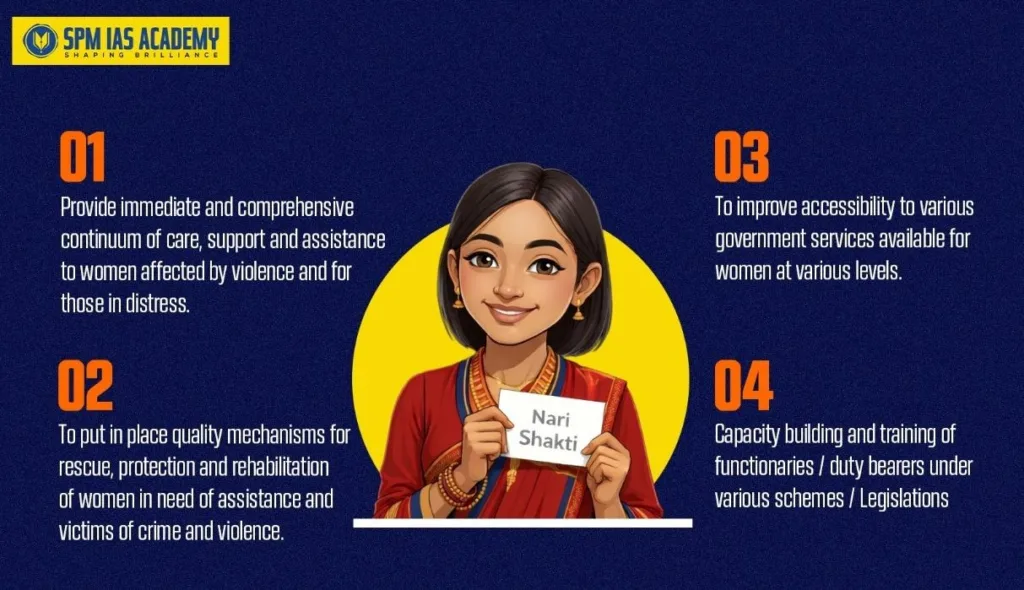
Mission Shakti aims to ensure care and protection for all women and girls by providing both short-term and long-term support services, along with access to relevant information for their holistic development and empowerment.
Moreover, the mission places special emphasis on assisting women and girls who are victims of violence, ensuring timely support, safety, and rehabilitation.
Overall, the mission seeks to create an enabling and secure environment by integrating welfare, protection, and empowerment measures. Accordingly, its key objectives include:
What is Mission Vatsalya?
Mission Vatsalya aims to ensure a healthy and happy childhood for every child in India. At its core, the mission seeks to empower children to realise their full potential and flourish in all dimensions of life-physical, emotional, social, and educational.
Furthermore, the initiative places strong emphasis on family-based and non-institutional care, especially for children living in difficult circumstances, thereby promoting a nurturing and protective environment over institutionalisation.
In addition, Mission Vatsalya endeavours to create a sensitive, supportive, and well-coordinated ecosystem for child welfare across the country. To achieve this, it focuses on strengthening the institutional framework related to child protection.
Consequently, the mission works towards reinforcing the capacity of Child Welfare Committees, statutory bodies, and service-delivery mechanisms at the district level, ensuring that child care and protection services are accessible, effective, and responsive nationwide.
Conclusion:
The capacity building programme on Mission Shakti and Mission Vatsalya marks an important step toward improving the effectiveness of women and child welfare schemes in Arunachal Pradesh. By focusing on digital skills, accurate reporting, and legal awareness, the initiative strengthens institutional capacity at the district level.
For UPSC and APPSC aspirants, this development offers a strong contemporary example of how governance reforms, technology, and human resource development combine to improve social justice outcomes.
Source:
https://www.pib.gov.in/PressReleaseIframePage.aspx?PRID=1841498®=3&lang=2
https://missionvatsalya.wcd.gov.in
| Article Title | Read |
|---|---|
| Arunachal Pradesh: History, Culture, Economy & Key Facts | Read → |
| Arunachal Statehood Day: History & Significance | Read → |
| Capital of Arunachal Pradesh – Itanagar | Read → |
| Donyi Polo Day & Indigenous Faith of Arunachal | Read → |
| Arunachal Pradesh’s Textile Heritage on Global Stage | Read → |
| Digital Inner Line Permit (ILP) System in Arunachal | Read → |
| Gaon Buras and Gaon Buris in Arunachal Pradesh | Read → |
| Importance of Current Affairs for UPSC in Arunachal | Read → |
| How to Prepare Current Affairs for APPSC 2025 | Read → |
| Arunachal Pradesh Current Affairs – Full Category | Arunachal Pradesh’s Textile Heritage on the Global Stage |
The capacity building programme in Itanagar aimed to enhance the skills and operational efficiency of field-level officials by improving accurate data entry, timely reporting, and effective use of digital portals. It is related to Mission Shakti and Mission Vatsalya, thereby strengthening women and child welfare governance in Arunachal Pradesh.
Mission Shakti is important because it provides integrated care, protection, and empowerment services to women and girls, especially victims of violence, through short-term and long-term support mechanisms. It provides its services through One Stop Centres, Women Helplines, legal aid, shelter, and economic empowerment schemes.
Mission Vatsalya strengthens child protection by promoting family-based, non-institutional care. It also aims to improve the capacity of Child Welfare Committees and District Child Protection Units. It also enables digital integration with portals like CARINGS to ensure transparent, responsive, and effective child welfare services.
Mission Shakti is a centrally sponsored scheme of the Government of India that aims to provide integrated care, protection, and empowerment services for women and girls, especially those affected by violence and distress, through safety, support, rehabilitation, and livelihood-oriented interventions.
Mission Vatsalya is a Government of India initiative focused on ensuring a safe, healthy, and nurturing environment for children, particularly those in difficult circumstances. It aims to achieve this by strengthening child protection systems, family-based care, and institutional capacities at the district and state levels.

Behind every article at SPM IAS Academy is a team of skilled content writers and subject experts committed to making preparation easier for aspirants. From answering common doubts to breaking down complex issues and current affairs, we create content that is accurate, easy to understand, and directly useful for UPSC, APSC, and other competitive exams.