
Why was Army-IAF Multi-Domain Combat Exercise in the news?
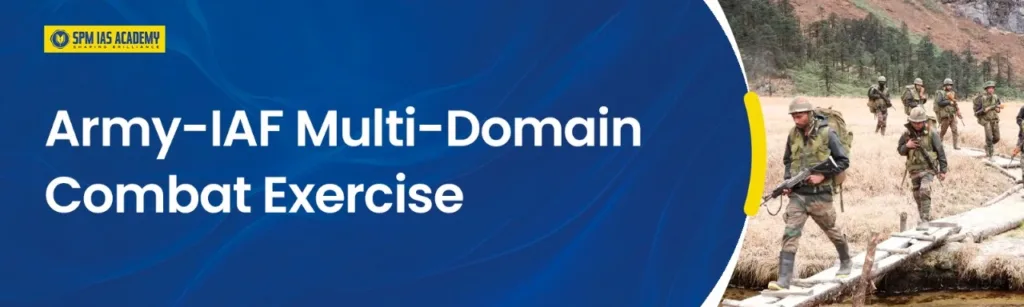
Recently, the Indian Army, in close coordination with the Indian Air Force, conducted a large-scale integrated multi-domain combat exercise. Notably, the exercise was carried out in the high-altitude Himalayan terrain of Arunachal Pradesh, near the Line of Actual Control.
Through this exercise, the armed forces aimed to enhance joint operational preparedness, improve inter-service coordination, and strengthen combat readiness for modern warfare scenarios. Consequently, the drill holds strategic importance for India’s border security and defence posture in sensitive frontier regions.
What are the Purposes of the Exercise?
1. Strengthening Jointness and Integration: Firstly, the exercise aimed to enhance interoperability among multiple combat and support elements. It ensured seamless coordination between Army ground forces, Indian Air Force air assets, surveillance systems, UAVs, and logistics and supply chains. Moreover, it aligns with India’s broader shift towards Integrated Theatre Commands, reinforcing joint planning and execution.
2. High-Altitude Combat Preparedness: Secondly, the drill tested combat effectiveness in extreme terrain and harsh climatic conditions. By doing so, it ensured operational readiness for potential conflict scenarios along the Eastern Line of Actual Control (LAC).
3. Precision Fire and Real-Time Targeting: In addition, the exercise focused on precision warfare by integrating artillery fire, close air support, UAV-based reconnaissance, and multi-sensor data fusion. Consequently, it validated real-time targeting, rapid decision-making, and coordinated strike capabilities.
4. Operationalisation of Integrated Battle Groups (IBGs): Finally, the exercise supported India’s transition towards agile, mobile, and self-contained Integrated Battle Groups (IBGs). As a result, it enhanced swift response capability and improved the Army’s ability to conduct rapid and flexible operations in modern combat environments.
What are the Strategic Significances?
1. Strengthening Preparedness along the LAC: To begin with, Arunachal Pradesh has witnessed increased PLA activity, including frequent patrols and accelerated infrastructure development along the Line of Actual Control (LAC). Against this backdrop, the exercise enhances India’s multi-domain combat capabilities, thereby improving deterrence, surveillance, and operational dominance in a sensitive frontier region.
2. Advancing India’s Defence Modernisation: Moreover, the exercise forms a key part of India’s broader military modernisation drive. It supports the shift towards network-centric warfare, multi-domain operations (MDO), and high-technology battlefield integration, which are essential for future-ready armed forces.
3. Evolution of the Air–Land Battle Doctrine: In addition, the drill strengthens the synchronised employment of air power and ground forces. As a result, it refines India’s air–land battle doctrine and enhances the ability to respond effectively to complex, multi-domain threats.
4. Strategic Signalling to Adversaries: Finally, the exercise sends a clear strategic message by demonstrating India’s robust defensive posture in difficult and high-altitude terrain. Consequently, it reinforces India’s firm commitment to safeguarding territorial integrity and maintaining stability along its borders.
What is Multi-Domain Operations (MDO)?
Multi-Domain Operations (MDO) is a modern approach to warfare where forces operate together across different domains instead of working separately. In simple terms, it means fighting as one integrated force on land, in the air, in space, and in the digital domain.
- First, on land, this includes infantry soldiers, mechanised units, and artillery systems operating on the ground.
- Next, in the Air domain, it involves fighter aircraft, attack helicopters, and unmanned aerial vehicles (UAVs) providing air support and surveillance.
- Then, in the cyber domain, this focuses on protecting military networks while also carrying out offensive cyber operations.
- After that, in the space domain, it uses satellites for intelligence, surveillance, reconnaissance (ISR), and communication support.
- At the same time, it also includes the domain of Electronic Warfare (EW) which includes jamming enemy signals and controlling the electromagnetic spectrum.
- Another important domain is Information Warfare. This deals with psychological operations, information control, and shaping perceptions.
Overall, Multi Domain Operations (MDO) ensures better coordination, faster decision-making, and stronger battlefield control. Therefore, it closely aligns with India’s future defence strategy based on Integrated Theatre Commands and joint military operations.
Why is Arunachal Pradesh Important from an Operational Context?
- Geostrategic Importance: To begin with, Arunachal Pradesh holds high strategic importance as it shares a long and disputed border with Tibet (China). Moreover, it constitutes the Eastern Sector of the Line of Actual Control (LAC), making it a critical area from a national security perspective.
- Terrain and Infrastructure Challenges: At the same time, the region presents severe operational challenges. It is characterised by high-altitude terrain, dense forest cover, and limited road connectivity, which restrict mobility and logistics. In addition, harsh winters and unpredictable weather conditions further complicate military operations.
Therefore, conducting exercises in Arunachal Pradesh allows the armed forces to simulate real battlefield conditions, test operational readiness, and enhance combat effectiveness in one of the most challenging terrains in the country.
Conclusion:
In conclusion, the Army-IAF Multi-Domain Combat Exercise underscores India’s growing emphasis on jointness, technological integration, and high-altitude combat readiness. Conducted in the strategically sensitive terrain of Arunachal Pradesh, the exercise strengthens deterrence along the LAC, supports defence modernisation, and refines multi-domain warfare capabilities. Overall, it reflects India’s firm commitment to safeguarding territorial integrity while preparing its armed forces for future, complex warfare scenarios through integrated and agile operations.
Mains Practice Question:
Q. Discuss the significance of the recent Army–IAF Multi-Domain Combat Exercise conducted in Arunachal Pradesh in strengthening India’s high-altitude operational preparedness and its transition toward Integrated Theatre Commands.
Source: Arunachal Times
FAQ:
The main objective of the Army – IAF Multi-Domain Combat Exercise was to enhance joint operational preparedness of the Indian Army and the Indian Air Force in high-altitude terrain near the Line of Actual Control (LAC). The exercise focused on improving coordination, precision strike capability, and readiness for modern multi-domain warfare.
Arunachal Pradesh was chosen because it lies along the Eastern Sector of the LAC and presents challenging operational conditions such as high altitude, dense forests, limited infrastructure, and harsh weather. Conducting the exercise in this region helps simulate real battlefield scenarios and strengthens India’s defensive posture in a strategically sensitive border area.