
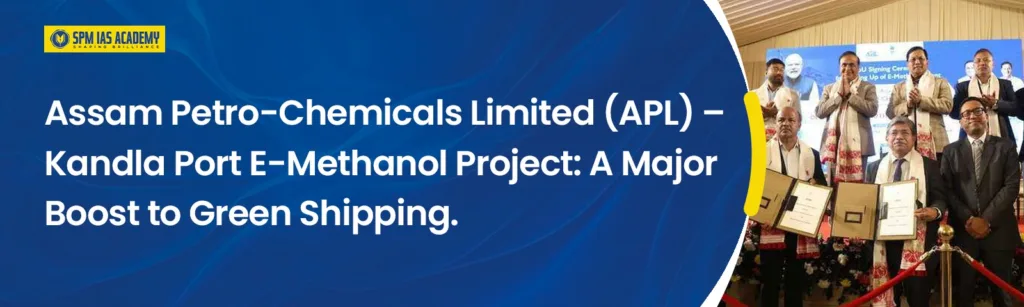
What Is the Assam Petro-Chemicals Limited (APL) – Kandla Port E-Methanol Project?
Assam Petro-Chemicals Ltd (APL) has taken a significant step in India’s clean energy journey. It has signed an MoU to set up a 150 tonnes per day e-methanol plant at Kandla Port in Gujarat. This project aims to produce green methanol, a low-carbon fuel. Moreover, this project will support maritime decarbonisation and green shipping. The initiative connects Assam’s public sector expertise with India’s port-led development. It is highly relevant for UPSC, APSC, and State PCS exams under environment, economy, and infrastructure themes.
For exam-focused guidance, explore Best APSC & UPSC Coaching in Guwahati to strengthen your preparation strategy.
What are the Key Details of the APL – Kandla Port MoU on e-Methanol Project?
- Project Proponent: Assam Petro-Chemicals Ltd (APL)
- Partner: Deendayal Port Authority (DPA)
- Location: Kandla Port, Gujarat
- Plant Capacity: 150 tonnes per day of e-methanol
- Investment: Over ₹1,200 crore
- Employment Potential: Around 3,500 direct and indirect jobs
Roles and Responsibilities Under this agreement:
Role of Deendayal Port Authority (DPA):
Firstly, DPA will provide port-based infrastructure. It will provide land and logistical support within the port area. This ensures seamless integration of green fuel production with maritime operations.
Role of Assam Petro-Chemicals Ltd (APL):
Secondly, APL will establish and operate the green e-methanol production facility. The company brings technical expertise and experience in petro-chemicals, now aligned with clean energy goals.
What Is E-Methanol and Why Is It Important?
E-methanol is a green fuel produced using renewable energy sources, captured carbon dioxide, and green hydrogen. Unlike conventional methanol, it has a very low carbon footprint. It is produced by combining green hydrogen generated via renewable energy powered electrolysis with captured carbon dioxide.
Why is E-Methanol important?
Firstly, e-methanol is emerging as a cleaner alternative to conventional shipping fuels such as heavy fuel oil and marine diesel. Since the global shipping sector is a major contributor to air pollution and carbon emissions. The use of e-methanol helps significantly to lower the environmental footprint of maritime transport.
Secondly, e-methanol plays a vital role in reducing greenhouse gas emissions. When produced using renewable energy and captured carbon dioxide, it offers a low-carbon or near-zero-carbon fuel option. As a result, it directly contributes to climate change mitigation efforts.
Moreover, the adoption of e-methanol supports global climate commitments. Many countries and international bodies are working toward net-zero targets under frameworks such as the Paris Agreement. In this context, e-methanol provides a practical pathway for hard-to-abate sectors like shipping to decarbonise.
Importantly, e-methanol is compatible with existing shipping engines. It requires only technical modifications rather than complete engine replacement. This makes the transition to cleaner fuels faster, more cost-effective, and more feasible for shipping companies.
Therefore, due to its environmental benefits, technological feasibility, and alignment with global climate goals, e-methanol is increasingly recognised as a key fuel in the global energy transition, especially in the maritime sector.
What are the significances of APL-Kandla Port e-Methanol project for India’s Maritime Decarbonisation?
Supporting Green Shipping Corridors:
The project will support green shipping on major international trade routes, including the Singapore-Rotterdam corridor. As a result, Indian ports can become active participants in global low-carbon shipping networks.
Aligning with National Climate Goals:
Moreover, the initiative aligns with India’s commitments under the Paris Agreement and its broader net-zero and green hydrogen missions.
Strategic Importance of Kandla Port:
Once commissioned, the plant is expected to position Kandla Port as a major green fuel hub. This enhances India’s port competitiveness and strengthens port-led industrialisation under initiatives like Sagarmala.
Why This APL-Kandla Port E-Methanol Project Matters for Assam?
Although the plant is located in Gujarat, it significantly strengthens Assam’s role in India’s clean energy transition. APL’s leadership in this project highlights how state PSUs can contribute beyond regional boundaries. Consequently, Assam gains national visibility in the green energy sector.
What are the Economic and Employment benefits of this APL–Kandla Port E-Methanol Project?
The Assam Petro-chemicals Limited (APL) – Kandla Port E-Methanol Project offers wide-ranging economic and employment benefits. It strengthens industrial growth while supporting India’s long-term sustainability goals.
1. Major Capital Investment and Economic Activity:
Firstly, the project involves a large-scale capital investment of over ₹1,200 crore. This infusion of funds will stimulate economic activity across construction, engineering, equipment manufacturing, and infrastructure development. As a result, it will contribute to regional and national economic growth during both the construction and operational phases.
2. Generation of Skilled and Semi-Skilled Employment:
Secondly, the establishment and operation of the e-methanol plant will create significant employment opportunities. It will generate demand for skilled professionals such as engineers, technicians, and energy specialists. At the same time, it will also create semi-skilled and support jobs in plant operations, maintenance, safety, and administration. This helps strengthen the local labour market.
3. Growth of Ancillary Industries and Logistics:
Moreover, the project will provide a strong boost to ancillary industries and logistics services. Sectors such as transportation, storage, port services, equipment supply, and maintenance will benefit from increased demand. Consequently, the surrounding industrial ecosystem around Kandla Port will expand and diversify.
4. Long-Term Industrial and Technological Spillovers:
In the long run, the project is expected to generate industrial and technological spillovers. Exposure to green fuel technologies will promote innovation, skill development, and knowledge transfer in clean energy and chemical manufacturing. This can encourage future investments in green hydrogen, green fuels, and low-carbon industries.
What is the Assam Petro-chemicals Limited (APL)?
- Firstly, Assam Petro-Chemicals Limited (APL) is a state-level public sector undertaking of the Government of Assam. It was established in 1971 at Namrup with the primary objective of producing methanol and formalin.
- Subsequently, the company began its commercial production of methanol and formalin in June 1976.
- At present, APL is implementing a mega expansion project involving a 500 TPD methanol plant and a 200 TPD formaldehyde plant at Namrup. The total investment for this expansion is around ₹1,709 crore.
- In terms of equity participation, the project is being supported by the Government of Assam, Oil India Limited, and Assam Gas Company Limited.
- Notably, Assam Petro-Chemicals Limited became the first company from Assam to be listed on the Bombay Stock Exchange (now BSE) in 1975, reflecting its early industrial prominence.
- Currently, APL produces methanol and formalin at its Namrup plant and supplies these products across India. Additionally, it exports to neighbouring countries such as Nepal, Bhutan, and Bangladesh.
- Overall, APL plays a crucial role in strengthening Assam’s petro-chemical base and supporting both domestic and regional markets.
Stay updated with reliable insights using the UPSC current affairs pdf for daily revision.
Conclusion:
The APL – Kandla Port e-Methanol project marks a transformative step in India’s journey toward green shipping and clean energy. With substantial investment, employment generation, and strategic environmental benefits, the project strengthens both India’s maritime decarbonisation roadmap and Assam’s contribution to national clean energy goals.
Source:
FAQ:
The APL–Kandla Port E-Methanol Project is a green energy initiative under which Assam Petro-Chemicals Limited (APL) will set up a 150 tonnes per day e-methanol plant at Kandla Port in Gujarat. The project aims to produce green methanol to support maritime decarbonisation and promote low-carbon shipping.
The project is important because it supports green shipping and maritime decarbonisation. By supplying low-carbon e-methanol fuel, it helps reduce emissions from international shipping routes, including the Singapore–Rotterdam corridor, and strengthens India’s role in global green shipping networks.
The project aligns with India’s net-zero commitments, green hydrogen mission, and obligations under the Paris Agreement. By promoting e-methanol as a cleaner fuel for shipping, it provides a practical solution for reducing emissions in a hard-to-abate sector like maritime transport.
The project involves an investment of over ₹1,200 crore and is expected to generate around 3,500 direct and indirect jobs. It will boost construction, engineering, logistics, port services, and ancillary industries. In the long term, it will also create technological spillovers in green fuels and clean energy manufacturing.