
At the India AI Impact Summit 2026 held at Bharat Mandapam, India presented a human-centric roadmap for Artificial Intelligence through the M.A.N.A.V. vision. Prime Minister Narendra Modi outlined a framework that places ethics, accountability, sovereignty, inclusion, and legitimacy at the core of AI development. As home to one-sixth of the world’s population and one of the largest youth and technology talent pools, India aims to shape global AI governance responsibly.
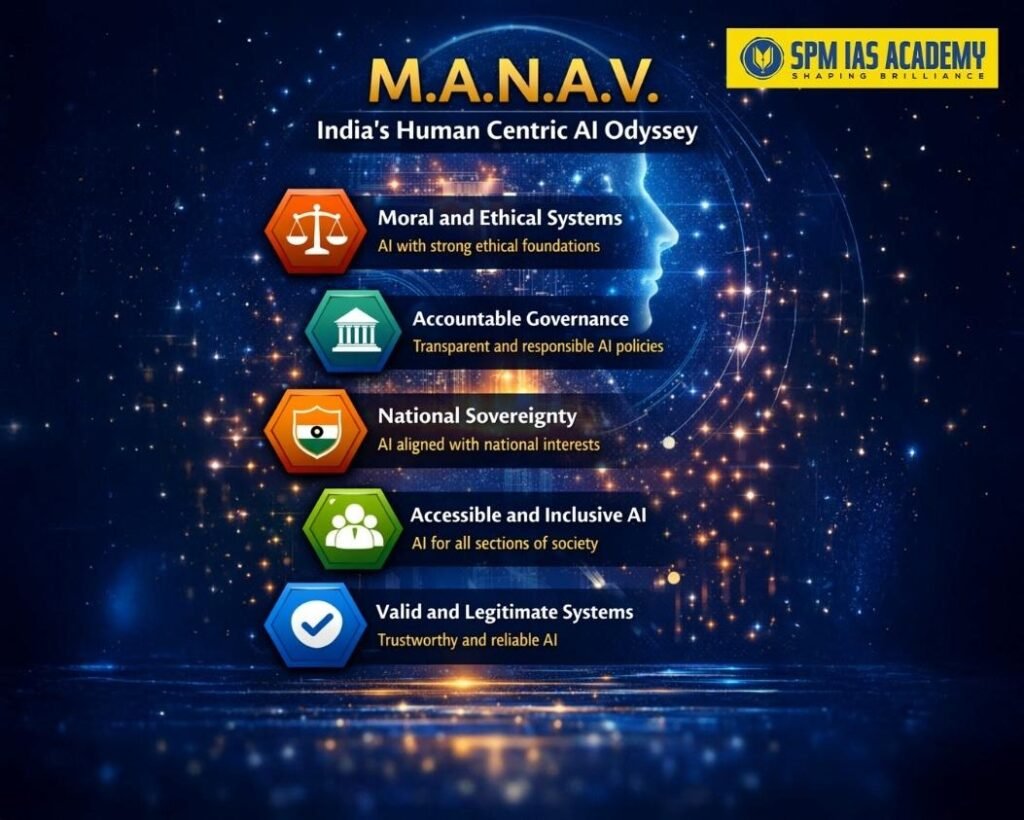
The term M.A.N.A.V. vision stands for Moral and Ethical Systems, Accountable Governance, National Sovereignty, Accessible and Inclusive AI, and Valid and Legitimate Systems. It represents India’s comprehensive strategy for inclusive and responsible AI development.
H2: What is India’s MANAV Vision for AI?
India’s M.A.N.A.V. Vision for Artificial Intelligence presents AI not merely as a technological tool, but as an extension of human dignity and aspirations. The framework ensures that AI development aligns with democratic values, constitutional principles, and societal welfare.
The acronym M.A.N.A.V. stands for:
- M – Moral and Ethical Systems
- A – Accountable Governance
- N – National Sovereignty
- A – Accessible and Inclusive AI
- V – Valid and Legitimate Systems
Through this approach, India seeks to balance technological innovation with ethical safeguards and social responsibility.
H2: How is India Driving the MANAV Vision for AI?
India is translating the MANAV vision into action through coordinated policy initiatives, digital infrastructure, and institutional frameworks. Several flagship programmes support this vision, including the IndiaAI Mission, National Education Policy 2020, Digital Public Infrastructure, and regulatory reforms.
H3: Ensuring Moral and Ethical AI Systems:
Firstly, India emphasizes that AI must be rooted in strong moral and ethical systems. The Prime Minister highlighted fairness, transparency, and human oversight as non-negotiable principles.
The National Education Policy 2020 integrates AI literacy and computational thinking at multiple levels. This prepares students to understand both the power and ethical implications of AI technologies.
Moreover, India demonstrated global leadership by securing a Guinness World Records title for receiving 250,946 pledges within 24 hours for an AI responsibility campaign. This transformed ethical AI into a national movement.
H3: Mechanisms to Drive Accountable Governance in AI:
Secondly, accountable governance ensures trust in AI systems.
The IndiaAI Mission, approved with an outlay exceeding ₹10,300 crore, strengthens computing, datasets, skilling, and innovation capacity. Importantly, it embeds governance and oversight mechanisms from the outset.
India’s AI Governance Guidelines promote trust, equity, accountability, and fairness. These frameworks ensure AI systems remain explainable, lawful, and aligned with democratic principles.
H3: National Sovereignty in the Digital Era:
Thirdly, the MANAV vision expands sovereignty beyond borders to include data, algorithms, and digital infrastructure.
India strengthens domestic computer capacity and promotes indigenous AI model development. Initiatives such as the India Semiconductor Mission, secure data governance frameworks, and investments in digital public infrastructure support technological self-reliance.
At the same time, India maintains global collaboration while safeguarding strategic autonomy in AI development.
H3: Ensuring Accessible and Inclusive AI:
Fourthly, the MANAV vision ensures AI benefits all sections of society.
India’s Digital Public Infrastructure (DPI) allows AI solutions to scale across healthcare, education, agriculture, and governance.
Platforms such as MeghRaj GI Cloud, IndiaAI Kosh, AI Data Labs Network and National Supercomputing Mission provide shared access to GPUs, TPUs, datasets, and high-performance computing resources. These initiatives lower entry barriers and democratize AI innovation nationwide.
H3: Regulating AI for Trust, Safety, and Legality:
Finally, the MANAV vision emphasizes trust, safety, and legality.
The Information Technology (Intermediary Guidelines and Digital Media Ethics Code) Amendment Rules, 2026 regulate synthetically generated content and deepfakes.
Under the IndiaAI Mission’s Safe and Trusted AI pillar, projects focus on bias mitigation, privacy-preserving AI design, algorithmic auditing and risk assessment frameworks. These safeguards ensure AI systems remain lawful, transparent, and socially beneficial.
H2: Pax Silica Initiative:
The Pax Silica Initiative, discussed during the AI Impact Summit, reflects India’s broader ambition to promote peace, cooperation, and ethical norms in the era of silicon-driven intelligence.
- Moreover, it encourages international collaboration in AI governance to ensure coordinated global standards.
- In addition, it promotes responsible semiconductor supply chains to strengthen technological resilience and reduce vulnerabilities.
- Furthermore, the initiative supports the development of secure and sustainable digital infrastructure across nations.
- At the same time, it emphasizes building ethical innovation ecosystems rooted in trust and transparency.
Therefore, through the Pax Silica Initiative, India signals its commitment to shaping a stable, secure, and cooperative global AI order.
Conclusion: MANAV Vision and India’s Leadership in Human-Centric AI Governance
India’s M.A.N.A.V. Vision for AI represents a transformative framework for responsible and inclusive artificial intelligence governance. By integrating ethical AI systems, digital sovereignty, inclusive AI access and lawful AI deployment, India positions itself as a global leader in AI governance. Moreover, the convergence of initiatives such as IndiaAI Mission, AI Governance Guidelines, National Education Policy 2020 and Pax Silica Initiative highlights India’s comprehensive strategy for AI democratization.
For competitive examinations UPSC CSE and APSC CCE, themes such as India’s MANAV vision for AI, human-centric artificial intelligence and responsible AI regulation remain highly significant. It helps in understanding emerging technology policy and global AI discourse.
For structured preparation, explore UPSC coaching in Assam for expert mentorship and answer-writing guidance.
Mains Practice Question:
“India’s M.A.N.A.V. Vision for AI represents a human-centric approach to artificial intelligence governance.” Discuss the key pillars of India’s M.A.N.A.V. Vision for AI and examine how initiatives such as the IndiaAI Mission, Digital Public Infrastructure, and regulatory frameworks contribute to responsible and inclusive AI development in India.
Students can also join UPSC coaching in north east India for comprehensive GS and current affairs preparation.
Source:
https://www.pib.gov.in/PressReleasePage.aspx?PRID=2230282®=3&lang=1
Frequently Asked Questions:
India’s M.A.N.A.V. Vision for AI is an approach for human-centric Artificial Intelligence. The Prime Minister of India announced this at the India AI Impact Summit 2026. It stands for Moral and Ethical Systems, Accountable Governance, National Sovereignty, Accessible and Inclusive AI, and Valid and Legitimate Systems.
M.A.N.A.V. in India’s AI strategy represents Moral and Ethical Systems, Accountable Governance, National Sovereignty, Accessible and Inclusive AI, and Valid and Legitimate Systems. All these form the core pillars of responsible AI governance in India.
India is implementing the MANAV Vision for AI through initiatives like the IndiaAI Mission, AI Governance Guidelines, Digital Public Infrastructure (DPI), National Education Policy 2020, and the Digital Personal Data Protection Act 2023.
The IndiaAI Mission, approved with an outlay of over ₹10,300 crore. It supports computing infrastructure, datasets, AI skilling, innovation and Safe & Trusted AI systems to ensure accountable and inclusive AI development in India.
India’s MANAV Vision for AI promotes ethical AI systems, digital sovereignty, inclusive technology access, and lawful AI regulation. Moreover, it aims to position India as a responsible global leader in Artificial Intelligence governance.

Behind every article at SPM IAS Academy is a team of skilled content writers and subject experts committed to making preparation easier for aspirants. From answering common doubts to breaking down complex issues and current affairs, we create content that is accurate, easy to understand, and directly useful for UPSC, APSC, and other competitive exams.