
India has adopted a comprehensive strategy to democratize Artificial Intelligence (AI) by ensuring accessible, affordable, and inclusive AI infrastructure for all sections of society. India’s AI democratization approach goes beyond ready-made applications. It focuses on core AI building blocks such as affordable computing power, open datasets, digital public infrastructure and AI model ecosystems. Through major initiatives like the IndiaAI Mission, Bhashini platform, AIKosh data repository, and the Digital Personal Data Protection Act 2023, the government aims to build a secure, ethical, and innovation-driven AI ecosystem.
This AI democratization strategy is highly relevant for UPSC, APSC, and APPSC current affairs. It reflects India’s growing role in AI governance, digital transformation, inclusive technology development, and emerging technology policy.
In this article, we will learn what AI democratization means. Moreover, this article also highlights India’s AI democratization strategy and other related topics in relation to the process of democratization of Artificial Intelligence (AI).
What Does Democratization of AI Mean?
Democratization of AI refers to expanding access to artificial intelligence tools, infrastructure, and resources to a diverse set of users. It ensures that startups, researchers, students, farmers, and public institutions can use AI effectively.
- Importantly, AI democratization includes access to affordable computing power so that AI development is not limited to large corporations.
- Moreover, it ensures the availability of large datasets and reusable AI models to support research and application development.
- In addition, it promotes the development of AI applications for public welfare in sectors such as agriculture, healthcare, and governance.
- Furthermore, it depends on strong digital infrastructure and connectivity to enable large-scale AI deployment.
- At the same time, it incorporates ethical and regulatory safeguards to ensure responsible and secure AI usage.
Thus, India’s AI strategy emphasizes inclusion, accessibility, and sustainability in building its AI ecosystem.
Key Pillars of India’s AI Democratization Strategy:
1. Democratizing AI Applications for Public Impact:
- Firstly, India promotes AI applications that directly benefit citizens and improve public service delivery.
- For instance, Bhashini enables language access through AI and supports digital inclusion across diverse linguistic groups.
- Similarly, Kisan e-Mitra assists farmers by providing AI-based advisory services and agricultural guidance.
- In addition, MausamGPT supports disaster forecasting and management through advanced AI-driven weather analysis.
- Therefore, these initiatives ensure that Artificial Intelligence strengthens governance, agriculture, and public welfare systems.
2. Accessible Data and AI Models:
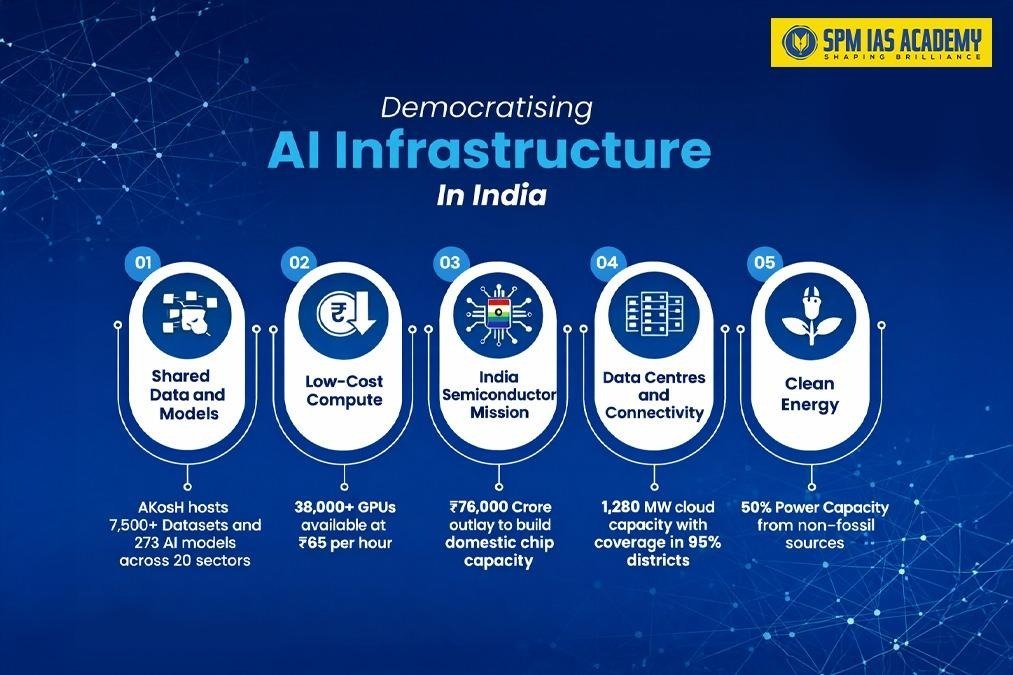
- Secondly, India has developed AIKosh, a national AI data platform designed to promote open and shared access to AI resources.
- Notably, AIKosh provides over 7,500 datasets to support research and innovation.
- In addition, it offers around 273 reusable AI models that developers can adapt for various applications.
- As a result, the platform enables developers, startups, and researchers to build AI solutions without facing high entry barriers.
3. Affordable Computing Power:
- Moreover, computing infrastructure plays a critical role in the democratization of Artificial Intelligence.
- Under the IndiaAI Mission, the government has onboarded more than 38,000 high-end GPUs to strengthen AI research capacity.
- Importantly, these GPUs are available at a subsidized rate of ₹65 per hour, which is significantly lower than the global average.
- As a result, startups, researchers, and innovators can develop AI models without facing a heavy financial burden.
4. Robust Infrastructure and Connectivity:
- In addition, robust digital infrastructure plays a vital role in supporting AI deployment across the country.
- Notably, widespread 5G connectivity now covers 99.9% of districts in India.
- As a result, this high level of digital penetration enables large-scale adoption of AI in sectors such as education, healthcare, agriculture, and governance.
5. Sustainable and Green Energy for AI:
- Firstly, AI systems require high energy consumption due to intensive computing processes.
- Therefore, India aligns its AI infrastructure development with green energy and sustainability goals.
- Notably, by June 2025, India achieved 50% of its installed electricity capacity from non-fossil fuel sources.
- As a result, this transition supports sustainable AI growth while simultaneously addressing climate change and environmental concerns.
Steps Taken by India to Promote AI Democratization:
Regulatory and Policy Framework:
- Firstly, India has strengthened its digital governance structure to support responsible AI growth.
- In this direction, the GI Cloud (MeghRaj) under the Digital India initiative provides secure cloud infrastructure for e-governance services.
- Moreover, the Digital Personal Data Protection Act 2023 establishes safeguards around personal data and privacy.
- As a result, these measures promote ethical AI development while protecting citizens’ rights.
Education, Skilling, and AI Literacy:
- Secondly, India places strong emphasis on human capital development to build an AI-ready workforce.
- Accordingly, the government has established five National Centres of Excellence for Skilling to enhance AI capabilities.
- In addition, the Skilling for AI Readiness initiative prepares individuals for emerging technology roles.
- Furthermore, the YUVAi initiative encourages AI learning among young students.
- At the same time, the AI Competency Framework provides structured guidance for AI education and training.
- Therefore, these initiatives prepare the workforce for an AI-driven economy and help reduce the digital divide.
Why AI Democratization Is Important for India:
- Firstly, AI democratization strengthens the inclusive digital economy by expanding technology access to all sections of society.
- Moreover, it boosts the startup ecosystem by reducing entry barriers and encouraging innovation.
- In addition, it improves public service delivery through AI-driven solutions in governance and welfare schemes.
- Furthermore, it supports rural and agricultural transformation by providing data-based advisory and precision tools.
- At the same time, it enhances disaster management and climate resilience through predictive analytics and real-time monitoring.
Students preparing for technology governance topics can explore UPSC coaching in Assam for expert guidance on AI policy and digital governance.
Therefore, AI democratization advances India’s vision of becoming a global technology leader while ensuring equitable and sustainable growth.
What is Bhashini platform?
- Firstly, Bhashini is an AI-powered platform that enables translation and speech services across multiple Indian languages.
- It allows citizens to access digital services even if they are not comfortable with reading or writing in a particular language.
- Notably, the platform was launched in July 2022 to promote digital inclusion and language accessibility.
- Moreover, around 1.2 million users have downloaded the Bhashini app.
- In addition, it supports more than 36 Indian languages, thereby expanding linguistic coverage.
- Furthermore, the platform integrates over 350 AI models and serves more than 450 active customers across sectors.
What is AIKosh?
- Firstly, AIKosh serves as India’s national shared AI resource platform, bringing together datasets and AI models on a single unified system.
- As of February 2026, it hosts 7,541 datasets and 273 AI models covering 20 different sectors.
- Moreover, by December 2025, the platform had recorded over 3.85 lakh visits, reflecting strong user engagement.
- In addition, it registered around 11,000 users and facilitated nearly 26,000 downloads.
Conclusion: India’s AI Democratization Strategy and the Future of Inclusive Technology
India’s comprehensive strategy to democratize Artificial Intelligence reflects a balanced approach between innovation and responsibility. Through the IndiaAI Mission, AIKosh platform, and AI skilling initiatives, India aims to build an inclusive and secure AI ecosystem.
The focus on accessible AI resources, green energy alignment, public impact applications, and strong regulatory safeguards demonstrates India’s commitment to responsible AI governance. Therefore, key themes such as AI democratization in India, IndiaAI Mission and AIKosh platform remain highly relevant in understanding India’s digital transformation strategy and emerging technology governance.
For aspirants studying emerging technologies and governance, UPSC coaching in north east India offers structured preparation and expert mentorship.
Mains Practice Question:
“Democratization of Artificial Intelligence is essential for inclusive digital growth.” Discuss India’s strategy to democratize Artificial Intelligence with reference to the IndiaAI Mission, AIKosh platform, affordable computing infrastructure, and regulatory safeguards.
Source:
https://www.pib.gov.in/PressReleasePage.aspx?PRID=2225781®=3&lang=1
Frequently Asked Questions:
AI democratization in India refers to making Artificial Intelligence accessible, affordable, and usable for startups, researchers, students, farmers, and public institutions. Moreover, initiatives like the IndiaAI Mission, AIKosh platform, and subsidized computing infrastructure can promote AI democratization in India.
The IndiaAI Mission is an initiative of the government of India aiming to provide affordable access to high-end GPUs, supports AI research and innovation. Moreover, it also aims to strengthen India’s AI ecosystem to promote inclusive digital growth.
AIKosh is India’s national AI data platform. It offers over 7,500 datasets and 273 reusable AI models. It helps developers and startups build AI solutions without high entry barriers.
India ensures responsible AI development through measures like the Digital Personal Data Protection Act 2023, secure cloud infrastructure under GI Cloud (MeghRaj), and ethical AI governance frameworks.
AI democratization strengthens India’s digital economy, boosts the startup ecosystem, and improves public service delivery. Furthermore, it supports rural transformation and enhances disaster management and climate resilience.

Behind every article at SPM IAS Academy is a team of skilled content writers and subject experts committed to making preparation easier for aspirants. From answering common doubts to breaking down complex issues and current affairs, we create content that is accurate, easy to understand, and directly useful for UPSC, APSC, and other competitive exams.