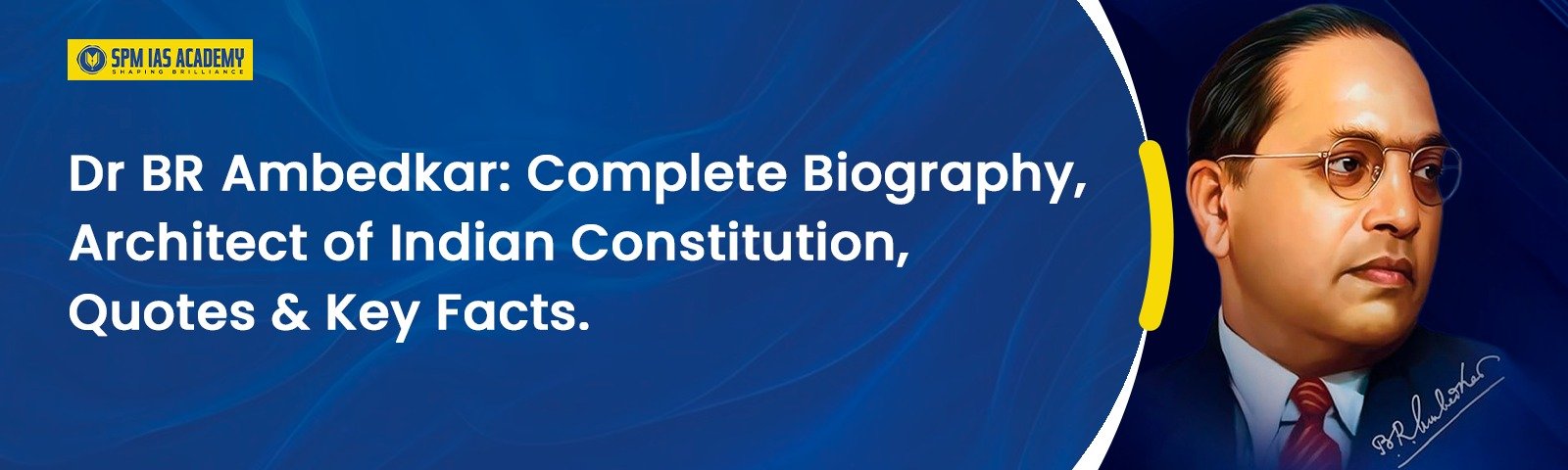
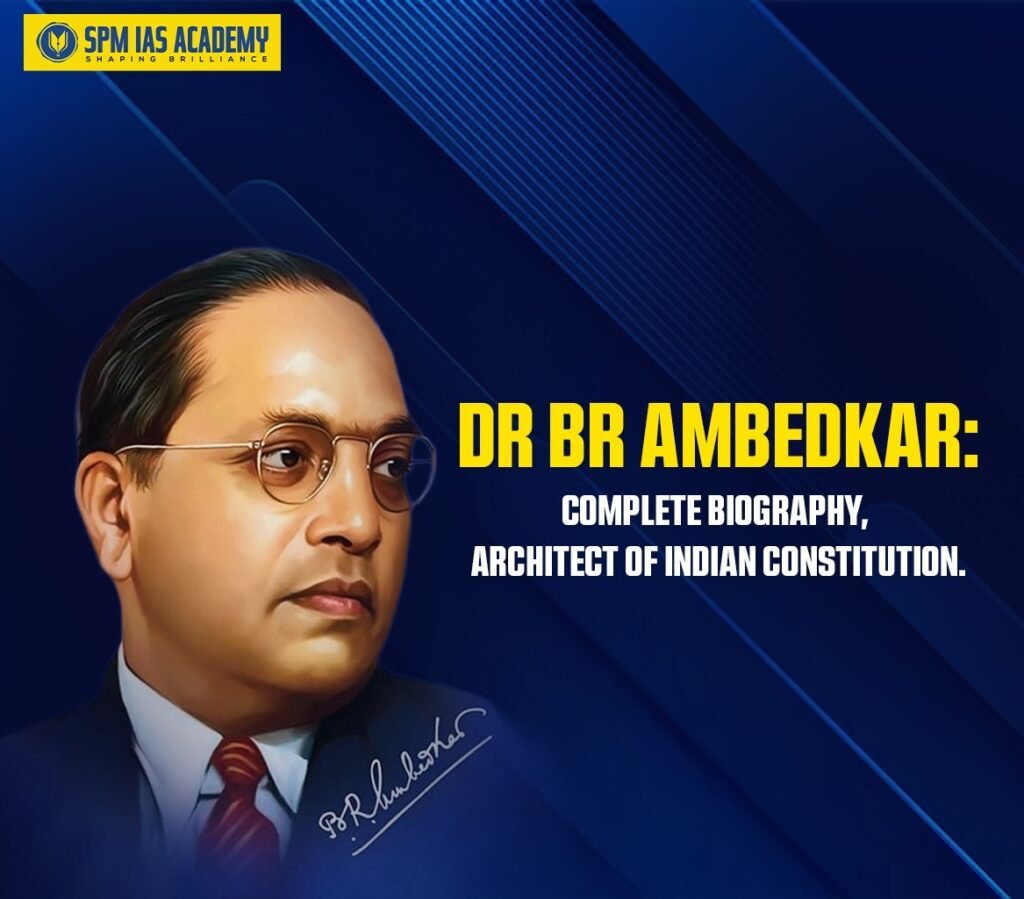
About Dr BR Ambedkar
Dr BR Ambedkar (Bhimrao Ramji Ambedkar), born on 14 April 1891 in Mhow, Madhya Pradesh, was an Indian jurist, economist, social reformer, and politician. He is known as the Father of the Indian Constitution. He served as the Chairman of the Drafting Committee of the Constituent Assembly and became India’s first Law Minister in 1947. He devoted his life to fighting caste discrimination and advocating for the rights of Dalits and marginalised communities. He passed away on 6 December 1956 and was posthumously awarded the Bharat Ratna in 1990.
Key facts about Dr BR Ambedkar:
- Born: 14 April 1891, Mhow, Madhya Pradesh.
- Died: 6 December 1956, Delhi.
- Role in Constitution: Chairman, Drafting Committee; studied 60+ constitutions.
- First Law Minister: India, 1947; resigned in 1951 over the Hindu Code Bill.
- Famous slogan: Educate, Agitate, Organise.
- Historic achievement: First Dalit to earn a doctorate from a foreign university; principal author of India’s Constitution.
Biography of Dr BR Ambedkar – Life Story
Dr BR Ambedkar was born on 14 April 1891 in Mhow (now officially called Dr Ambedkar Nagar) in the Central Provinces, present-day Madhya Pradesh. His father, Subedar Ramji Maloji Sakpal, was a British Indian Army officer. He was the 14th and last child of Ramji Maloji Sakpal and Bhimabai Sakpal.
His family belonged to the Mahar caste, which was considered untouchable in the rigid caste hierarchy of that time. From his school days, young Bhimrao experienced sharp caste discrimination. At school, Dalit children were made to sit separately, could not touch communal water supplies and received little attention from teachers.
Surname Change
His original family surname was Sakpal. A kind Brahmin teacher named Krishnaji Keshav Ambedkar changed his surname to ‘Ambedkar’ in school records — the name by which the world now knows him.
Life Timeline:
| Year | Event |
| 1891 | Born on 14 April in Mhow, Madhya Pradesh — 14th child of Ramji Sakpal. |
| 1897 | Enrolled at Elphinstone High School, Bombay — first Dalit student to do so. |
| 1913 | Received Baroda State Scholarship to study at Columbia University, New York. |
| 1915 | Completed M.A. in Economics from Columbia University. |
| 1917 | Earned Ph.D. in Economics from Columbia University. |
| 1921 | Completed M.Sc. in Economics from London School of Economics. |
| 1923 | Earned D.Sc. from LSE; became a Barrister from Gray’s Inn, London. |
| 1924 | Founded Bahishkrit Hitakarini Sabha (Depressed Classes Institute) to promote Dalit education. |
| 1927 | Led Mahad Satyagraha (20 March) — Dalits’ right to use public water. |
| 1930 | Led Kalaram Temple Movement, Nashik. |
| 1930-32 | Participated in all three Round Table Conferences in London. |
| 1932 | Signed the Poona Pact with Mahatma Gandhi. |
| 1936 | Founded the Independent Labour Party. |
| 1942 | Appointed Labour Member in Viceroy’s Executive Council. |
| 1947 | Appointed India’s first Law Minister; began work as Chairman, Drafting Committee. |
| 1949 | Delivered final speech in Constituent Assembly on 25 November; Constitution adopted on 26 November. |
| 1951 | Resigned as Law Minister in protest over the Hindu Code Bill. |
| 1956 (Oct) | Publicly converted to Buddhism in Nagpur with approximately 500,000 followers. |
| 1956 (Dec) | Passed away on 6 December in Delhi. |
| 1990 | Awarded Bharat Ratna (posthumous). |
Dr BR Ambedkar Biography – Education Across Three Continents
One of the most remarkable aspects of the Dr BR Ambedkar biography is his extraordinary educational journey. Despite facing severe caste discrimination at every step, he became one of the most highly educated Indians of his era — earning multiple doctorates from world-class universities.
| Year | Qualification | Institution |
| 1912 | B.A. in Economics and Political Science | Bombay University, India |
| 1915 | M.A. in Economics | Columbia University, New York, USA |
| 1916 | M.A. in Economics — ‘National Dividend of India’ | Columbia University, New York, USA |
| 1921 | M.Sc. in Economics | London School of Economics, UK |
| 1923 | D.Sc. (Economics) — ‘The Problem of the Rupee’ | London School of Economics, UK |
| 1923 | Bar-at-Law (Barrister) | Gray’s Inn, London, UK |
| 1927 | Ph.D. in Economics | Columbia University, New York, USA |
| 1952 | Honorary LL.D. | Columbia University, USA |
| 1953 | Honorary D.Litt. | Osmania University, India |
Note: Ambedkar studied the constitutions of more than 60 countries before drafting the Indian Constitution. His academic mentors at Columbia included philosopher John Dewey and economist Edwin R. A. Seligman.
Dr BR Ambedkar – Social Movements and Activism
Dr BR Ambedkar did not limit his work to academics or law. Instead, he actively fought on the ground to break down the walls of caste discrimination. He launched several powerful movements and founded important organisations.
Mahad Satyagraha (1927)
On 20 March 1927, Ambedkar led the Mahad Satyagraha or Chavdar Tale Satyagraha in Mahad, Maharashtra. He led thousands of Dalits to the Chavdar Lake to assert their right to use the public water tank. This was one of the first organised mass movements for Dalit civil rights in India.
Kalaram Temple Movement (1930)
In 1930, Ambedkar organised the Kalaram Temple Movement in Nashik to demand the right of Dalits to enter Hindu temples. The protest lasted for several years and drew national attention.
Round Table Conferences (1930-1932)
Ambedkar participated in all three Round Table Conferences held in London between 1930 and 1932. He strongly advocated for separate electorates for Dalits, arguing that political representation was essential for their progress.
Poona Pact (1932)
When the British government’s Communal Award granted separate electorates to Dalits, Mahatma Gandhi went on a fast in Yerwada Jail to oppose it. As a result, Ambedkar and Gandhi reached the Poona Pact. Under this pact, Dalits accepted reserved seats within the general electorate in place of separate electorates.
Organisations Founded by Ambedkar
- Bahishkrit Hitakarini Sabha (1923): To promote education and socio-economic improvement among Dalits.
- Independent Labour Party (1936): To safeguard the interests of workers and marginalised communities.
- Scheduled Castes Federation (1942): Transformed from the ILP to focus on the political rights of Dalits.
- Republican Party of India (1956): Founded just before his death to further Dalit political interests.
Newspapers Founded by Ambedkar
- Mooknayak (1920): ‘Leader of the Voiceless’ – his first newspaper.
- Bahishkrit Bharat (1927): ‘Excluded India’ – spread awareness about Dalit rights.
- Equality Janta (1929): Continued his press campaign against caste discrimination.
Ambedkar and Indian Constitution – Chief Architect
The relationship between Ambedkar and the Indian Constitution is inseparable. When India became independent in 1947, the Constituent Assembly chose Dr Ambedkar to chair the Drafting Committee. He studied over 60 constitutions and worked tirelessly, often through severe ill health, to complete the task.
Key Constitutional Provisions Championed by Ambedkar
| Article / Provision | What It Does | Ambedkar’s Role |
| Article 14 | Right to Equality — equality before law | Foundational provision for a just society |
| Article 15 | Prohibition of discrimination on grounds of religion, race, caste, sex, place of birth | Directly addressed caste discrimination |
| Article 17 | Abolition of Untouchability | His personal mission; a foundational moral provision |
| Article 21 | Right to Life and Personal Liberty | Argued it must include social and economic freedoms |
| Article 32 | Right to Constitutional Remedies – approach Supreme Court for Fundamental Rights | Called it the ‘Heart and Soul of the Constitution’ |
| Articles 330-342 | Reservation for SCs, STs, and OBCs in legislature and public services | Champion of affirmative action for historical justice |
| Directive Principles (Part IV) | Guides the state to reduce inequality and promote social justice | Played a crucial role in including socio-economic directives |
| Preamble | Liberty, Equality, Fraternity, Justice | Deeply influenced by his own life-long ideals |
Ambedkar’s Final Speech – 25 November 1949
On 25 November 1949, the day before the Constitution was adopted, Ambedkar delivered his historic farewell address to the Constituent Assembly. He warned about three grave dangers: (1) continuing social inequality, (2) the rise of party politics over constitutional principles, and (3) blind hero worship. He also underlined a key contradiction — on 26 January 1950, India would enter political democracy, but deep social and economic inequality would persist.
Ambedkar and Article 370
As Law Minister, Ambedkar strongly opposed Article 370, which granted special status to Jammu and Kashmir. He refused to draft the article, stating that it went against the full integration of India under one Constitution.
Contribution of Dr BR Ambedkar – Beyond the Constitution
The contribution of Dr BR Ambedkar extends far beyond the drafting of the Constitution. He made significant contributions to economics, labour rights, women’s empowerment, and national institutions.
1. Contribution to the Reserve Bank of India
Ambedkar’s book ‘The Problem of the Rupee: Its Origin and Its Solution’ (1923) served as the primary reference for the Royal Commission on Indian Currency and Finance. The guidelines he presented were later passed as the RBI Act 1934, making him one of the intellectual founders of the Reserve Bank of India. His earlier thesis at Columbia University also provided the academic basis for the Finance Commission of India.
2. Contribution to Labour Rights
As a Labour Member in the Viceroy’s Executive Council from 1942, Ambedkar successfully campaigned to reduce working hours from 12 hours per day to 8 hours per day. This was a landmark achievement for India’s working class. Furthermore, he introduced welfare schemes for workers and advocated for minimum wages and social security.
3. Women’s Rights and the Hindu Code Bill
Ambedkar drafted the Hindu Code Bill to give Hindu women equal rights in marriage, divorce, inheritance, and adoption. However, the legislation faced strong opposition in Parliament. When Prime Minister Nehru refused to push it through, Ambedkar resigned from the Cabinet in 1951 in protest – a principled stand for women’s rights.
4. Conversion to Buddhism and the Dalit Buddhist Movement
On 14 October 1956, in Nagpur, Ambedkar publicly converted to Buddhism along with approximately 500,000 followers — the largest mass religious conversion in modern history. He had declared in 1935 that he would not die a Hindu. He chose Buddhism because he believed it aligned with values of equality, reason, and human dignity. He authored ‘The Buddha and His Dhamma’ to articulate his vision of Buddhism as a philosophy of liberation.
5. Contribution to Education
Ambedkar promoted education among Dalits throughout his life. He founded the People’s Education Society in 1945, established Sydenham College of Commerce and Economics, and set up several schools and institutions. Numerous universities and institutions across India today carry his name.
Key Contributions at a Glance
| Area | Contribution |
| Indian Constitution | Chairman, Drafting Committee; Fundamental Rights, reservation, abolition of untouchability (Article 17), Article 32. |
| Reserve Bank of India | The book on currency reform laid the intellectual foundation for the RBI Act 1934. |
| Labour Rights | Reduced working hours from 12 to 8 hours per day; workers’ welfare schemes. |
| Women’s Rights | Drafted the Hindu Code Bill for equal legal rights in marriage, divorce, and inheritance. |
| Dalit Rights | Mahad Satyagraha, Kalaram Temple Movement, Poona Pact, political organisations. |
| Buddhism | Revived Buddhism in India through mass conversion; authored ‘The Buddha and His Dhamma.’ |
| Finance Commission | His Columbia thesis provided the basis for the Finance Commission of India (Article 280). |
Dr BR Ambedkar Quotes
The Dr BR Ambedkar quotes are powerful tools for UPSC, APSC Mains answers, essays, and interview answers. These quotes capture his philosophy of equality, education, and social justice in the most direct way possible.
| Quote | Best Used For |
| “Educate, Agitate, Organise.” | Opening line for essays on social justice, Dalit rights, and empowerment. |
| “I measure the progress of a community by the degree of progress which women have achieved.” | Essays and answers on women’s empowerment, GS Paper II (Social Justice). |
| “We are Indians, firstly and lastly.” | Essays on nationalism, national identity, and unity. |
| “Constitution is not a mere lawyers document, it is a vehicle of Life, and its spirit is always the spirit of Age.” | GS Paper II Polity answers; essays on constitutional democracy. |
| “However good a Constitution may be, if those who are implementing it are not good, it will prove to be bad.” | Essays on governance, accountability, and democracy. |
| “So long as you do not achieve social liberty, whatever freedom is provided by the law is of no avail to you.” | Powerful opener for essays on equality and social justice. |
| “I like the religion that teaches liberty, equality and fraternity.” | Essays on secularism, religion, and social harmony. |
| “Cultivation of mind should be the ultimate aim of human existence.” | Essays on education and self-improvement. |
Exam Tip: Use Dr BR Ambedkar quotes as opening or closing lines in UPSC Mains essays. The Constitution quote is especially powerful for Polity and Governance answers.
Students preparing essays on Dr. B. R. Ambedkar can strengthen concepts through UPSC coaching in Assam.
Dr BR Ambedkar Jayanti – Equality Day, 14 April
Dr BR Ambedkar Jayanti, also called Bhim Jayanti, is celebrated every year on 14 April to mark the birth anniversary of Babasaheb Ambedkar. The Government of India officially recognises 14 April as Equality Day.
| Detail | Fact |
| Date | 14 April every year |
| Other name | Bhim Jayanti |
| Official name | Equality Day |
| Major sites of observation | Chaitya Bhoomi (Mumbai), Diksha Bhoomi (Nagpur), Dr Ambedkar National Memorial (Delhi), Parliament of India |
| Significance | Celebrates his life; promotes Dalit rights, social justice, and constitutional values |
Mahaparinirvan Diwas – 6 December
The death anniversary of Dr Ambedkar on 6 December is observed as Mahaparinirvan Diwas every year. Millions of followers gather at Chaitya Bhoomi, Dadar, Mumbai to pay their respects. The word ‘Mahaparinirvan’ comes from Buddhism and means ‘passing into complete nirvana.’
Major Writings and Books by Dr BR Ambedkar
Dr Ambedkar was a prolific writer. His books and essays remain essential reading for students of Indian history, social science, and constitutional law.
| Book / Work | Year | Significance |
| Castes in India: Their Mechanism, Genesis and Development | 1916 | Presented at Columbia University; seminal analysis of caste origins. First published in India in 1917. |
| The Problem of the Rupee: Its Origin and Its Solution | 1923 | Basis for the RBI Act 1934 and the Reserve Bank of India. |
| Annihilation of Caste | 1936 | His most famous work; calls for complete abolition of the caste system. |
| Who Were the Shudras? | 1946 | Analyses origins of the Shudra caste; questions Hindu social hierarchy. |
| Pakistan or the Partition of India | 1945 | Examines the demand for Pakistan and the two-nation theory. |
| The Untouchables | 1948 | Historical and sociological study of untouchability in India. |
| Thoughts on Linguistic States | 1955 | Advocates for reorganisation of states on linguistic lines. |
| The Buddha and His Dhamma | 1957 (posthumous) | His vision of Buddhism as a philosophy of social liberation. |
Legacy and Awards – Contribution of Dr BR Ambedkar to India
Awards and Honours
- Bharat Ratna (1990): India’s highest civilian award, conferred posthumously.
- Honorary LL.D., Columbia University (1952): In recognition of his role in drafting India’s Constitution.
- Honorary D.Litt., Osmania University (1953).
- Statue in Parliament (1967): A 12-foot bronze statue installed in the Parliament of India.
- Portrait in Central Hall of Parliament (1990).
Conclusion – Dr BR Ambedkar’s Enduring Legacy
In conclusion, Dr BR Ambedkar was far more than a constitutional draftsman. He was a visionary who transformed the architecture of modern India through law, scholarship, social action, and personal sacrifice. His life story captured fully in the Dr BR Ambedkar biography — is proof that education, determination, and moral courage can change the world.
For students preparing for UPSC, APSC, and State PCS examinations, a thorough understanding of Ambedkar and the Indian Constitution, his social movements, his writings, and his enduring relevance is absolutely essential. His ideas appear across GS Paper I (Modern History), GS Paper II (Polity, Social Justice), and Essay papers. Therefore, mastering this topic gives aspirants a significant advantage across multiple sections of the examination.
Stay updated with current news to connect Ambedkar’s constitutional ideas with contemporary governance issues.
Source:
Frequently Asked Questions:
Dr BR Ambedkar (Bhimrao Ramji Ambedkar) was an Indian jurist, economist, social reformer, and the Father of the Indian Constitution. He is called Babasaheb, meaning ‘respected father,’ because of his role as a father figure and guide to millions of Dalits and marginalized communities across India.
The contribution of Dr BR Ambedkar includes: drafting the Indian Constitution as Chairman of the Drafting Committee, abolishing untouchability through Article 17, ensuring reservations for marginalised communities, founding the intellectual basis of the Reserve Bank of India, reducing working hours from 12 to 8 hours, drafting the Hindu Code Bill for women’s rights, and leading the Dalit rights movement in India.
Dr BR Ambedkar Jayanti is celebrated every year on 14 April, his birth anniversary. It is officially recognised as Equality Day. It is also called Bhim Jayanti. The day is observed at Chaitya Bhoomi (Mumbai), Diksha Bhoomi (Nagpur), and the Dr Ambedkar National Memorial in Delhi.
The most famous Dr BR Ambedkar quote is ‘Educate, Agitate, Organise.’ Other widely known quotes include: ‘I measure the progress of a community by the degree of progress which women have achieved’; ‘We are Indians, firstly and lastly’; and ‘Constitution is not a mere lawyers document, it is a vehicle of Life.’
Ambedkar served as the Chairman of the Drafting Committee of the Constituent Assembly. He drafted the Constitution, incorporated Fundamental Rights including abolition of untouchability (Article 17), reservation policies, and Article 32, which he called the ‘Heart and Soul of the Constitution.’ He studied over 60 constitutions before drafting India’s supreme law.
Ambedkar converted to Buddhism on 14 October 1956 because he believed the caste system was inherent to Hinduism and could not be reformed from within. He chose Buddhism because he found it aligned with his values of equality, reason, and human dignity. He had declared in 1935, ‘I was born in Hinduism, but I will not die as a Hindu.’
The Poona Pact was a 1932 agreement signed between Dr BR Ambedkar and Mahatma Gandhi in Yerwada Jail, Pune. Under it, Dalits gave up separate electorates (proposed in the British government’s Communal Award) in exchange for a larger number of reserved seats for them within the general electorate

Behind every article at SPM IAS Academy is a team of skilled content writers and subject experts committed to making preparation easier for aspirants. From answering common doubts to breaking down complex issues and current affairs, we create content that is accurate, easy to understand, and directly useful for UPSC, APSC, and other competitive exams.