

Blue Flag Beaches of India are among the cleanest, safest, and most eco-friendly beaches in the world. A beach earns the prestigious Blue Flag certification from the Foundation for Environmental Education (FEE), based in Denmark. India has made remarkable progress in the global Blue Flag programme and currently holds one of the highest numbers of certified beaches in Asia.
If you are preparing for UPSC, APSC, or any State PCS exam, this topic is highly relevant for General Studies papers on environment, geography, and government schemes. In this article, we cover everything you need to know about Blue Flag Beaches of India – what the certification means, the criteria for it, the full list of certified beaches, and why it matters.
Students seeking quality UPSC coaching in Assam can explore structured mentorship, test series, and expert guidance here.
What is Blue Flag Certification? Understanding the Blue Flag Programme
The Blue Flag is an internationally recognised eco-label awarded to beaches, marinas, and sustainable boating tourism operators across the world. The Foundation for Environmental Education (FEE), headquartered in Copenhagen, Denmark, manages this programme globally. Since its launch in France in 1985, the Blue Flag programme has grown into one of the most respected voluntary environmental certification systems in the world.
In India, the Society for Integrated Coastal Management (SICOM), which operates under the Ministry of Environment, Forest and Climate Change (MoEFCC), coordinates the Blue Flag Beach programme. SICOM evaluates Indian beaches and submits them to FEE for certification. This makes the Blue Flag certification not just an environmental achievement but also a strong indicator of good coastal governance.
Criteria for Blue Flag Certification: What Makes a Beach Eligible?
A beach must meet 33 strict criteria across four main categories to earn the Blue Flag certification. These categories cover water quality, environmental education and information, environmental management, and safety and services. Let us look at each category briefly.
Water Quality Standards
Water quality is the most important criterion for any Blue Flag beach. The beach must have clean seawater that meets strict microbiological and chemical standards. No industrial or sewage waste water should discharge into the beach area. Regular water quality testing must take place throughout the bathing season to ensure the safety of visitors.
Environmental Education and Information
Blue Flag beaches must actively promote environmental awareness among visitors. The beach management must display information boards about the local coastal ecosystem, flora, fauna, and the Blue Flag programme itself. They must also conduct at least five environmental education activities every year to engage the local community and tourists.
Environmental Management
The beach authorities must actively manage waste and litter. Adequate waste bins and recycling facilities must be available across the beach area. Moreover, the beach must take strong steps to protect the natural coastal environment, including sand dunes, wetlands, and local wildlife habitats. No unauthorised construction or camping should take place in sensitive coastal areas.
Safety and Services
A Blue Flag beach must provide essential safety infrastructure. This includes trained lifeguards during peak bathing hours, first aid equipment, clean and accessible toilets, shower facilities, and disabled-friendly access. The beach must also have proper parking facilities and must restrict vehicle movement on the beach itself to protect both visitors and the environment.
List of Blue Flag Beaches of India: All Certified Beaches
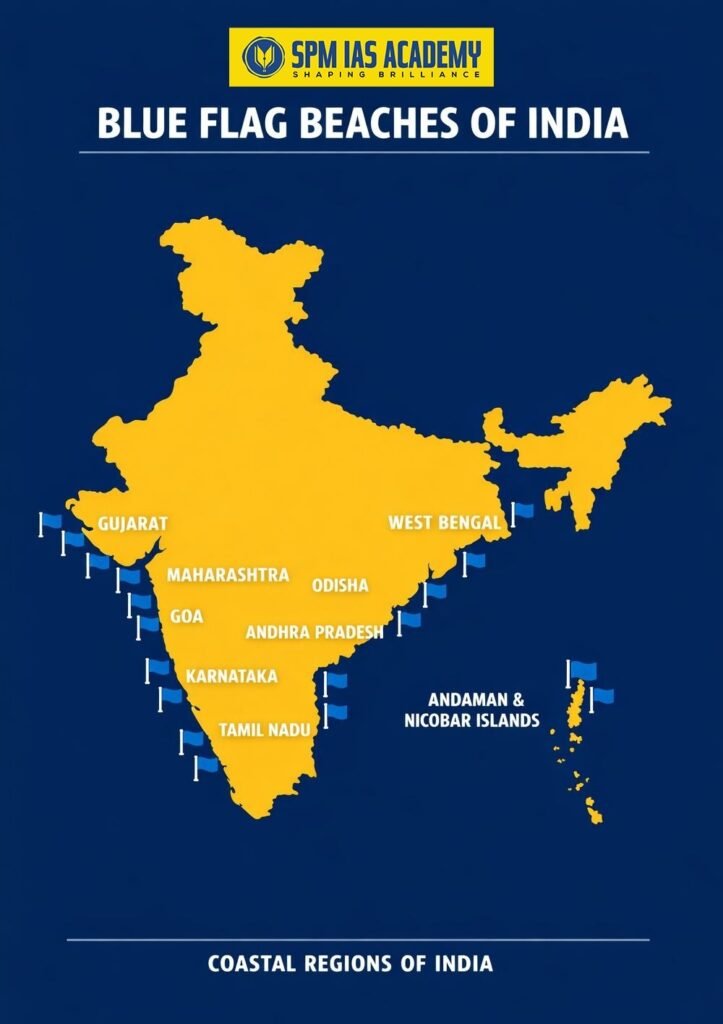
India achieved a major milestone when it first received Blue Flag certification for eight beaches in 2020. Since then, the country has expanded the list significantly. As of the latest update of 2025, India has 18 Blue Flag certified beaches, making it one of the leading countries in Asia under the Blue Flag programme. Here is the complete list of Blue Flag Beaches of India:
- Shivrajpur Beach – Dwarka, Gujarat
- Ghoghla Beach – Diu (Daman and Diu)
- Radhanagar Beach – Havelock Island, Andaman and Nicobar Islands
- Kasarkod Beach – Uttara Kannada, Karnataka
- Padubidri Beach – Udupi, Karnataka
- Kappad Beach – Kozhikode, Kerala
- Rushikonda Beach – Visakhapatnam, Andhra Pradesh
- Golden Beach (Puri Beach) – Puri, Odisha
- Kasarkod Beach (revisited) – Karnataka
- Eden Beach – Puducherry
- Miramar Beach – Panaji, Goa
- Taj Mahal Beach (Sinquerim Beach) – Goa
- Kovalam Beach – Thiruvananthapuram, Kerala
- Shrivardhan – Raigad district, Maharashtra
- Nagaon – Raigad district, Maharashtra
- Parnaka – Palghar, Maharashtra
- Guhagar – Ratnagiri, Maharashtra
- Ladghar – Ratnagiri, Maharashtra
This impressive list of Blue Flag Beaches of India shows the country’s growing commitment to coastal sustainability and environmental management. Each certified beach has undergone rigorous evaluation before receiving the prestigious Blue Flag tag.
India’s Journey in the Blue Flag Programme: A Timeline of Achievement
India formally joined the international Blue Flag programme in 2018. Before that, the government launched its own Beach Environment and Aesthetics Development (BEAD) scheme to improve the quality of Indian beaches. The BEAD scheme laid the groundwork for the Blue Flag certification effort.
In October 2020, India celebrated a historic moment when eight beaches received the Blue Flag certification for the first time. This achievement made India the first country in Asia and second in the whole world to receive the Blue Flag certification for multiple beaches in a single year. Subsequently, India added more beaches to the list, and by 2022 and 2023, the number grew to 13 certified beaches. As 2025, there are 18 Blue Flag Beaches in India.
Furthermore, India set a target to certify 100 beaches under the Blue Flag programme in the coming years. This target reflects the government’s long-term vision for sustainable coastal tourism and environmental protection under the Integrated Coastal Zone Management (ICZM) framework.
Key Government Bodies Related to Blue Flag Beaches in India
Several important government bodies work together to manage and develop Blue Flag Beaches in India. Aspirants must remember these bodies for their UPSC and State PCS preparation.
- Ministry of Environment, Forest and Climate Change (MoEFCC) – The nodal ministry for India’s Blue Flag programme.
- Society for Integrated Coastal Management (SICOM) – The implementing agency that evaluates and nominates beaches for Blue Flag certification.
- Foundation for Environmental Education (FEE) – The international body based in Denmark that grants the Blue Flag certification globally.
- National Coastal Zone Management Authority (NCZMA) – Oversees coastal zone regulations and sustainable coastal development.
Benefits of Blue Flag Certification for India
The Blue Flag certification brings several direct benefits to India’s beaches, local communities, and the national economy.
- First, it boosts international tourism by giving foreign tourists confidence in the cleanliness and safety of Indian beaches.
- Second, it promotes local employment by developing beach infrastructure and coastal tourism facilities.
- Third, it forces local authorities to maintain high environmental standards, which directly protects the marine ecosystem.
- Additionally, Blue Flag certification improves India’s global image as a responsible environmental steward. It demonstrates that India can meet international standards for coastal management, which strengthens the country’s position in global environmental diplomacy and negotiations.
Stay updated with important environmental and geography current affairs relevant for UPSC and state PCS examinations.
Conclusion:
Blue Flag Beaches of India represent a powerful story of environmental commitment, coastal conservation, and sustainable tourism. From Shivrajpur in Gujarat to Radhanagar in Andaman, each beach on the list of Blue Flag Beaches of India stands as a model for the entire country to follow. The Blue Flag certification, awarded by the Foundation for Environmental Education, is not just a badge. Rather, it is a promise to protect India’s precious coastal heritage.
For UPSC, APSC, and State PCS aspirants, this topic brings together geography, environment, government schemes, and current affairs – all under one umbrella. Understanding the Blue Flag programme, the criteria for certification, the complete list of Blue Flag beaches will help you score well in both Prelims and Mains.
Source:
Frequently Asked Questions:
Blue Flag Beaches of India are eco-friendly and clean beaches certified under the international Blue Flag programme. Moreover, these beaches meet strict standards of water quality, safety, and environmental management.
As of 2025, India has 18 Blue Flag Beaches. Therefore, India ranks among the top countries in Asia for certified sustainable beaches.
The Foundation for Environmental Education (FEE) grants Blue Flag certification globally. Additionally, in India, the Society for Integrated Coastal Management (SICOM) manages the evaluation process.
A beach must meet 33 criteria related to water quality, environmental education, safety, and management. As a result, only well-maintained and sustainable beaches receive certification.
Blue Flag Beaches boost tourism, create employment, and promote environmental conservation. Furthermore, they improve India’s global image as a sustainable tourism destination.

Behind every article at SPM IAS Academy is a team of skilled content writers and subject experts committed to making preparation easier for aspirants. From answering common doubts to breaking down complex issues and current affairs, we create content that is accurate, easy to understand, and directly useful for UPSC, APSC, and other competitive exams.