
Z+ security is the highest level of personal security cover that the Government of India provides to individuals facing serious threats to their lives. It sits at the very top of India’s multi-tier security category system and involves a large team of armed personnel deployed round the clock. For UPSC, APSC, and State PCS aspirants, the topic of Z+ security is important for General Studies papers covering polity, internal security, and current affairs.
For structured preparation, explore UPSC coaching in Assam at SPM IAS Academy for expert guidance.
In this article, we explain everything you need to know about Z plus security – what it means, how the security categories work, who has Z+ security in India, what it costs, and which agencies provide it.
What is Z+ Security? A Clear and Simple Explanation
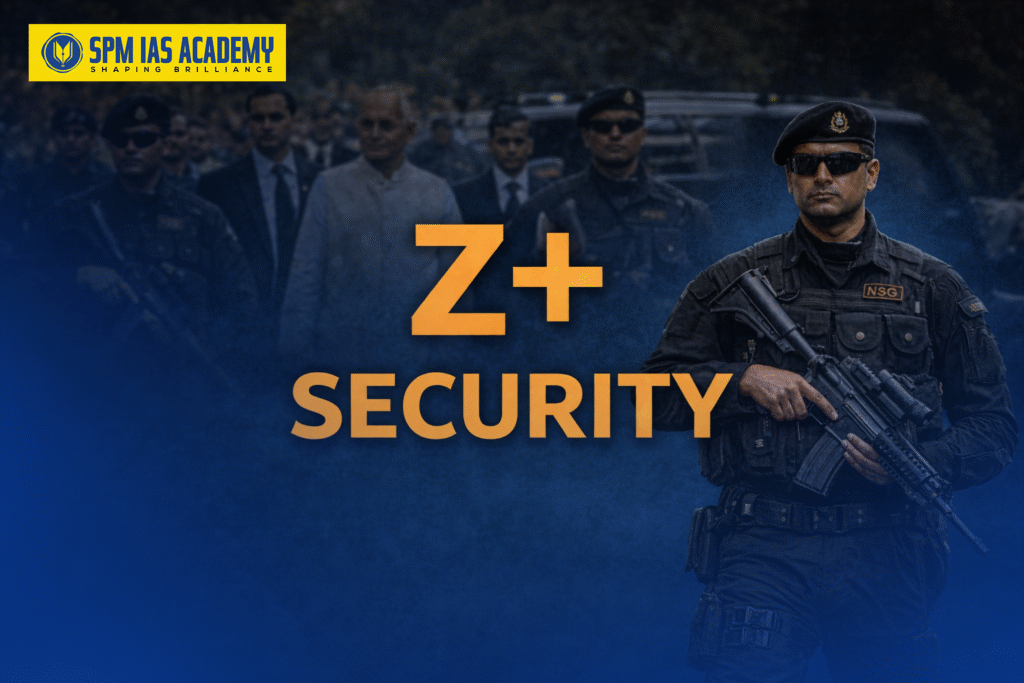
Z+ security is the topmost category in India’s personal protection framework. The government assigns this level of security to individuals who face an exceptionally high and credible threat to their life. A team of 55 or more security personnel, including commandos and armed guards, provides Z plus security cover to the protected person at all times.
The security personnel who form the Z+ security cover come from elite forces such as the National Security Guard (NSG), the Central Reserve Police Force (CRPF), the Central Industrial Security Force (CISF), and the Indo-Tibetan Border Police (ITBP). The protected individual receives 24-hour security coverage at home, during travel, at public events, and at any location they visit across India.
Security Categories in India: From X to Z+ Explained
India follows a structured system of personal security categories. The government assigns these categories based on the nature and level of threat an individual faces. The threat assessment comes from intelligence agencies such as the Intelligence Bureau (IB) and the Research and Analysis Wing (RAW). Understanding all the security tiers helps aspirants answer comparison-based questions in competitive exams.
X Category Security:
X category is the basic level of personal security in India. It provides two armed security personnel to the protected individual. This category applies to people who face a low but credible threat. State governments typically provide X category security to local politicians, businesspersons, and other individuals with moderate risk profiles.
Y Category Security:
Y category security involves a team of 11 security personnel, including one or two commandos. This category is for individuals who face a moderate and well-established threat. Many senior politicians, judges, and public figures in India receive Y category security cover from central or state forces.
Y+ Category Security:
Y+ category is a step above Y category and involves approximately 11 security personnel with additional commandos. It serves individuals who face a higher level of threat than Y category warrants. Several Union Ministers, Chief Ministers, and prominent public figures receive Y plus security cover in India.
Z Category Security:
Z category security provides a cover of 22 personnel, including trained commandos. This level is for VIPs and public figures who face a serious and persistent threat. Senior Union Ministers, Chief Ministers of certain states, and prominent leaders often receive Z category security. The central government deploys forces such as CRPF and CISF for this category.
Z+ Category Security: The Highest Level:
Z+ security is the most intensive security arrangement in India. It deploys 55 or more armed security personnel around the protected person. The team includes NSG commandos, who are India’s most elite counter-terrorism force, along with CRPF, CISF, or ITBP personnel. The Z plus security cover extends to the person’s residence, office, travel route, and all places they visit. In some cases, the government also deploys a pilot vehicle, escort vehicles, and an ambulance as part of the Z+ security convoy.
SPG Protection: A Special Category Beyond Z+
Above Z+ security, India has a special category called the Special Protection Group (SPG). The SPG Act, 1988 governs this protection, and the SPG covers only the Prime Minister of India and, under certain circumstances, former Prime Ministers and their immediate family members. The SPG is a dedicated force trained exclusively for close protection of the highest constitutional functionaries. It is important to note that SPG protection is separate from the regular Z+ category and operates under its own legal framework.
Who Decides Z+ Security Cover in India?
The decision to grant Z plus security in India does not rest with any single person. Instead, a structured threat assessment process determines who receives what level of protection. The Intelligence Bureau (IB) conducts a detailed threat perception analysis of the individual concerned. Based on the IB’s report, the Ministry of Home Affairs (MHA) takes the final decision on the type and level of security to be provided.
The MHA reviews security assignments periodically. If the threat to a person reduces or increases, the government upgrades or downgrades the security category accordingly. This ensures that the limited number of trained security personnel are deployed where the threat is most serious.
Stay updated with reliable current affairs from SPM IAS Academy to strengthen exam preparation.
Who Has Z+ Security in India?
Several top politicians, religious leaders, and public figures in India currently hold or have held Z+ security cover. The government does not always make such assignments public, as revealing security details can itself become a threat. However, based on official information and news reports, the following are among those who have received Z plus security in India at various points:
- Senior Union Cabinet Ministers, including the Home Minister and Defence Minister
- Chief Ministers of states facing active security threats
- Prominent religious and spiritual leaders who face organised threats
- Senior leaders of national political parties
- Top judiciary and constitutional figures in certain situations
- Business leaders and industrialists who face credible and verified threats
It is important to note that Z+ security is not a privilege or status symbol. The government provides it strictly based on credible and verified threat inputs. Any individual whether a politician, activist, journalist, or business leader, can receive Z plus security if the threat assessment justifies it.
Cost of Z+ Security: Who Pays for It?
Z+ security is extremely expensive to maintain. The cost of deploying 55 or more trained commandos and personnel, along with vehicles, communication equipment, and logistical support, runs into several lakhs of rupees per month. In most cases where the government grants security due to a perceived threat, the state or central government bears the cost.
However, when a private individual such as a businessman or celebrity requests security cover, the government may charge them for the service. In such cases, the protected person must pay the actual cost of deploying the security personnel. The Supreme Court of India has previously directed the government to recover security costs from individuals who do not face genuine government-assessed threats but enjoy security for prestige or personal convenience.
Security Agencies That Provide Z+ Security in India
Multiple central armed police forces and elite agencies work together to provide Z+ security cover in India. Each agency has a specific role in the overall security architecture.
- National Security Guard (NSG) – It is India’s premier counter-terrorism force, commonly known as the Black Cats. NSG commandos form the core of Z+ security teams for the most high-risk individuals.
- Central Reserve Police Force (CRPF) – It is India’s largest paramilitary force, widely used for VIP security across the country.
- Central Industrial Security Force (CISF) – Deployed for security of important public figures, airports, and critical infrastructure.
- Indo-Tibetan Border Police (ITBP) – Specially trained mountain warfare troops also deployed for VIP protection in specific regions.
- State Police Forces – Supplement central security in the respective state where the protected person resides or travels.
Conclusion:
Z+ security is the highest level of personal protection that the Government of India provides to individuals under serious threat. It involves 55 or more armed personnel from elite forces like the NSG, CRPF, CISF, and ITBP, deployed 24 hours a day, seven days a week. The Ministry of Home Affairs, guided by the Intelligence Bureau’s threat perception report, decides who receives Z plus security in India.
For UPSC, APSC, and State PCS aspirants, understanding what is Z plus security, how the security category system works from X to Y, Y+, Z, and Z+ and who has Z+ security in India is essential for scoring well in GS Paper 3 on internal security and in the current affairs sections of both Prelims and Mains.
Remember that Z+ security is not a privilege. It is a protective measure driven purely by threat intelligence.
Source:
Frequently Asked Questions:
Z+ security in India is the highest level of VIP security provided by the government. Moreover, it includes 55 or more armed personnel for 24/7 protection.
The government provides Z+ security to individuals facing serious and verified threats. Therefore, senior politicians, judges, and prominent public figures often receive this protection.
Elite forces like NSG, CRPF, CISF, and ITBP provide Z+ security in India. Additionally, state police support these forces when required.
The Intelligence Bureau assesses the threat level, and the Ministry of Home Affairs takes the final decision. As a result, security is assigned based on credible intelligence inputs.
Z+ security costs several lakhs per month due to manpower and logistics. However, the government usually bears the cost unless a private individual requests the cover.