
Why do women still hold only 15% seats in Lok Sabha despite being 50% of India’s population? The Women’s Reservation Bill 2023 tries to change this. The Women’s Reservation Bill 2023, officially known as the Nari Shakti Vandan Adhiniyam, is the Constitution (128th Amendment) Bill, 2023. It reserves one-third of seats for women in Lok Sabha, state legislative assemblies, and the Delhi Assembly. Parliament passed this historic bill in September 2023.
This article covers all key features, debates, history, and significance of the Women’s Reservation Bill 2023 for UPSC, APSC, APPSC, and other state PCS exams.
Women’s Reservation Bill 2023: An Overview
The Women’s Reservation Bill 2023 is a landmark constitutional amendment in India. It seeks to increase the political representation of women at the national and state levels. The bill amends the Constitution to add a new provision for women’s reservation in legislatures.
Currently, women hold only 15% of total seats in the 17th Lok Sabha. In state legislative assemblies, women hold an average of just 9% of seats. Therefore, this bill aims to correct this deep imbalance.
- Official Name: The Constitution (One Hundred and Twenty-Eighth Amendment) Bill, 2023
- Popular Name: Nari Shakti Vandan Adhiniyam
- Ministry: Law and Justice
- Introduced in: Lok Sabha on 19 September 2023
- Passed in Lok Sabha: 20 September 2023
- Passed in Rajya Sabha: 21 September 2023
- Presidential Assent: 29 September 2023
Legislative Journey of the Women’s Reservation Bill 2023
| Stage | House / Body | Date |
| Introduced | Lok Sabha | 19 September 2023 |
| Passed | Lok Sabha | 20 September 2023 |
| Passed | Rajya Sabha | 21 September 2023 |
| Presidential Assent | President of India | 29 September 2023 |
| Commencement | After census + delimitation | To be notified |
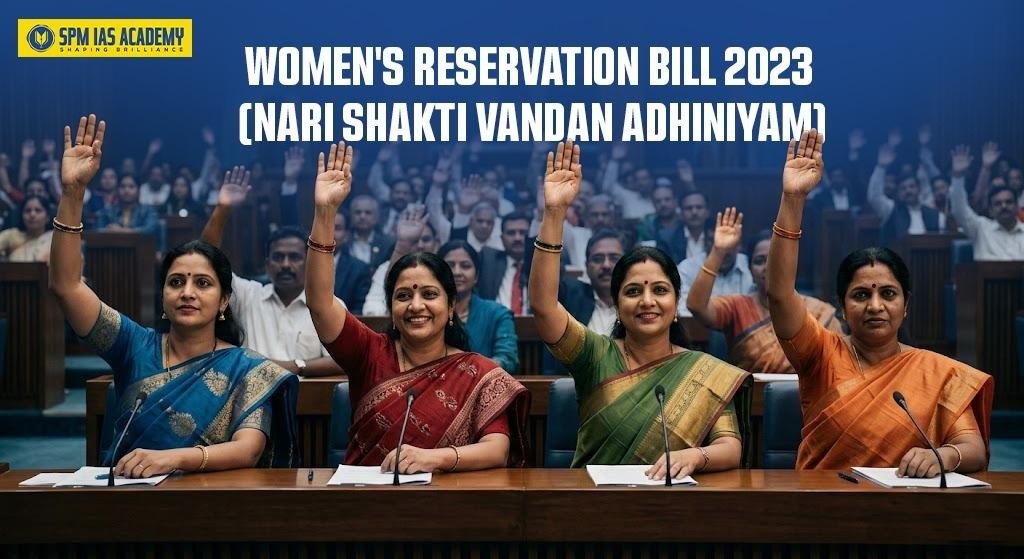
What Is Women’s Reservation Bill 2023? (Simple Explanation)
The Women’s Reservation Bill 2023 is a constitutional amendment. It adds a provision to reserve one-third of all seats for women in Parliament and state assemblies. Furthermore, this reservation applies within the seats already reserved for Scheduled Castes and Scheduled Tribes.
In simple words, if a constituency is reserved for SCs or STs, one-third of such reserved seats will also go to women from those communities. This makes the bill inclusive of marginalised women too.
When Will Women’s Reservation Start in India?
Women’s reservation in India will not start immediately. It will begin only after the next Census (Census 2027) is completed and delimitation of constituencies takes place. Therefore, the implementation of the Women’s Reservation Bill 2023 may take a few years. As a result, experts believe that women’s reservation in Lok Sabha and state assemblies may start only in the mid-2030s, after these processes are finished.
Key Features of the Women’s Reservation Bill 2023 at a Glance
| Feature | Details |
| Bill Name | The Constitution (128th Amendment) Bill, 2023 |
| Popular Name | Nari Shakti Vandan Adhiniyam |
| Ministry | Law and Justice |
| Reservation Quota | One-third (33%) of total seats |
| Applicable Bodies | Lok Sabha, State Legislative Assemblies, Delhi Assembly |
| Includes SC/ST Reserved Seats | Yes – one-third of SC/ST seats also reserved for women |
| Reservation Period | 15 years (extendable by Parliament) |
| Seat Rotation | After each delimitation exercise |
| Trigger Condition | Effective after next census and delimitation |
| Rajya Sabha & Councils | Not covered under this bill |
| OBC Reservation for Women | Not included in this bill |
Key Features of the Women’s Reservation Bill (Nari Shakti Vandan Adhiniyam) 2023
The main feature of Women’s Reservation Bill 2023 is 33% reservation for women in Parliament.
1. One-Third Reservation for Women
The bill reserves, as nearly as may be, one-third of all seats in the following bodies:
- Lok Sabha (Lower House of Parliament)
- State Legislative Assemblies across all states
- Legislative Assembly of the National Capital Territory of Delhi
This reservation covers seats within SC and ST reserved categories as well. Therefore, women from SC and ST communities will also benefit.
2. Commencement Linked to Census and Delimitation
The reservation will not start immediately. It will become effective only after the following two events occur:
- First: The government conducts the next census and publishes its data.
- Second: A delimitation exercise happens based on that census data.
As a result, the actual implementation of the Women’s Reservation Bill 2023 is linked to Census 2027 and the subsequent delimitation. This means the reservation may take several years to come into effect.
3. Duration of Reservation
The reservation will remain in force for a period of 15 years. However, Parliament can extend it further through legislation. This gives flexibility for review and continuation based on outcomes.
4. Rotation of Reserved Seats
Reserved seats will rotate after each delimitation exercise. The law made by Parliament will determine the method of rotation. This means a constituency reserved for women in one period may not remain reserved in the next.
However, experts have raised concerns about this rotation. They argue that rotation may discourage elected women from investing in their constituencies. A Ministry of Panchayati Raj study found that seat rotation reduced the re-election rates of women at panchayat level to just 15%.
5. Exclusions
The bill does not cover the following bodies:
- Rajya Sabha (Upper House of Parliament)
- State Legislative Councils (Vidhan Parishad)
- No separate sub-quota for women from Other Backward Classes (OBCs)
History of Women’s Reservation Bills in India
The demand for women’s reservation in Parliament is not new. India has debated this issue for nearly three decades. Earlier bills lapsed repeatedly due to political disagreements. Understanding this history is important for UPSC mains answers.
History of Women’s Reservation Bills in India (1996-2023)
| Year | Bill | Outcome |
| 1996 | 81st Amendment Bill | Examined by Joint Committee. Lapsed with dissolution of 11th Lok Sabha. |
| 1998 | 84th Amendment Bill | Lapsed with dissolution of 12th Lok Sabha. |
| 1999 | Amendment Bill | Lapsed with dissolution of 13th Lok Sabha. |
| 2008 | 108th Amendment Bill | Passed by Rajya Sabha. Lapsed with dissolution of 15th Lok Sabha. |
| 2023 | 128th Amendment Bill | Passed by both Houses. Received Presidential assent. Now an Act. |
The 73rd and 74th Constitutional Amendments of 1993 introduced reservation for women in Panchayats and Municipalities. They reserved one-third of seats for women at the local body level. However, no such provision existed at the Parliament or state assembly level until 2023.
Why Is the Women’s Reservation Bill Necessary?
Several facts and reports justify the need for the Women’s Reservation Bill 2023. Consider the following data points:
- Firstly, women form nearly 50% of India’s population. However, they remain underrepresented in politics.
- Moreover, women held only about 15% of Lok Sabha seats in the 17th Lok Sabha. Therefore, their participation at the national level is still low.
- Additionally, women’s representation in state assemblies is only around 9%. Consequently, their voice in state-level decision-making remains limited.
- Furthermore, the 2015 Report on the Status of Women in India described this situation as “dismal.” It also recommended at least 50% reservation in decision-making bodies.
- At the same time, India is a signatory to CEDAW. Therefore, the country must work to eliminate gender discrimination in political life.
- In addition, the Inter-Parliamentary Union (IPU) in 2022 confirmed that quotas improve women’s political representation. Hence, reservation can bring real change.
- Finally, a 2003 study showed that women leaders invest more in public welfare. As a result, women’s participation can improve governance and social outcomes.
Therefore, the Women’s Reservation Bill 2023 is a necessary step to make Indian democracy truly representative. It gives women the political power they deserve as half of the population.
For quality preparation, explore UPSC coaching in north east India by SPM IAS Academy for expert guidance.
Women’s Reservation Bill 2023: Pros and Cons (Debate)
The Women’s Reservation Bill has been a subject of intense debate in India. Supporters and critics have raised valid points.
| Pros (Arguments in Favour) | Cons (Concerns and Criticism) |
| Firstly, women form nearly 50% of India’s population but hold only about 15% of Lok Sabha seats. Therefore, reservation can improve representation. | Firstly, seat rotation may discourage MPs from working for their constituencies. As a result, long-term development may suffer. |
| Moreover, panchayat reservation has shown positive results. Women leaders have invested more in public welfare. | Moreover, the bill does not include Rajya Sabha and state legislative councils. Therefore, representation remains incomplete. |
| Additionally, India is a signatory to CEDAW. Hence, it must promote gender equality in politics. | Additionally, OBC women do not get a separate quota. Hence, some groups may remain underrepresented. |
| Furthermore, the Inter-Parliamentary Union (IPU, 2022) confirms that quotas increase women’s representation. Therefore, reservation can bring real change. | Furthermore, the bill depends on census and delimitation. As a result, implementation may take many years. |
| Finally, the Standing Committee (2009) supported reservation and found that women leaders make meaningful contributions. |
Alternate Methods to Increase Women’s Representation
Some experts have suggested alternatives to direct seat reservation. These alternatives aim to increase women’s political representation without reducing voter choice.
Option 1: Reservation Within Political Parties
Under this method, political parties must field a fixed percentage of women candidates. Several countries, including Sweden, Norway, South Africa, and France, use this approach. In these countries, internal party quotas have helped women reach 38-46% representation in Parliament.
Option 2: Dual-Member Constituencies
Under this option, some constituencies elect two members – one being a woman. This method does not reduce voter choice. However, critics point out that women may become secondary to male candidates in such arrangements.
To achieve 33% women representation, approximately half of all constituencies would need to be dual-member. This would increase the total number of MPs by 50%, making Parliamentary functioning more complex.
Global Comparison: Women in Legislatures
- Firstly, many countries have more women in Parliament than India. They use different ways like party quotas to increase representation.
- For example, Sweden and Norway have about 46% women in Parliament. They achieved this through party quotas.
- Similarly, South Africa has around 45% women. It also uses party-level quotas.
- Moreover, Australia and France have about 38% women in Parliament. These countries also follow party quotas.
- In addition, the UK has around 35% women in the House of Commons.
- On the other hand, Bangladesh has about 21% women. It uses reserved seats in Parliament.
- However, India has only about 15% women in the 17th Lok Sabha. Therefore, women’s representation is still low.
- Also, Japan has only about 10% women in Parliament. This is one of the lowest among major democracies.
- Overall, India is behind many countries, even its neighbours. Moreover, countries with strong party quotas perform much better than India.
Constitutional Provisions Related to Women’s Reservation
- Firstly, Article 243D (3) gives at least one-third seats to women in Panchayats. The government added this through the 73rd Amendment in 1993.
- Similarly, Article 243T (3) reserves one-third seats for women in Municipalities. This came through the 74th Amendment in 1993.
- Moreover, Article 330 provides reservation for SCs and STs in the Lok Sabha. Therefore, it supports fair representation.
- In addition, Article 332 gives reservation for SCs and STs in state assemblies. Hence, it ensures inclusion at the state level.
- Furthermore, Articles 81 and 82 deal with delimitation of Lok Sabha seats. They help adjust seats after each census.
- Finally, the 128th Constitutional Amendment adds a new rule for women’s reservation. As a result, it creates similar reservation in Parliament and state assemblies.
Significance of the Women’s Reservation Bill 2026 for India
The Nari Shakti Vandan Adhiniyam carries deep political and social significance for India. It reflects a major shift in national policy on gender justice and democratic representation.
- Firstly, it meets a 27-year-old demand for women’s reservation in Parliament. Therefore, it answers a long-pending issue.
- Moreover, it recognises women’s role in governance and nation-building. Hence, it gives them proper importance.
- Additionally, it follows global rules like CEDAW. As a result, India supports gender equality at the international level.
- Furthermore, it builds on the success of women’s reservation in local bodies. Therefore, it expands this idea to higher levels.
- In addition, it shows strong political will to reduce gender imbalance. Consequently, it aims to create fair representation.
- Finally, it will affect delimitation after Census 2027. So, it will help plan future seat distribution.
Conclusion:
In conclusion, the Women’s Reservation Bill 2023 (Nari Shakti Vandan Adhiniyam) is a very important step for India. It aims to give women equal representation in Parliament and state assemblies. Moreover, it will help to reduce the gap in political participation.
Furthermore, the women’s reservation bill 2023 supports fairness and strengthens democracy. It also builds on the success of reservation in local bodies. Therefore, it can improve governance and decision-making in the country.
Stay updated with currentaffairs at SPM IAS Academy to strengthen your UPSC preparation and analysis skills.
However, the bill will take time to start because it depends on Census 2027 and delimitation. So, its full impact will be seen in the coming years. Overall, the Nari Shakti Vandan Adhiniyam shows India’s commitment to gender equality. Hence, it will play a key role in shaping a more inclusive and balanced political system.
Source:
Frequently Asked Questions:
The Women’s Reservation Bill 2023 provides 33% reservation for women in Lok Sabha and state assemblies. Moreover, it aims to increase women’s political representation in India.
The bill will be implemented only after Next Census 2027 and delimitation are completed. Therefore, women’s reservation may start in the mid-2030s.
The bill reserves one-third (33%) of total seats for women. Additionally, it includes seats reserved for SC and ST women.How many seats are reserved under the Women’s Reservation Bill 2023?
The bill is important because women hold only about 15% of Lok Sabha seats. Therefore, it helps improve gender equality and political representation.
The main concerns include delay due to census and delimitation and rotation of seats. Moreover, some experts argue that it does not include OBC women separately.

Behind every article at SPM IAS Academy is a team of skilled content writers and subject experts committed to making preparation easier for aspirants. From answering common doubts to breaking down complex issues and current affairs, we create content that is accurate, easy to understand, and directly useful for UPSC, APSC, and other competitive exams.