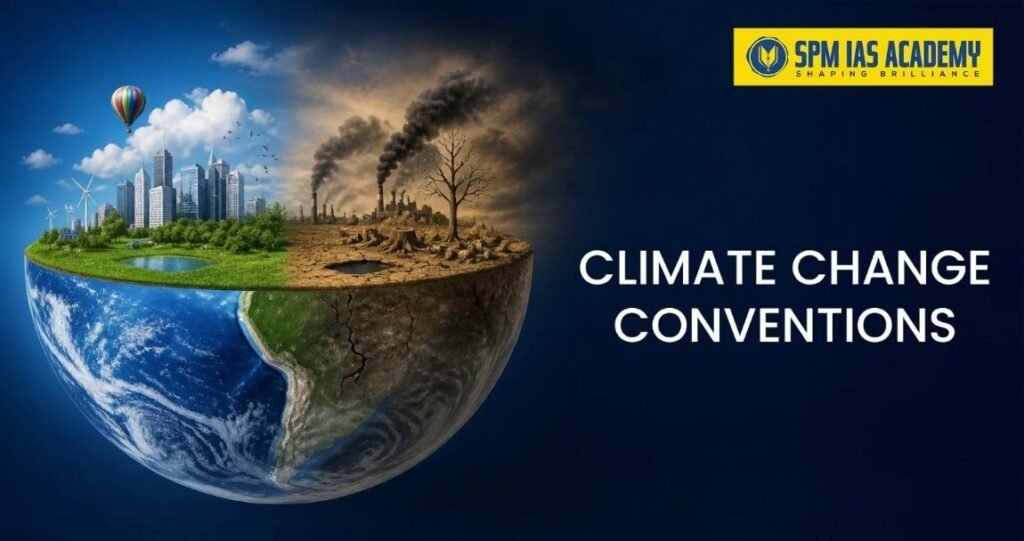
Climate change is one of the biggest challenges the world faces today. Nations across the globe have signed several international agreements to fight it. These agreements are called climate change conventions. The most important ones are the UNFCCC (1992), the Kyoto Protocol (1997), and the Paris Agreement (2015).
This article explains all these conventions clearly. It covers their objectives, key features, and recent COP outcomes. This topic is very important for UPSC, APSC, and all State PCS exams.
Explore expert guidance through UPSC & APSC coaching north east India for structured preparation and better results.
Climate Change Conventions: What Are They and Why Do They Matter?
Climate change conventions are formal international agreements. Countries sign these to reduce greenhouse gas emissions. They also aim to limit global temperature rise. These conventions build a legal and institutional framework for global climate action. They follow the principle of Common but Differentiated Responsibilities (CBDR). This means all countries must act. However, developed nations must do more because of their historical role in causing emissions.
Three major international climate change conventions shape global policy today. These are the UNFCCC, the Kyoto Protocol, and the Paris Agreement. Each one built upon the previous agreement. Together, they form the backbone of global climate governance.
UNFCCC: The 1992 United Nations Framework Convention on Climate Change
The UNFCCC stands for United Nations Framework Convention on Climate Change. It is the foundational international treaty on climate change. The United Nations adopted it on 9 May 1992. World leaders signed it at the Earth Summit in Rio de Janeiro, Brazil. That summit is also known as the Rio Summit or the Rio Conference. It was part of the United Nations Conference on Environment and Development (UNCED). As many as 154 nations signed the treaty at that summit. It entered into force on 21 March 1994. Today, 198 countries are Parties to the UNFCCC.
Objective of the UNFCCC
The primary goal of the UNFCCC is to stabilize greenhouse gas concentrations in the atmosphere. This stabilisation must happen at a safe level. Moreover, it should prevent dangerous human-induced interference with the climate system. At the same time, it must allow ecosystems to adapt naturally. It must also ensure food security and allow sustainable development to continue.
Key Features of the UNFCCC
- The UNFCCC itself is not legally binding. However, it provides the legal foundation for binding agreements like the Kyoto Protocol and Paris Agreement.
- It established the Conference of the Parties (COP) as its supreme decision-making body.
- Moreover, it set up two subsidiary bodies: the Subsidiary Body for Implementation (SBI) and the Subsidiary Body for Scientific and Technological Advice (SBSTA).
- It created a Financial Mechanism to help developing countries. The Global Environment Facility (GEF) and the Green Climate Fund (GCF) serve this mechanism.
- Notably, the UNFCCC Secretariat is located in Bonn, Germany. It supports the operations of the Convention and the COP.
- India hosted the COP of all three Rio Conventions: the UNFCCC, the Convention on Biological Diversity (CBD), and the UN Convention to Combat Desertification (UNCCD). This is a rare achievement.
Conference of the Parties (COP): Key Meetings and Outcomes
The Conference of the Parties (COP) is the main decision-making body of the UNFCCC. Moreover, all member countries meet every year to review progress and plan climate action. Additionally, the first COP took place in Berlin, Germany in 1995. Since then, the host country rotates among UN regional groups.
Important COP Meetings and Their Outcomes:
- COP1 (1995, Berlin): Firstly, countries launched the Berlin Mandate. They agreed to work on binding emission targets.
- COP3 (1997, Kyoto): Moreover, countries adopted the Kyoto Protocol. It set legal emission targets for developed nations.
- COP7 (2001, Marrakesh): Additionally, countries adopted the Marrakesh Accords. These gave clear rules to implement the Kyoto Protocol.
- COP13 (2007, Bali): Furthermore, countries adopted the Bali Action Plan. It started talks on a new climate agreement.
- COP15 (2009, Copenhagen): In addition, countries created the Copenhagen Accord. They made voluntary promises to reduce emissions.
- COP16 (2010, Cancun): Also, countries adopted the Cancun Agreements. Developed nations promised climate finance support.
- COP21 (2015, Paris): Importantly, countries adopted the Paris Agreement. This became a major global climate deal.
- COP27 (2022, Sharm el-Sheikh): Moreover, countries created a Loss and Damage Fund. It helps nations facing climate disasters.
- COP28 (2023, Dubai): Additionally, countries agreed to reduce fossil fuel use. They also completed the first global progress review.
- COP29 (2024, Baku): Furthermore, developed countries promised large financial support for developing nations by 2035.
- COP30 (2025, Belem, Brazil): Finally, countries called for more funding. They focused on protecting people from climate impacts.
Stay updated with latest climate developments through currentaffairs to strengthen your exam preparation effectively.
Kyoto Protocol 1997: First Legally Binding Climate Agreement
The Kyoto Protocol is a landmark international climate agreement. Countries adopted it in Kyoto, Japan on 11 December 1997. It entered into force on 16 February 2005. The Protocol extended the objectives of the 1992 UNFCCC. Moreover, it introduced legally binding emission reduction targets. As of 2020, 192 countries were Parties to the Kyoto Protocol.
Key Features of the Kyoto Protocol
- Firstly, the Protocol only bound developed countries to reduce emissions. It followed the principle of Common but Differentiated Responsibilities.
- Secondly, it targeted six greenhouse gases: carbon dioxide (CO2), methane (CH4), nitrous oxide (N2O), hydrofluorocarbons (HFCs), perfluorocarbons (PFCs), and sulphur hexafluoride (SF6).
- It provided the First Commitment Period (2008-2012) within which the developed nations had to cut emissions by 5% below 1990 levels.
- It also provided Second Commitment Period (2013-2020). It is known as the Doha Amendment. As per this agreement, the developed nations had to reduce emissions by at least 18% below 1990 levels.
- The USA signed but never ratified the Kyoto Protocol. Canada withdrew from the Protocol in 2012.
- Moreover, the Protocol introduced three flexible mechanisms: Emissions Trading, Clean Development Mechanism (CDM), and Joint Implementation (JI).
- The Clean Development Mechanism (CDM) allowed developed countries to fund clean energy projects in developing nations. They earned carbon credits in return.
Limitations of the Kyoto Protocol
The Kyoto Protocol faced major challenges.
- Firstly, it did not bind developing nations, including large emitters like China and India.
- Secondly, the USA never ratified it. Moreover, the emission reduction targets were too modest.
Therefore, the world needed a stronger and more inclusive agreement. This led to the Paris Agreement in 2015.
Paris Agreement 2015: The Landmark Global Climate Deal
The Paris Agreement is the most comprehensive global climate agreement to date. Countries adopted it at COP21 in Paris, France in December 2015. It entered into force on 4 November 2016. Notably, almost every country in the world is a party to the Paris Agreement. It replaced the Kyoto Protocol and introduced a universal framework.
Key Goals of the Paris Agreement
- Firstly, limit global average temperature rise to well below 2 degrees Celsius above pre-industrial levels.
- Secondly, pursue efforts to limit the temperature rise to 1.5 degrees Celsius.
- Moreover, to strengthen countries’ ability to deal with the impacts of climate change.
- Furthermore, to ensure finance flows to support low-carbon and climate-resilient development.
Key Features of the Paris Agreement
- Nationally Determined Contributions (NDCs): Every country submits its own climate action plan. NDCs outline each nation’s targets to reduce emissions and adapt to climate change.
- Ratchet Mechanism: Countries must submit new, more ambitious NDCs every five years. This ensures continuous improvement.
- Global Stocktake (GST): Every five years, countries collectively assess progress toward the Paris Agreement goals. The first GST happened at COP28 in 2023. It found the world is significantly off-track for the 1.5 degrees Celsius goal.
- Climate Finance: Developed nations must provide financial support to developing nations. At COP29 (2024), developed countries committed at least USD 300 billion per year to developing nations by 2035.
- Loss and Damage: This addresses harm from climate change that countries cannot adapt to. COP27 (2022) formally established a Loss and Damage Fund.
- Transparency Framework: All countries must report their emissions and climate actions regularly.
India’s Role in Climate Change Conventions
India plays a very active role in all major climate change conventions. As a developing nation, India has contributed very little to historical greenhouse gas emissions. However, India faces significant climate impacts. Therefore, India advocates for climate justice and equity in all negotiations.
- India ratified the UNFCCC in 1993. It ratified the Paris Agreement in 2016.
- India submitted its updated NDC in 2022. It targets 50% of its installed electricity capacity from non-fossil sources by 2030.
- India launched the National Action Plan on Climate Change (NAPCC) in 2008. It includes eight national missions on solar energy, energy efficiency, water, and more.
- India co-founded the International Solar Alliance (ISA) with France at COP21 in 2015.
- India announced its Panchamrit targets at COP26 in Glasgow (2021). These include net zero emissions by 2070.
- India hosted the COP of all three Rio Conventions. This is a unique distinction.
Key Concepts You Must Know
Common but Differentiated Responsibilities (CBDR)
CBDR is the core principle of all climate change conventions. It means all nations share the responsibility to fight climate change. However, developed nations must lead because they caused most historical emissions. They must also provide finance and technology to developing countries.
Climate Finance
Climate finance refers to funds that flow from developed to developing nations. These funds support clean energy, adaptation, and disaster resilience. The Green Climate Fund (GCF) and the Global Environment Facility (GEF) are the main channels. At COP29 (2024), developed nations pledged USD 300 billion per year by 2035.
Mitigation and Adaptation
- Mitigation means reducing greenhouse gas emissions. For example, switching to renewable energy or planting forests.
- Adaptation means adjusting to the current and expected impacts of climate change. For example, building sea walls or drought-resistant crops.
Conclusion
In conclusion, climate change conventions like the UNFCCC, Kyoto Protocol, and Paris Agreement form the backbone of global climate action. They guide countries to reduce greenhouse gas emissions, promote sustainable development, and address climate challenges. Moreover, regular COP meetings help review progress and set new goals.
Furthermore, principles like Common but Differentiated Responsibilities (CBDR) and climate finance ensure fairness between developed and developing nations. Therefore, these agreements play a key role in building a coordinated global response to climate change.
Overall, understanding climate change conventions, their key features, and global significance is very important for UPSC, APSC, and other competitive exams. Hence, strong international cooperation remains essential to achieve a climate-resilient and sustainable future.
Source:
Frequently Asked Questions:
Climate change conventions are international agreements to reduce greenhouse gas emissions and fight global warming. Moreover, they guide global climate action.
The UNFCCC (1992) is the main global treaty on climate change. Therefore, it provides the foundation for agreements like the Kyoto Protocol and Paris Agreement.
The Kyoto Protocol is the first legally binding climate agreement. It requires developed countries to reduce greenhouse gas emissions.
The Paris Agreement aims to limit global temperature rise to well below 2°C. Additionally, it encourages countries to submit climate action plans called NDCs.
The Conference of the Parties (COP) is the decision-making body of the UNFCCC. Moreover, countries meet annually to review progress and set new climate goals.

Behind every article at SPM IAS Academy is a team of skilled content writers and subject experts committed to making preparation easier for aspirants. From answering common doubts to breaking down complex issues and current affairs, we create content that is accurate, easy to understand, and directly useful for UPSC, APSC, and other competitive exams.