
A rare Super El Nino is forming in the Pacific Ocean in 2026. Scientists say it could be one of the strongest climate events in over a century. It will affect India’s monsoon, global rainfall, droughts, and floods.
This article covers everything UPSC, APSC, and State PCS aspirants need to know.
Super El Nino: Meaning and Definition
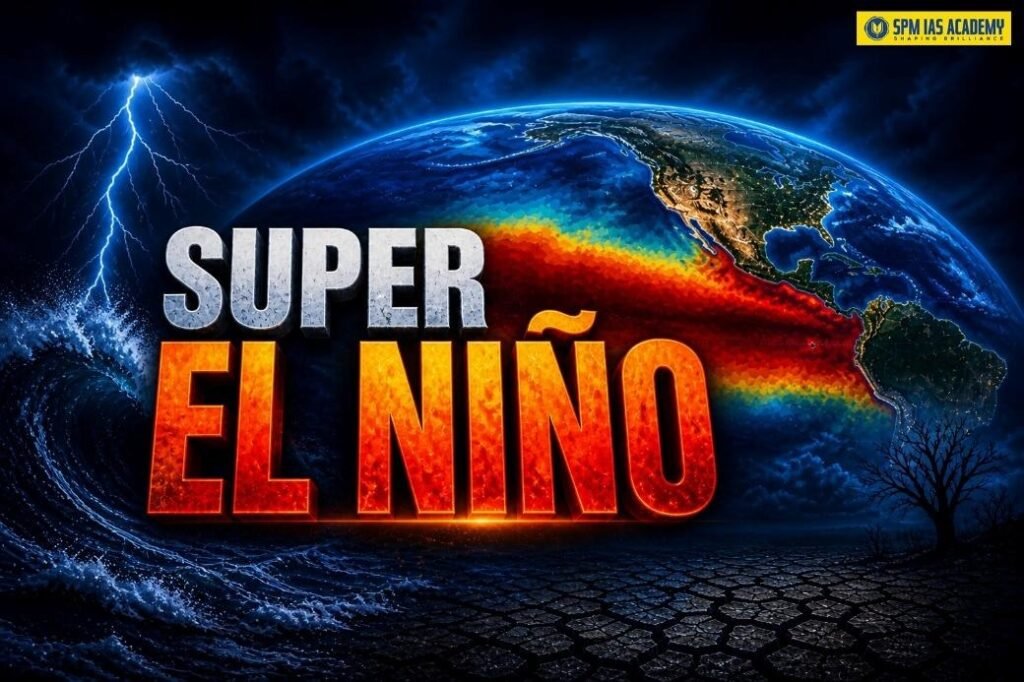
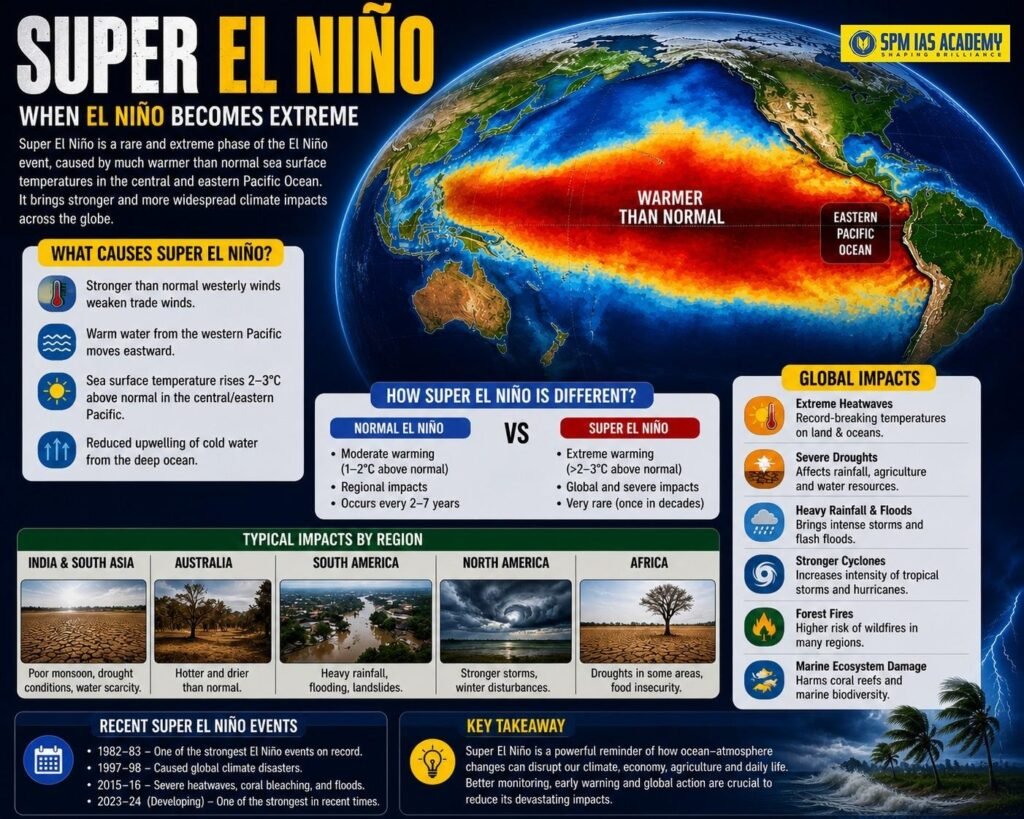
Super El Nino is an extreme version of the regular El Nino climate event. It forms in the equatorial Pacific Ocean. During this event, sea surface temperatures (SST) rise far above normal. Scientists call it ‘super’ when sea surface temperature (SST) anomalies cross 2°C above the long-term average. For comparison, a normal El Nino begins when the SST anomaly crosses just 0.5°C.
Therefore, a Super El Nino is at least four times more intense than a standard event. It does not just warm the ocean. It changes weather patterns across the entire planet.
What Is El Nino?
El Nino is a natural climate phenomenon. It is part of a larger system called ENSO (El Nino Southern Oscillation). ENSO has two phases: El Nino and La Nina.
- During normal conditions, trade winds blow from east to west across the Pacific Ocean.
- These winds push warm surface water towards Asia and Australia. However, during El Nino, the trade winds weaken significantly.
- As a result, warm water stays in the central and eastern Pacific. This raises sea surface temperatures in that region.
Consequently, this change in ocean temperature affects rainfall and temperature patterns worldwide. India, Australia, Africa, and the Americas all feel its impact.
El Nino vs La Nina: Key Differences
- El Nino: trade winds weaken, warm water builds in the eastern Pacific, dry conditions over India and Australia.
- La Nina: trade winds strengthen, cool water rises in the eastern Pacific, above-normal monsoon rainfall in India.
- ENSO-neutral: normal trade wind conditions, average rainfall globally.
Super El Nino 2026: What Is Happening Right Now?
- In April 2026, major climate agencies raised alarms about a developing Super El Nino. The United States agency NOAA (National Oceanic and Atmospheric Administration) released a key update on 6 April 2026.
- It stated that there is a 62 per cent chance of El Nino development between June and August 2026.
- Furthermore, NOAA predicted the probability rises to over 70 per cent for July to September 2026. It increases further to 80 per cent for August to October 2026. The event is likely to last until the end of 2026.
- Additionally, the European Centre for Medium-Range Weather Forecasts (ECMWF) and other international models also confirm this trend. They suggest that average SST anomalies in the equatorial Pacific could exceed 2°C. This would officially qualify the event as a Super El Nino.
Signs That Point to a Super El Niño in 2026
- Firstly, scientists observe above-average sea surface temperatures from Baja California to the west-central Pacific Ocean.
- Moreover, the upper ocean heat levels in the Pacific remain warmer than normal.
- Additionally, subsurface Pacific temperatures have shown a steady rise since December 2025.
- Furthermore, La Niña conditions are weakening faster than expected.
- Finally, international climate models indicate a sea surface temperature (SST) anomaly above 2°C.
Historical Super El Nino Events: What Happened Before?
Super El Nino events are rare. Only three have occurred in recent history. Each one caused massive disruption worldwide. Therefore, studying past events helps us understand what 2026 may bring.
The Three Known Super El Nino Events
- 1982–83: Severe droughts in Australia, India, and Africa; heavy floods in South America.
- 1997–98: Worst recorded event at the time; widespread coral bleaching; droughts across South Asia; long-term changes in soil moisture in Australia.
- 2015–16: Record global average temperature; massive coral bleaching worldwide; large-scale droughts in El Nino-sensitive regions.
Moreover, a study published in the journal Nature Communications in December 2025 found something alarming. Super El Nino events can trigger Climate Regime Shifts (CRS). These are sudden, long-lasting changes in the climate system. They affect ecosystems, soil moisture, rainfall, and human livelihoods for years or even decades.
Impact of Super El Niño on India’s Monsoon
- Firstly, India depends heavily on the southwest monsoon for agriculture and water supply. Therefore, any disruption creates serious challenges.
- Moreover, a strong El Niño usually weakens the southwest monsoon. As a result, India receives below-normal rainfall from June to September.
- On the other hand, it often increases rainfall during the northeast monsoon. This mainly affects states like Tamil Nadu, Andhra Pradesh, and Odisha.
- Furthermore, a Super El Niño has a much stronger impact. It can cause widespread drought across many parts of India.
- Additionally, farmers, food production, and water reservoirs face severe stress. Consequently, this may lead to food inflation, water scarcity, and economic slowdown.
State-Wise Impact on India
- Firstly, Northwest and Central India face a high risk of drought and heat waves.
- Moreover, Northeast India and Assam may experience irregular monsoon patterns.
- Additionally, Tamil Nadu and Coastal Andhra Pradesh may receive above-normal rainfall during the northeast monsoon.
- Furthermore, Peninsular India faces a higher risk of water stress during the kharif season.
- Finally, the Himalayan region may see changes in snowfall patterns. As a result, river flows can get affected.
Global Impacts of Super El Nino 2026
Super El Nino does not affect India alone. It reshapes weather across the entire globe. Scientists have identified several ‘hotspots’ that face the greatest risk.
Region-wise Global Impacts
- Central South Asia: major shifts in surface soil moisture leading to drought
- Western Amazon (South America): prolonged drought conditions
- East Africa: long-term shifts in surface air temperature
- Central Australia: swings between drought and flooding, as seen in 1997–98 and 2015–16
- Gulf of Mexico and Atlantic: sea surface temperature regime shifts
- Southeast Asia and Maritime Continent: disruption to regular rainfall patterns
In addition, Super El Nino events intensify existing climate change effects. Rising ocean temperatures combine with El Nino warming to create record-breaking global heat. The 2015–16 event set a new global temperature record at that time. The 2026 event could break that record.
What Are Climate Regime Shifts (CRS)?
Climate Regime Shifts are a key concept that UPSC aspirants must understand. The 2025 Nature Communications study highlights them as a major risk linked to Super El Nino.
A Climate Regime Shift means the climate system suddenly jumps from one stable state to another. For example, a region that normally receives good rainfall may permanently shift to drier conditions. This transition is often abrupt and long-lasting. It does not reverse easily.
Furthermore, CRS events pose serious threats to biodiversity, agriculture, water availability, and human well-being. They can affect entire ecosystems for decades. Super El Nino events significantly increase the probability of such shifts occurring.
Government Response and Disaster Preparedness
- Governments and climate agencies worldwide are already preparing for the 2026 Super El Nino. Early warning systems, crop advisory services, and water management plans are being activated.
- In India, the India Meteorological Department (IMD) monitors ENSO conditions closely. It issues seasonal monsoon forecasts based on Pacific Ocean data. The government also activates the National Disaster Management Authority (NDMA) for drought and flood preparedness.
- Moreover, international cooperation through the World Meteorological Organization (WMO) helps coordinate responses. Countries share data, issue joint alerts, and align food security plans.
Conclusion:
The possible formation of a Super El Nino in 2026 is a major global climate event. It reminds us how deeply connected the ocean and atmosphere are. Moreover, it also shows how one warming event in the Pacific Ocean can reshape weather across six continents.
For India, the key risks include monsoon disruption, drought in major farming states, and increased flood risk in some coastal regions. At the same time, for the world, the risks include extreme temperatures, loss of coral reefs, and long-term Climate Regime Shifts.
Therefore, understanding Super El Nino is essential for every UPSC, APSC, and State PCS aspirant.
Source:
Super El Niño weakens the southwest monsoon in India. As a result, the country receives below-normal rainfall, which affects agriculture and water supply.
Yes, Super El Niño often causes widespread drought conditions in India. Moreover, it increases the risk of heat waves and water scarcity.
Northwest and Central India face high drought risk. Additionally, Northeast India may see irregular rainfall, while Tamil Nadu may get more rainfall during the northeast monsoon.
Super El Niño affects agriculture, food production, and water resources. Therefore, it can lead to food inflation and economic slowdown.
Super El Niño is an extreme form of the El Niño climate phenomenon. It occurs when sea surface temperatures (SST) in the Pacific Ocean rise more than 2°C above normal. Therefore, it causes severe global weather changes, including droughts, floods, and heatwaves.

Behind every article at SPM IAS Academy is a team of skilled content writers and subject experts committed to making preparation easier for aspirants. From answering common doubts to breaking down complex issues and current affairs, we create content that is accurate, easy to understand, and directly useful for UPSC, APSC, and other competitive exams.