
What are the classical dances of India?
There are eight classical dances in India. These are Bharatanatyam, Kathak, Kathakali, Mohiniyattam, Odissi, Kuchipudi, Manipuri, and Sattriya. The classical dances of India carry centuries of tradition, spirituality, and artistic excellence. Each dance form belongs to a specific region of India. The Sangeet Natak Akademi officially recognizes these eight dance forms. Questions on classical dances of India appear regularly in UPSC Prelims, APSC, and other State PCS exams. Therefore, every aspiring civil servant must know this topic well.
How Many Types of Classical Dance in India Are There?
Many students ask how many types of classical dance in India exist? The answer is eight. India currently has eight officially recognized classical dance forms. The Sangeet Natak Akademi, India’s national academy for performing arts, recognizes and promotes these dance forms. Each of these classical dances of India follows codified techniques. They all draw inspiration from the ancient text Natyashastra, written by Bharata Muni. These dance forms also follow the Abhinaya Darpana, another key classical treatise.
Furthermore, every classical dance form has three essential elements. These are Nritta (pure rhythmic movement), Nritya (expressive dance with emotion), and Natya (dramatic storytelling). Together, these three elements make classical dances of India unique and deeply meaningful.
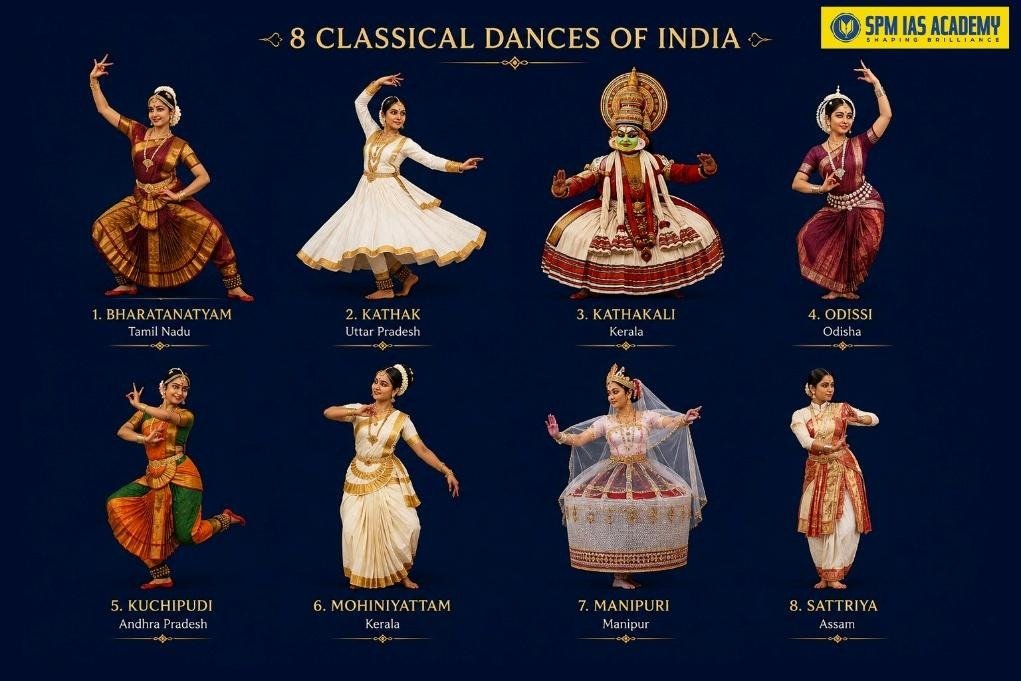
List of Classical Dances of India with States
The following is the complete list of classical dances of India with their associated states. This list is frequently asked in UPSC Prelims, APSC, and other competitive exams.
| Classical Dance Form | State |
| Bharatanatyam | Tamil Nadu |
| Kathak | Uttar Pradesh |
| Kathakali | Kerala |
| Mohiniyattam | Kerala |
| Odissi | Odisha |
| Kuchipudi | Andhra Pradesh |
| Manipuri | Manipur |
| Sattriya | Assam |
Note: Two classical dances of India – Kathakali and Mohiniyattam – both come from Kerala.
Eight Classical Dances of India: Key Features and Origin
Let us now study the eight classical dances of India in detail. Each dance form has its own history, style, and cultural importance.
1. Bharatanatyam (Tamil Nadu)
Bharatanatyam is one of the oldest classical dances of India. It originates from the temple traditions of Tamil Nadu. This dance follows the Natyashastra and the Abhinaya Darpana of Nandikesvara. Bharatanatyam is known as the Ekaharya style. This means a single dancer plays multiple characters in one performance. Key features include:
- Firstly, strong geometric precision and rhythmic footwork (adavus).
- Secondly, expressive eye movements are called drishti bheda.
- Thirdly, codified hand gestures are known as hasta mudras.
- In addition, this dance form aims to express all nine rasas, especially Shringara and Bhakti.
- Traditional performance order: Alarippu, Jatiswaram, Shabdam, Varnam, Padam, Tillana
- Moreover, it is accompanied by Carnatic music with mridangam, violin, and flute.
- In the modern period, E. Krishna Iyer and Rukmini Devi Arundale revived this dance form.
- Some of the notable exponents of Bharatnatyam dance form are Balasaraswati, Yamini Krishnamurthy, Padma Subrahmanyam etc.
2. Kathak (Uttar Pradesh)
Kathak is a major classical dance of India from Uttar Pradesh. The word Kathak comes from ‘Katha’, which means story. Storytellers originally performed Kathak in temples. During the Bhakti movement, it grew into a full classical form. Later, Mughal court patronage added refinement to its technique. Key points:
- Kathak is famous for intricate footwork (tatkar) and rapid spins (chakkars).
- While performing Kathak, dancers wear heavy ankle bells called ghungroos.
- This dance form has strong links to Hindustani classical music.
- Some of the notable themes include stories of Radha and Krishna from Rasa Lila.
- This dance form reached its peak under Wajid Ali Shah, the last Nawab of Awadh.
- Some of the notable exponents of Kathak dance form are Birju Maharaj, Sitara Devi, and Shambhu Maharaj.
3. Kathakali (Kerala)
Kathakali is one of the most visually striking classical dances of India. It developed in Kerala from ritual theatre forms like Krishnattam and Ramanattam. It is a dance-drama that combines dance, music, acting, and visual design. Important facts:
- The themes of Kathakali are drawn from the Ramayana, Mahabharata, and Puranas.
- Notably, elaborate facial makeup with colour symbolism: green for virtue, red for aggression, black for evil etc. is an integral feature of this dance form.
- In Kathakali, dancers use heavy costumes, massive skirts, and ornate headgear.
- Moreover, it involves communication through codified hand gestures and intense eye movements.
- In addition, the musical instruments which are used in the performance of this dance are chenda, maddalam, and cymbals.
- Notable exponents of Kathakali dance form are Ramankutty Nair and Kalamandalam Gopi.
4. Mohiniyattam (Kerala)
Mohiniyattam is a graceful classical dance of India from Kerala. Its name comes from Mohini, the enchanting female form of Lord Vishnu. It is a solo dance form with a predominantly Lasya (graceful) style. Key features:
- Mohiniyattam uses gentle and circular body movements. Dancers perform it with soft footwork and graceful rhythm.
- Moreover, dancers express emotions through subtle facial expressions. They also use lyrical body language to create a smooth performance.
- The traditional costume of Mohiniyattam is a white and gold Kasavu saree. This costume reflects Kerala’s cultural identity.
- In addition, Mohiniyattam uses lyrics written in Manipravala. Manipravala is a blend of Tamil, Malayalam, and Sanskrit.
- Maharaja Swati Tirunal gave royal support to Mohiniyattam. His patronage helped the dance form grow and gain recognition.
- Kalamandalam Kalyanikutty Amma and Pallavi Krishnan are notable exponents of Mohiniyattam. They played an important role in promoting this classical dance form.
5. Odissi (Odisha)
Odissi is one of the most ancient classical dances of India. It comes from Odisha and focuses on Vaishnavism, especially stories of Lord Krishna. People also call it a mobile sculpture because of its beautiful sculptural poses.
Key facts and features of Odissi dance form:
- Odissi is known for its graceful Tribhanga posture and strong Chowk stance. These poses give the dance its sculptural beauty.
- Moreover, dancers use fluid torso movements and a lyrical style. This makes Odissi soft, expressive, and elegant.
- Odissi draws major inspiration from Jayadeva’s Gita Govinda. Therefore, many performances focus on devotion, love, and stories of Lord Krishna.
- In addition, Odissi uses Odissi classical music as its main accompaniment. The music supports the rhythm, mood, and expression of the dance.
- Odissi shares some mudras with Bharatanatyam. However, it maintains a distinct regional style from Odisha.
- Kelucharan Mohapatra, Sanjukta Panigrahi, and Sonal Mansingh are notable performers of Odissi. They helped popularise this classical dance form nationally and internationally.
6. Kuchipudi (Andhra Pradesh)
Kuchipudi is a vibrant classical dance of India from Andhra Pradesh. It originated in the Kuchipudi village of the Krishna district. Earlier, people called it Yakshagaana. In the 17th century, Siddhendra Yogi gave it a systematic devotional form.
Key features of Kuchipudi dance form:
- Kuchipudi combines group dance-dramas with solo performances. This makes the dance form both dramatic and expressive.
- Moreover, dancers perform Kuchipudi with brisk movements and strong abhinaya. They use facial expressions and gestures to present emotions clearly.
- Kuchipudi dancers wear colourful and light costumes. These costumes help them perform fast footwork with ease.
- In addition, Kuchipudi includes unique solo items like Manduka Shabdam and Tala Chitra Nritya. These items show the technical skill of the dancer.
- Kuchipudi follows the Carnatic music tradition. The music supports the rhythm, expression, and devotional mood of the performance.
- Yamini Krishnamurthy, Raja Reddy, and Radha Reddy are notable dancers of Kuchipudi. They helped popularise this classical dance form in India and abroad.
7. Manipuri (Manipur)
Manipuri is an ancient classical dance of India from the state of Manipur. It connects deeply with rituals, festivals, and mythology. Its oldest form is Lai Haraoba, which represents the creation of the universe through dance.
Key facts of Manipuri dance form:
- King Bhagyachandra organised Ras Leela in the 18th century. This gave Manipuri dance a strong devotional and cultural foundation.
- Moreover, Manipuri dance includes major forms like Ras, Sankirtana, and Thang-Ta. Each form reflects the spiritual and martial traditions of Manipur.
- Dancers do not wear ankle bells in Manipuri dance. This helps them maintain softness, grace, and fluidity in movement.
- In addition, male dancers play the Pung and Kartal while performing. The Pung is a drum, while the Kartal is a pair of cymbals.
- Sankirtana combines dance with devotional group singing. It plays an important role in Manipur’s Vaishnavite tradition.
- Manipuri dance movements are soft, graceful, and circular. Therefore, the dance form creates a calm and spiritual visual appeal.
8. Sattriya (Assam)
Sattriya is the youngest among the classical dances of India. It comes from Assam and belongs to the Vaishnava tradition. The great saint Srimanta Sankaradeva introduced it in the 15th century. It evolved inside Sattras, which are Vaishnava monasteries. This gives the dance its name.
Key features of Sattriya Dance:
- Sattriya was used to spread Neo-Vaishnavism through dance and drama. Srimanta Sankaradeva developed it as a devotional art form in Assam in 15th-16th century.
- Moreover, Sattriya has two major streams. These include Bhaona-based dance-dramas and independent dance numbers.
- The Chali style focuses on grace and lyrical beauty. It presents soft, elegant, and expressive movements.
- In contrast, the Jhumura style highlights vigour and majesty. It uses stronger movements and a more powerful performance style.
- Sattriya strictly follows codified principles of mudras, footwork, rhythm, and music. These rules give the dance its classical structure.
- In the modern period, Sattriya gained recognition as a classical dance form of India. Today, it represents Assam’s Vaishnavite culture and artistic heritage.
Criteria for Recognition of Classical Dance Forms in India
The Sangeet Natak Akademi uses specific criteria to recognise a dance form as classical. These criteria help separate classical dances from folk, regional, and contemporary dance forms.
- A classical dance form must have a strong textual foundation. It should draw from Bharata Muni’s Natyashastra or other classical treatises.
- Moreover, it must follow the threefold structure of Indian classical dance. This includes Nritta or pure dance, Nritya or expressive dance, and Natya or dramatic storytelling.
- It must use the Rasa-Bhava framework. Dancers should express emotions in a controlled way to create specific aesthetic experiences.
- In addition, the dance form must balance Lasya and Tandava. Lasya represents grace, while Tandava represents energy and vigour.
- A recognised classical dance must follow codified techniques. It should have fixed rules for postures, footwork, gestures, and body movements.
- Furthermore, it must use a structured Abhinaya system. This includes facial expressions, eye movements, body language, and hand gestures or mudras.
- The dance form should follow the Guru-Shishya Parampara. Teachers must pass knowledge to students through a traditional learning system.
- It must also have spiritual or thematic depth. Most classical dances draw themes from mythology, epics, devotion, or philosophy.
- Moreover, the dance form must show a distinct regional identity. Its music, costume, makeup, instruments, and performance style should reflect a specific region.
- Finally, it must show historical continuity. A classical dance form should have a long tradition of practice, preservation, and evolution over time.
Therefore, classical dances of India combine textual tradition, codified technique, spiritual depth, regional identity, and historical continuity.
Key Elements of Classical Dances of India
- Classical dances of India follow the Natyashastra-based framework. They use the ancient principles of Bharata Muni’s Natyashastra for technique, movement, expression, and aesthetics.
- Moreover, classical dances use Abhinaya, or modes of expression. Dancers express meaning through Angika or body movement, Vachika or music and recitation, Aharya or costume and makeup, and Sattvika or inner emotion.
- The Rasa-Bhava theory plays a central role in classical dance. Dancers express bhavas or emotions to create rasas or aesthetic feelings in the audience.
- In addition, rhythm and music guide every performance. Dancers coordinate their movements with tala or rhythm and raga or melody of Indian classical music.
- Classical dances also follow the Guru-Shishya Parampara. Teachers pass knowledge, technique, discipline, and tradition directly to students.
- Furthermore, every classical dance balances Lasya and Tandava. Lasya shows grace and softness, while Tandava shows energy, strength, and power.
Therefore, the classical dances of India share common features like Natyashastra principles, Abhinaya, Rasa-Bhava theory, rhythm, music, Guru-Shishya tradition, and Lasya-Tandava balance. These elements make the topic important for UPSC, APSC, and State PCS exams.
Role of Sangeet Natak Akademi in Promoting Classical Dances of India
- Sangeet Natak Akademi plays a major role in preserving and promoting the classical dances of India. It works under the Ministry of Culture, Government of India.
- The Government of India established Sangeet Natak Akademi in 1952. Since then, it has supported India’s traditional performing arts, including classical dance, music, and theatre.
- Moreover, the Akademi recognises and preserves classical dance forms. It helps protect their traditional techniques, performance styles, and cultural identity.
- It also conducts workshops, masterclasses, and training programmes. These activities support the Guru-Shishya Parampara and help young dancers learn from experienced artists.
- Furthermore, Sangeet Natak Akademi provides scholarships, grants, and fellowships. These benefits support dancers, researchers, gurus, and dance institutions.
- The Akademi organises national and international festivals. Through these events, it promotes Indian classical dances on larger platforms.
- In addition, it archives performances and publishes research material. This helps preserve classical dance knowledge for future generations.
- It also honours outstanding artists through awards and fellowships. These recognitions encourage excellence in Indian classical dance traditions.
Therefore, Sangeet Natak Akademi strengthens the classical dances of India through recognition, preservation, training, research, and promotion. This topic is important for UPSC, APSC, and State PCS exams under Indian art and culture.
Conclusion:
In conclusion, the classical dances of India reflect India’s rich cultural heritage, spirituality, and regional diversity. India has eight classical dance forms: Bharatanatyam, Kathak, Kathakali, Mohiniyattam, Odissi, Kuchipudi, Manipuri, and Sattriya. Moreover, these dance forms follow the Natyashastra, Abhinaya, Rasa-Bhava theory, and Guru-Shishya Parampara. The Sangeet Natak Akademi also plays a key role in preserving and promoting Indian classical dances. Therefore, UPSC, APSC, and State PCS aspirants must study the list of classical dances of India with states, their origin, key features, and important facts for Indian art and culture preparation.
Source:
Also read :
India has eight classical dance forms recognized by the Sangeet Natak Akademi.
Bharatanatyam is widely considered the oldest surviving classical dance of India.
Sattriya is the classical dance from Assam. Srimanta Sankaradeva introduced it in the 15th century.

Behind every article at SPM IAS Academy is a team of skilled content writers and subject experts committed to making preparation easier for aspirants. From answering common doubts to breaking down complex issues and current affairs, we create content that is accurate, easy to understand, and directly useful for UPSC, APSC, and other competitive exams.