
The G20 (Group of Twenty) is one of the most important global forums for economic cooperation and governance. It includes the world’s major developed and developing economies. Together, G20 countries represent around 85% of global GDP, 75% of international trade, and about two-thirds of the world’s population.
Moreover, the G20 plays a key role in addressing global economic stability, climate change, sustainable development, and financial reforms. Therefore, understanding the G20, its members, objectives, structure, and India’s role is very important for UPSC, APSC, and all State PCS exams.
What is G20? Meaning and Background
The G20 (Group of Twenty) is an informal international forum of major economies. It brings together 19 countries and the European Union (EU).
Origin of G20
- Firstly, the G20 was formed in 1999 after the Asian Financial Crisis.
- Initially, it focused on meetings of Finance Ministers and Central Bank Governors.
- However, after the 2008 Global Financial Crisis, the G20 became a leaders’ summit-level forum.
Therefore, today the G20 acts as the main platform for global economic coordination.
G20 Member Countries List
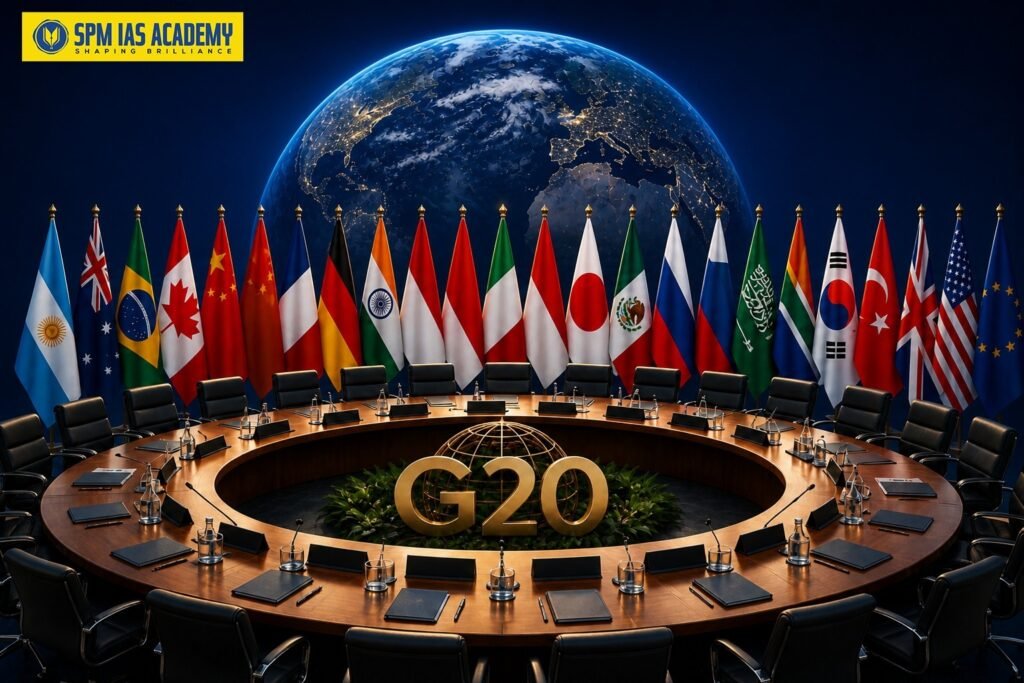
The G20 includes the following members:
Countries in G20
- Argentina
- Australia
- Brazil
- Canada
- China
- France
- Germany
- India
- Indonesia
- Italy
- Japan
- Mexico
- Russia
- Saudi Arabia
- South Africa
- South Korea
- Türkiye
- United Kingdom
- United States
Other Members
- European Union (EU)
- African Union (AU) (added as permanent member in 2023)
The inclusion of the African Union reflects growing focus on the Global South.
What are the Objectives of G20?
The G20 focuses on multiple global issues. Its key objectives include:
- Firstly, the G20 promotes global economic stability and sustainable growth.
- Moreover, it coordinates international financial policies among major economies.
- Additionally, it works to reform global financial institutions like the IMF and World Bank.
- Furthermore, it addresses key issues such as climate change and sustainable development.
- In addition, it strengthens global trade and improves supply chains.
- Also, it supports the growth of the digital economy and encourages innovation.
Therefore, the G20 plays a crucial role in global governance and policy coordination.
Structure of G20
The G20 does not have a permanent secretariat. Instead, it works through a flexible structure.
1. G20 Presidency:
The G20 presidency rotates annually among member countries. Therefore, each year a different country leads the forum. Moreover, the host country actively sets the agenda and priorities for that year. As a result, it guides discussions and shapes the focus areas of the G20.
2. Troika System
The G20 follows a Troika system to ensure continuity in its work. It includes the previous president, the current president, and the next president. Moreover, these three countries work together to guide the agenda and maintain consistency. Therefore, the Troika system helps ensure smooth coordination and continuity in G20 policies and decisions.
3. Two Tracks of G20
The G20 works through two main tracks to manage its wide range of issues.
(A) Finance Track
The Finance Track deals with economic matters, and it includes finance ministers and central bank governors who focus on financial stability and economic policies.
(B) Sherpa Track
Moreover, the Sherpa Track handles broader global issues. It covers areas such as climate change, health, education, and development. Therefore, both tracks together ensure that the G20 addresses both economic and social challenges effectively.
4. Engagement Groups
G20 includes various engagement groups:
- Business (B20)
- Think Tanks (T20)
- Youth (Y20)
- Women (W20)
- Civil Society (C20)
These groups increase public participation and policy input.
Important G20 Summits
G20 Summits are annual meetings of world leaders. They discuss major global economic and political issues.
Recent Key G20 Summits:
- 2008 (Washington DC): Firstly, leaders held the first G20 Leaders’ Summit. They focused on the global financial crisis.
- 2009 (London): Moreover, leaders worked on global financial recovery and economic stability.
- 2015 (Antalya): Additionally, the summit focused on terrorism and migration challenges.
- 2020 (Riyadh): Furthermore, leaders addressed the global COVID-19 pandemic and coordinated response strategies.
- 2023 (New Delhi): Notably, India hosted the summit and highlighted inclusive growth and global cooperation.
- 2024 (Rio de Janeiro, Brazil): Moreover, Brazil hosted the summit and focused on social inclusion and sustainable development.
- 2025 (Johannesburg): Finally, South Africa hosted the 20th G20 Leaders’ Summit. Leaders focused on solidarity, equality, and sustainability, while addressing issues like debt sustainability, energy transition, and inclusive growth.
For regular updates on international topics like G20, students should follow currentaffairs for daily insights.
India’s G20 Presidency 2023: Key Highlights
India hosted the G20 Summit in New Delhi in September 2023. The theme was “Vasudhaiva Kutumbakam” (One Earth, One Family, One Future).
Major Achievements:
- Firstly, the African Union became a permanent G20 member.
- Moreover, Global Biofuel Alliance launched.
- Additionally, India-Middle East-Europe Economic Corridor was announced.
- Furthermore, focus on Digital Public Infrastructure (DPI).
India highlighted the voice of the Global South.
Significance of G20 in Global Politics
The G20 plays a crucial role in today’s global system.
Economic Importance:
- Moreover, it covers around 85% of global GDP.
- Additionally, it represents the major economies of the world.
Political Importance:
- Furthermore, the G20 promotes multilateral cooperation among nations.
- In addition, it bridges the gap between developed and developing countries.
Strategic Importance:
- Also, the G20 addresses key global challenges such as climate change.
- Moreover, it focuses on energy security.
- Additionally, it responds to global crises effectively.
- Therefore, the G20 acts as a key platform for global problem-solving and coordination.
Challenges Faced by G20
- Firstly, geopolitical tensions create major challenges. For example, conflicts like USA-China rivalry and Russia–Ukraine war affect cooperation.
- Moreover, the G20 lacks binding decisions. Therefore, members do not have to strictly follow agreements.
- Additionally, differences between developed and developing countries create disagreements. These differences slow down decision-making.
- Furthermore, the implementation of commitments remains slow. As a result, many goals take time to achieve.
- Therefore, consensus-building within the G20 becomes difficult.
Conclusion
In conclusion, the G20 (Group of Twenty) is one of the most powerful global forums for economic cooperation and global governance. It plays a vital role in maintaining financial stability, sustainable development, and international coordination. Moreover, with rising global challenges like climate change, economic crises, and geopolitical tensions, the importance of the G20 summit and its decisions continues to grow.
Furthermore, India’s active participation and leadership in the G20 presidency highlight its growing global influence. Therefore, understanding the G20, its members, objectives, structure, and global significance is essential for UPSC, APSC, and other competitive exams.
Students preparing for civil services can explore reliable UPSC & APSC coaching in Assam for expert guidance and preparation.
Hence, the G20 remains a key platform for building a balanced, inclusive, and sustainable global future.
Source:
Frequently Asked Questions:
The G20 (Group of Twenty) is an international forum of major economies. Moreover, it brings together countries to discuss global economic stability, trade, and development.
The G20 includes 19 countries along with the European Union and the African Union. Therefore, it represents the world’s leading developed and developing economies.
The G20 aims to promote global economic growth, financial stability, and sustainable development. Additionally, it works on issues like climate change, trade, and global governance reforms.
India plays an important role in the G20 by promoting the interests of the Global South. Moreover, during its presidency in 2023, India focused on inclusive growth and digital public infrastructure.
The G20 is important because it represents 85% of global GDP and major world economies. Therefore, it acts as a key platform for international cooperation and global problem-solving.

Behind every article at SPM IAS Academy is a team of skilled content writers and subject experts committed to making preparation easier for aspirants. From answering common doubts to breaking down complex issues and current affairs, we create content that is accurate, easy to understand, and directly useful for UPSC, APSC, and other competitive exams.