India and China share a 3,488 km disputed border. This border has led to wars, standoffs, and diplomatic crises. Understanding the India-China border issue is essential for UPSC, APSC, and all State PCS exams. This article covers the history, key flashpoints, recent developments, and way forward in simple language.
This topic is highly important for UPSC and APSC aspirants as it frequently appears in the International Relations and Current Affairs sections of competitive exams.
India-China Border: An Overview
India and China are two of the world’s largest nations. They share a long and disputed border. The two countries have never formally agreed on where the boundary lies. This makes the India-China border one of the most sensitive geopolitical issues in Asia.
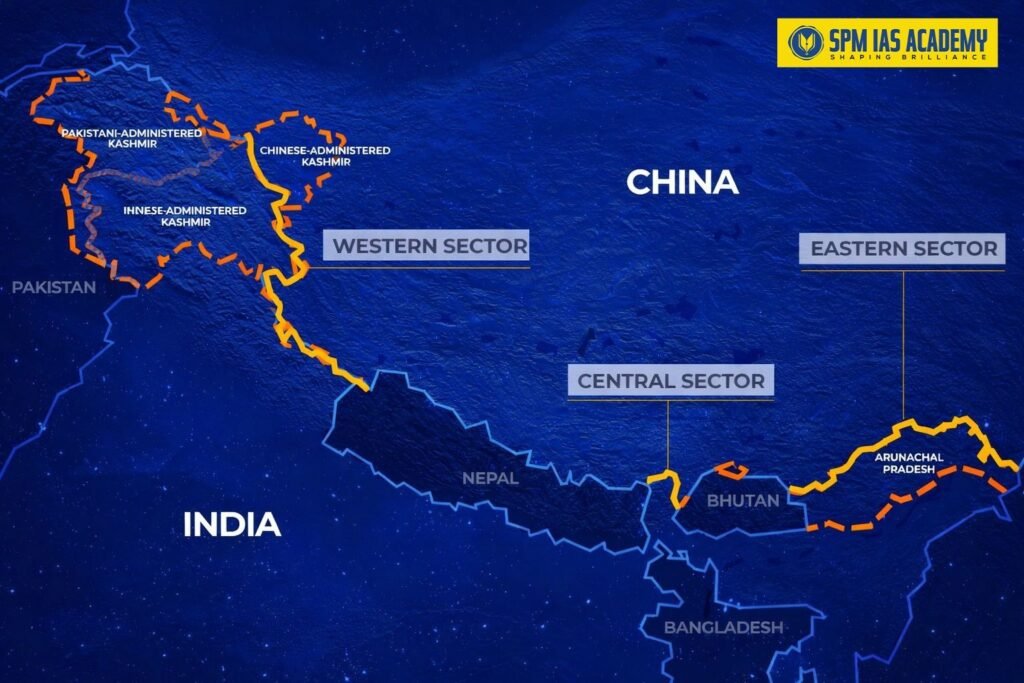
The total length of the India-China border is approximately 3,488 km. This border runs across three sectors. Each sector has its own history and disputes.
Three Sectors of the India-China Border
| Sector | States/UTs Involved | Key Disputed Area | Length (Approx.) |
| Western Sector | Ladakh (J&K) | Aksai Chin | ~2,152 km |
| Middle Sector | Himachal Pradesh, Uttarakhand | Bara Hoti, Nelang Valley | ~545 km |
| Eastern Sector | Arunachal Pradesh, Sikkim | Tawang, McMahon Line | ~1,140 km |
Historical Background of India-China Border Disputes
The root of the India-China border problem lies in colonial-era boundary lines. The British never clearly demarcated the border with China. This left behind unresolved territorial questions.
The Western Sector: Aksai Chin Dispute
- The Western Sector is the most contested zone. It covers the Ladakh region. The dispute here centres on Aksai Chin.
- In 1865, British surveyor William Johnson drew the Johnson Line. This line placed all of Aksai Chin in Kashmir.
- However, China never accepted this line. Later, the British proposed a revised Macartney-MacDonald Line in 1899. China did not formally respond to it.
- After independence, India continued to follow the Johnson Line. China, however, built a strategic road through Aksai Chin. India discovered this road only in 1957. This discovery worsened tensions sharply.
The Eastern Sector: McMahon Line and Arunachal Pradesh
- In 1914, the Shimla Convention took place between British India, China, and Tibet. Britain proposed the McMahon Line as the border. Tibet also agreed. However, China refused to sign the agreement.
- China calls Arunachal Pradesh ‘South Tibet’. It claims around 90,000 sq km of the state. India firmly rejects this claim. The McMahon Line remains India’s official border here.
The Middle Sector
- The Middle Sector runs through Himachal Pradesh and Uttarakhand. It covers about 545 km.
- Both countries claim sovereignty over several unmarked spots. Bara Hoti has seen frequent Chinese intrusions. Indian ITBP forces regularly patrol this area.
The 1962 India-China War: A Turning Point
The 1962 Sino-Indian War was a defining moment. India and China fought a brief but decisive war. China launched a large-scale offensive. India suffered a major military defeat.
The war resulted in China capturing Aksai Chin. It also exposed India’s military unpreparedness. The war ended the spirit of ‘Hindi-Chini Bhai Bhai’ permanently. After 1962, India completely revised its foreign and defence policy.
Key causes of the 1962 war were:
- Disagreement over the boundary in both western and eastern sectors.
- China’s occupation of Aksai Chin to build the Xinjiang-Tibet highway.
- Nehru’s Forward Policy of setting up military posts near the Chinese-claimed line.
- India’s decision to give asylum to the Dalai Lama in 1959.
What is the Line of Actual Control (LAC)?
The Line of Actual Control, or LAC, is the de facto boundary between India and China. It is not a formally recognised international border. Instead, it is a line that reflects where each country’s forces actually stand.
The LAC came into existence after the 1962 war. India and China have different perceptions of where exactly the LAC runs. This difference in perception frequently leads to faceoffs between troops.
Key Features of the LAC
- Total length: approximately 3,488 km.
- No formal treaty defines its exact alignment.
- Both sides patrol up to their respective claim lines.
- Buffer zones exist after multiple disengagement agreements.
- Governed by the 1993 and 1996 Border Peace and Tranquility Agreements.
Galwan Valley Clash 2020: A Major Crisis
In June 2020, Indian and Chinese troops clashed violently in the Galwan Valley. This was the deadliest border incident since 1967. Twenty Indian soldiers, including Colonel Santosh Babu, were killed. Chinese casualties were also reported but not officially confirmed for a long time.
The clash arose from Chinese attempts to prevent Indian construction activity near the LAC. It resulted in a severe downgrade of bilateral relations. Trade, flights, and visas all faced major restrictions. India also banned several Chinese mobile apps as a response.
Recent Developments: India-China Border Talks and the 2024 Agreement
Multiple Rounds of Military and Diplomatic Talks
After the 2020 Galwan clash, India and China began a long process of disengagement. They held 21 rounds of Corps Commander-level military talks. These talks aimed to reduce troops from friction points along the LAC.
Step by step, both sides disengaged from several areas:
- Pangong Tso (February 2021) — troops pulled back from both north and south banks
- Gogra Post (August 2021) — patrolling limited in buffer zone
- Gogra-Hot Springs area (September 2022) — further disengagement
- Depsang Plains and Demchok (October 2024) — final two friction points resolved
The October 2024 Patrol Agreement
In October 2024, India and China reached a landmark patrol agreement. Both sides agreed to restore patrolling rights in Depsang Plains and Demchok. This was the final breakthrough after four years of talks. The agreement came just before PM Modi and President Xi Jinping met at the BRICS summit in Kazan, Russia.
The agreement included:
- Withdrawal of troops from specific friction points.
- Resumption of patrolling as per pre-2020 patterns.
- A monitoring framework to verify troop withdrawal.
- Structured dialogue at multiple levels to resolve future standoffs.
Current Status: Disengagement but Not De-escalation
Disengagement at the six friction points is complete. However, de-induction of troops has not yet happened. Both sides still maintain heavy force deployments. Buffer zones created during standoffs also remain.
At the same time, normalisation steps have also begun. The Kailash-Mansarovar Yatra resumed. Direct flights are being restored. Visa processes are being eased. Border trade is also resuming.
Important Agreements on India-China Border
| Agreement / Event | Year | Key Provision |
| Panchsheel Agreement | 1954 | Five principles of peaceful coexistence; acknowledged Tibet as part of China |
| Shimla Convention / McMahon Line | 1914 | Defined eastern border; China did not sign |
| 1962 War Ceasefire | 1962 | China withdrew unilaterally; LAC came into being |
| Border Peace and Tranquility Agreement | 1993 | Both sides to maintain peace on LAC; no use of force |
| CBMs Agreement | 1996 | Further confidence-building; no threatening activities near LAC |
| Galwan Valley Clash | 2020 | Worst clash in decades; triggered disengagement talks |
| Patrol Agreement | 2024 | Restored patrolling at Depsang and Demchok; Modi-Xi meet |
Way Forward: India-China Border Relations
Both India and China must move beyond disengagement. They must now work towards de-escalation and de-induction. The bigger picture includes resolving the boundary question permanently.
Key steps for lasting peace:
- Conclude the remaining boundary negotiations through Special Representatives.
- Ensure pre-2020 status is restored in all buffer zones.
- Strengthen people-to-people ties through Kailash-Mansarovar Yatra and tourism.
- Separate bilateral trade from border tensions for economic stability.
- Expand military-to-military communication hotlines to prevent accidental conflict.
As External Affairs Minister S. Jaishankar has repeatedly stated, normalcy in India-China ties depends on peace and stability on the LAC. India’s position remains firm – there can be no forward movement in overall relations without a stable border.
Conclusion
The India-China border dispute is one of the most complex and long-standing territorial conflicts in the world. From the colonial-era Johnson Line to the 2024 Patrol Agreement, the journey has been full of tensions, wars, and diplomatic breakthroughs.
The India-China bilateral relationship will continue to shape the future of Asia. India must balance strategic autonomy, economic interests, and border security diplomatically. Peace on the LAC remains the cornerstone of stable India-China relations.
For students preparing for competitive exams like UPSC and APSC, staying updated with best APSC UPSC coaching centre in Guwahati can help strengthen conceptual clarity and exam strategy along with geopolitical topics like India-China relations.
Source:
Frequently Asked Questions
The India–China border dispute refers to the unresolved boundary between the two countries, which stretches about 3,488 km. Since both nations have different perceptions of the border, disputes frequently arise. Therefore, this issue remains important because it directly affects regional stability, national security, and diplomatic relations in Asia.
The Line of Actual Control (LAC) is the de facto boundary that separates Indian and Chinese forces. However, it is not a legally defined international border. As a result, both countries patrol up to their claimed lines, which often leads to face-offs and tensions along the border.
The 1962 war occurred due to multiple factors. First, both countries disagreed over boundary lines in the western and eastern sectors. Additionally, China built a strategic road through Aksai Chin, which increased tensions. Furthermore, India’s Forward Policy and the asylum given to the Dalai Lama intensified the conflict.
In June 2020, Indian and Chinese troops engaged in a violent clash in the Galwan Valley. Consequently, 20 Indian soldiers lost their lives, making it the deadliest conflict in decades. Moreover, this incident significantly worsened diplomatic relations and triggered multiple rounds of military and diplomatic talks.
The 2024 patrol agreement marked a major step toward reducing tensions along the LAC. Both countries agreed to withdraw troops from key friction points and restore patrolling rights. In addition, the agreement introduced a monitoring framework and renewed dialogue mechanisms, which aim to maintain peace and stability in the region.

Behind every article at SPM IAS Academy is a team of skilled content writers and subject experts committed to making preparation easier for aspirants. From answering common doubts to breaking down complex issues and current affairs, we create content that is accurate, easy to understand, and directly useful for UPSC, APSC, and other competitive exams.