
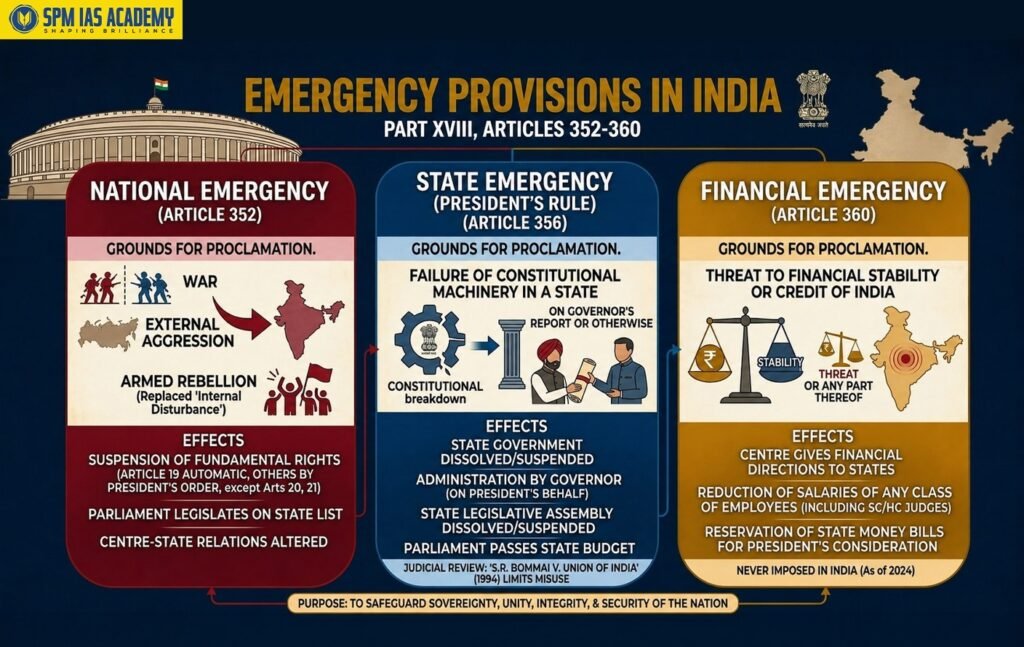
Emergency Provisions in India allow the government to take special powers during a national crisis. These provisions are given in Articles 352 to 360 of the Indian Constitution. They include three types of emergencies: National Emergency, State Emergency (President’s Rule), and Financial Emergency.
Moreover, these provisions can change the federal system into a more centralised system during difficult times. They affect fundamental rights, Centre-State relations, and governance. However, the Constitution also provides safeguards like parliamentary approval and judicial review to prevent misuse.
Therefore, understanding emergency provisions in India, their types, effects, and safeguards is very important for UPSC, APSC, and other competitive exams.
Explore top-quality coaching classes for UPSC & APSC in Assam for expert guidance and structured preparation.
Emergency Provisions in India: Overview and Constitutional Basis
The Indian Constitution is federal in normal times. However, it becomes unitary during an emergency. This is a unique feature of the Indian Constitution. Dr. B.R. Ambedkar called it a federation with a strong centralising tendency.
Part XVIII of the Indian Constitution covers emergency provisions. It runs from Article 352 to Article 360. The framers borrowed these provisions from the Government of India Act, 1935. They also took inspiration from the Weimar Constitution of Germany.
There are three types of emergencies in India:
- National Emergency – Article 352
- State Emergency (President’s Rule) – Article 356
- Financial Emergency – Article 360
Three Types of Emergencies at a Glance:
| Feature | National Emergency (Art. 352) | President’s Rule (Art. 356) | Financial Emergency (Art. 360) |
| Grounds | War, external aggression, armed rebellion | Failure of constitutional machinery in a state | Threat to financial stability of India |
| Proclaimed by | President on Cabinet’s written advice | President on Governor’s report or suo motu | President on Finance Ministry’s advice |
| Parliament approval | 1 month; Special majority | 2 months; Simple majority | 2 months; Simple majority |
| Maximum duration | No fixed limit; renewed every 6 months | 3 years (with conditions after 1 year) | No fixed limit; renewed every 6 months |
| Effect on states | Centre directs states on any matter | State legislature suspended or dissolved | Centre controls state finances |
| Proclaimed in India | 3 times (1962, 1971, 1975) | More than 100 times | Never proclaimed so far |
National Emergency Under Article 352
The President of India can declare a National Emergency. However, the Cabinet must send a written request first. The 44th Amendment Act of 1978 made this mandatory. It prevents any single person from misusing this power.
Grounds for National Emergency
A National Emergency can be declared on three grounds. These are
- War with a foreign country.
- External aggression by a foreign country.
- Armed rebellion within India (changed from ‘internal disturbance’ by the 44th Amendment).
Parliamentary Approval for National Emergency
Parliament must approve the proclamation within one month. Both Houses must pass it with a special majority. Special majority means two-thirds of members present and voting. It must also be a majority of the total membership of each House.
Effects of National Emergency
A National Emergency has far-reaching effects. It changes the entire structure of governance. Key effects include:
- The Centre can give directions to states on any subject.
- Moreover, Parliament can make laws on State List subjects.
- In addition, Fundamental Rights under Article 19 are automatically suspended.
- Furthermore, the President can modify the constitutional provisions on revenue sharing.
- The Lok Sabha term can be extended by one year at a time.
Revocation of National Emergency
The President can revoke a National Emergency. However, the Lok Sabha can also pass a resolution to revoke it. This is done by a simple majority. The 44th Amendment added this safeguard. It prevents misuse of emergency powers.
National Emergency: Instances in India
India has declared a National Emergency three times. Firstly, in 1962, the government declared an emergency during the India-China War. Moreover, in 1971, it declared another emergency during the India-Pakistan War. Finally, in 1975, Prime Minister Indira Gandhi declared a National Emergency on the grounds of internal disturbance. Therefore, these instances show how emergency provisions were used in different situations in India.
President’s Rule Under Article 356
President’s Rule is also called State Emergency. The President can impose it in a state. This happens when the constitutional machinery in a state breaks down. The Governor sends a report to the President. The President can also act without the Governor’s report.
Grounds for Imposing President’s Rule
- Firstly, failure of constitutional machinery in a state.
- Secondly, when no party or coalition can form a stable government.
- Thirdly, when the State government refuses to follow Central directives.
- Moreover, breakdown of law and order in the state.
Parliamentary Approval
Parliament must approve the President’s Rule within two months. Both Houses pass it with a simple majority. It is initially valid for six months. It can be extended up to three years with Parliament’s approval.
However, extension beyond one year requires two conditions:
- A National Emergency must already be in force in that state.
- The Election Commission must certify that elections cannot be held.
Effects of President’s Rule
- Firstly, the Governor runs the state on behalf of the President.
- Moreover, the state legislature is either suspended or dissolved.
- Additionally, Parliament makes laws for the state.
- Finally, the Council of Ministers in the state is dismissed.
Criticism and Sarkaria Commission
President’s Rule has been misused many times. It has been imposed more than 100 times in India. Many times, it was used to dismiss opposition state governments. The Sarkaria Commission (1983) criticised this misuse. The Supreme Court in the S.R. Bommai case (1994) set important limits. Now, courts can review the imposition of President’s Rule.
Financial Emergency Under Article 360
A Financial Emergency is declared under Article 360. It is declared when India’s financial stability is under threat. Fortunately, India has never declared a Financial Emergency so far.
Grounds for Imposition of Financial Emergency
The President can declare it when the financial credit or stability of India or any part of it is threatened.
Effects of Financial Emergency
- Firstly, the Centre directs states to follow strict financial propriety norms.
- Moreover, the Centre can reduce the salaries of both state and central government employees.
- Additionally, the Centre can even reduce the salaries of Supreme Court and High Court judges.
- Finally, all state money bills require the President’s approval before introduction.
Parliamentary Approval
Parliament must approve the Financial Emergency within two months. Both Houses pass it with a simple majority. Once approved, it continues until the President revokes it. There is no maximum time limit.
Key Constitutional Amendments Related to Emergency Provisions
| Amendment | Year | Key Change |
| 38th Amendment | 1975 | Made the President’s satisfaction final and non-justiciable. |
| 42nd Amendment | 1976 | Extended emergency provisions; added ‘armed rebellion’ alongside ‘war’. |
| 44th Amendment | 1978 | Strongest safeguard; replaced ‘internal disturbance’ with ‘armed rebellion’; Cabinet’s written advice made mandatory; Lok Sabha can revoke emergency by simple majority; Article 20 and 21 cannot be suspended even during emergency. |
Safeguards Against Misuse of Emergency Provisions in India
The Constitution has strong safeguards against emergency misuse. These safeguards protect democracy and federalism. Key safeguards are:
- The Cabinet must send written advice to the President before declaring National Emergency.
- Moreover, the Parliament must approve all emergencies within a fixed time period.
- Furthermore, Special majority is required for National Emergency approval.
- On the other hand, the Lok Sabha can revoke a National Emergency by a simple majority.
- Articles 20 and 21 (Right to Life and Protection Against Conviction) cannot be suspended even during an emergency.
- Judicial review is available — courts can check if emergency is valid (S.R. Bommai case).
- In addition, the 44th Amendment replaced ‘internal disturbance’ with ‘armed rebellion’ to prevent easy misuse.
Conclusion
In conclusion, emergency provisions in India play a crucial role in protecting the nation during crises. They allow the government to take strong actions under Articles 352, 356, and 360 of the Indian Constitution. Moreover, these provisions help maintain national security, constitutional order, and financial stability.
However, misuse of these powers can harm democracy and federalism. Therefore, the Constitution provides strong safeguards like parliamentary approval, judicial review, and constitutional amendments.
Furthermore, understanding the types of emergencies in India, their effects, and constitutional provisions is very important for exams and governance. As a result, students must clearly learn these concepts for UPSC, APSC, and other competitive exams.
Stay updated with daily insights through current affairs to strengthen your UPSC and APSC exam preparation.
Overall, emergency provisions in India balance power and responsibility. Hence, they ensure both national stability and protection of citizens’ rights.
Source:
Frequently Asked Questions:
Emergency provisions in India allow the central government to take special powers during a crisis. Moreover, they are defined under Articles 352 to 360 of the Indian Constitution.
There are three types of emergencies in India. These include National Emergency (Article 352), State Emergency (Article 356), and Financial Emergency (Article 360).
A National Emergency is declared during war, external aggression, or armed rebellion. Therefore, the central government gets more control over states.
President’s Rule is imposed when a state government fails to function properly. As a result, the President takes control of the state administration.
No, India has never declared a Financial Emergency so far. However, the Constitution allows it under Article 360 during financial instability.

Behind every article at SPM IAS Academy is a team of skilled content writers and subject experts committed to making preparation easier for aspirants. From answering common doubts to breaking down complex issues and current affairs, we create content that is accurate, easy to understand, and directly useful for UPSC, APSC, and other competitive exams.