BRICS is a group of major emerging economies. The name stands for Brazil, Russia, India, China, and South Africa. In recent years, the group has expanded significantly. As of 2026, BRICS has 10 full members and 10 partner countries. Understanding BRICS is very important for UPSC, APSC, and all State PCS exams.
This article covers the history, structure, expansion, key institutions, and latest developments of BRICS in simple language.
Explore expert guidance and structured preparation through UPSC & APSC coaching in Assam for better exam success.
BRICS: Meaning, Full Form, and Background
BRICS is an acronym. Each letter stands for a country. ‘B’ stands for Brazil. ‘R’ stands for Russia. ‘I’ stands for India. ‘C’ stands for China. ‘S’ stands for South Africa.
The idea of BRIC first came from Goldman Sachs economist Jim O’Neill. He used this term in 2001. He grouped these four fast-growing economies together. At that time, South Africa was not part of the group.
Later, these countries began meeting formally. The first BRIC Summit took place in Yekaterinburg, Russia, in 2009. South Africa joined in 2010. The group then became BRICS. It held its first full summit in 2011 in Sanya, China.
BRICS Expansion: From 5 Members to BRICS+
BRICS has grown rapidly in recent years. At the 2023 Johannesburg Summit, five new countries received invitations. Except Saudi Arabia, they joined as full members in January, 2024. Moreover, Indonesia joined in January, 2025. Let us look at this expansion step by step.
Original Members (BRICS)
- Brazil — founding member since 2009
- Russia — founding member since 2009
- India — founding member since 2009
- China — founding member since 2009
- South Africa — joined in 2010
New Full Members (BRICS+)
- Egypt – joined as full member in January 2024
- Ethiopia – joined as full member in January 2024
- Iran – joined as full member in January 2024
- United Arab Emirates (UAE) – joined as full member in January 2024
- Indonesia – joined in January 2025; first Southeast Asian member of BRICS
Though Saudi Arabia was invited to join BRICS membership, the country has not yet joined BRICS.
Partner Countries (as of 2025)
At the 2024 Kazan Summit, BRICS created a new category called partner countries. As of 2026, 10 nations received this status. They include Belarus, Bolivia, Cuba, Kazakhstan, Malaysia, Nigeria, Thailand, Uganda, Uzbekistan and Vietnam.
BRICS Member Countries at a Glance
| Country | Status | Year Joined | Key Significance |
| Brazil | Full Member | 2009 | Largest economy in South America; 2025 Chair |
| Russia | Full Member | 2009 | Permanent UNSC member; energy superpower |
| India | Full Member | 2009 | Fastest growing major economy; 2026 Chair |
| China | Full Member | 2009 | World’s second largest economy |
| South Africa | Full Member | 2010 | Only African founding member |
| Egypt | Full Member | 2024 | Suez Canal; gateway to Africa and Middle East |
| Ethiopia | Full Member | 2024 | Most populous landlocked country in the world |
| Iran | Full Member | 2024 | Major oil producer; sanctioned economy |
| UAE | Full Member | 2024 | Global financial hub in the Middle East |
| Indonesia | Full Member | 2025 | First Southeast Asian BRICS member; G20 member |
Objectives and Goals of BRICS
BRICS works on three main pillars. First, it focuses on political and security cooperation. Second, it promotes economic and financial cooperation. Third, it encourages people-to-people and cultural exchange.
The key objectives of BRICS are:
- Firstly, BRICS promotes the reform of global governance institutions like the UN, IMF, and World Bank.
- Moreover, it encourages trade and investment among member countries.
- Additionally, it works to reduce dependence on the US dollar in international trade.
- Furthermore, it supports sustainable development and climate action.
- In addition, it gives the Global South a stronger voice in world affairs.
- Finally, it develops alternatives to Western-dominated financial systems.
Key Institutions of BRICS
New Development Bank (NDB)
The New Development Bank is also called the BRICS Bank. BRICS members established it in 2014 at the Fortaleza Summit in Brazil. It started operations in 2016. Its headquarters is in Shanghai, China. Importantly, the NDB provides development finance to member countries. It focuses on infrastructure and sustainable development projects. Therefore, it is seen as an alternative to the World Bank.
BRICS Contingent Reserve Arrangement (CRA)
The CRA was also set up in 2014. It is a financial safety net. It provides short-term liquidity to BRICS members. Moreover, it protects them during a balance of payments crisis. Its total size is 100 billion US dollars. It is seen as an alternative to the IMF.
BRICS Payment System
BRICS members are working on a new payment system. It will reduce dependence on the SWIFT banking system. Furthermore, it will also encourage local currency trade among members. India’s RBI Governor stated in 2024 that India sees de-dollarisation as part of reducing risk in trade.
India and BRICS: Role, Importance, and Stand
- Firstly, India is one of the founding members of BRICS. Moreover, it plays a very active role in the group.
- Additionally, India uses BRICS as a platform to advance its national interests. It also pushes for a permanent seat in the UN Security Council.
- Furthermore, India promotes South-South cooperation and trade through BRICS.
- In addition, it supports the agenda of developing countries at the global level.
- Moreover, India strengthens its ties with Russia and other emerging economies.
- At the same time, India diplomatically balances China’s influence within the group.
- Importantly, India maintains an independent stance in BRICS. Therefore, experts describe its position as “pro-India.”
At the 17th BRICS Summit in Rio (July 2025), Prime Minister Narendra Modi announced that India will give a new direction to BRICS. As a result, India will chair BRICS in 2026 and host the 18th BRICS Leaders Summit.
BRICS Latest News and Developments 2024-2025
16th BRICS Summit, Kazan, Russia (October 2024)
- Russia hosted the 16th Summit in Kazan in October 2024
- Egypt, Ethiopia, Iran, and UAE participated as full members for the first time
- The new ‘partner country’ category was created at this summit
- Nine nations received partner country status
- PM Modi and President Xi Jinping held talks at Kazan; agreed to resume patrolling at the LAC
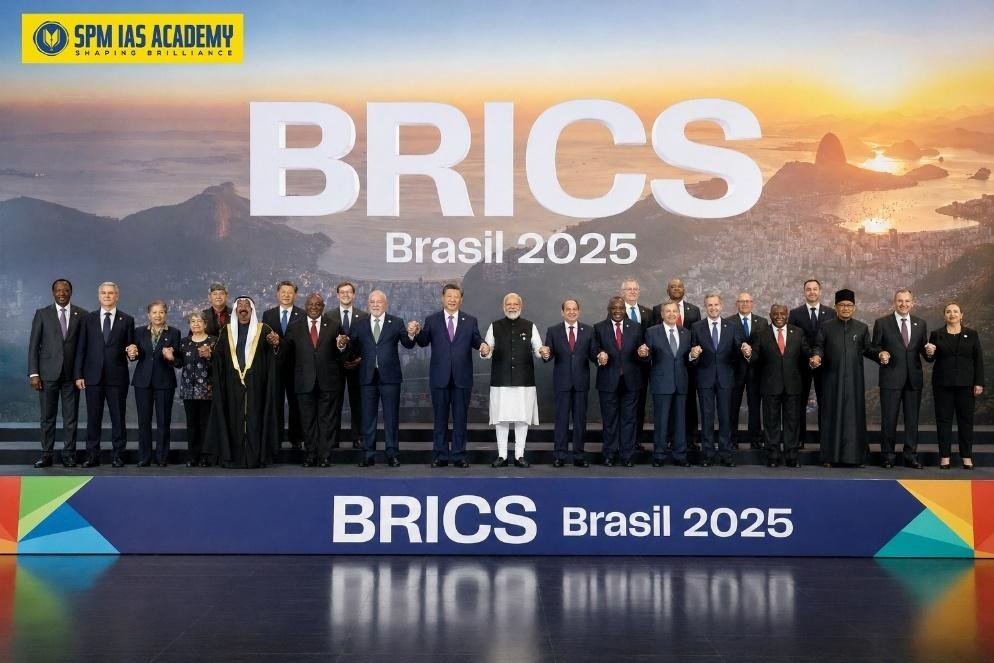
17th BRICS Summit, Rio de Janeiro, Brazil (July 2025)
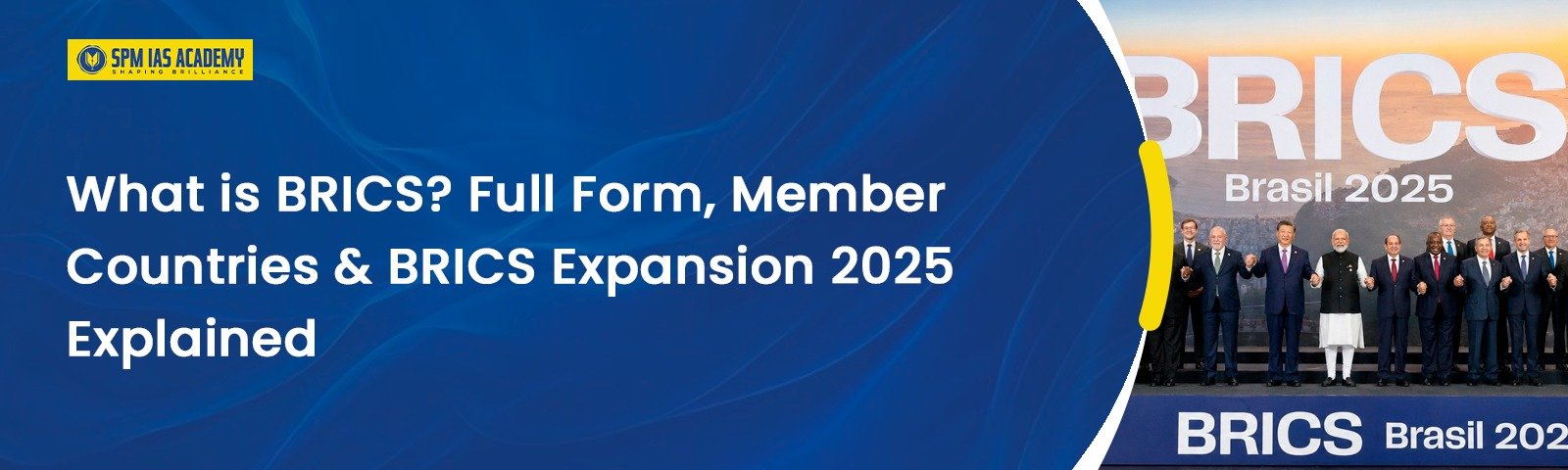
Brazil held the 17th BRICS Summit in Rio de Janeiro on 6-7 July 2025. The theme was ‘Strengthening Global South Cooperation and Promoting a More Inclusive and Sustainable Global Governance’.
Key outcomes of the 2025 Summit:
- Indonesia participated as a full member for the first time
- BRICS leaders condemned rising unilateral trade tariffs by the US
- Leaders adopted a declaration on global governance of Artificial Intelligence (AI)
- The group called on the UN to take the lead in formulating global AI rules
- Brazil pushed for BRICS institutional development and internal cohesion
- The declaration supported India and Brazil for a greater role in the UN Security Council
- India announced it will chair BRICS in 2026 and host the 18th Summit
Notably, Chinese President Xi Jinping and Russian President Vladimir Putin did not attend in person. Putin participated via video conference due to his ICC arrest warrant. Xi’s absence was the first time he missed a BRICS summit since 2012.
Stay updated with daily insights and exam-focused analysis through reliable current affairs for UPSC preparation.
BRICS Summits – Key Milestones
| Year | Summit Location | Key Outcome |
| 2009 | Yekaterinburg, Russia | First BRIC Summit; four founding members met formally |
| 2011 | Sanya, China | South Africa joined; group renamed BRICS |
| 2014 | Fortaleza, Brazil | New Development Bank (NDB) and CRA established |
| 2023 | Johannesburg, South Africa | Five new countries invited to join BRICS |
| 2024 | Kazan, Russia | Four new members joined; partner country category created |
| 2025 | Rio de Janeiro, Brazil | Indonesia’s first summit; AI governance declaration; India to chair in 2026 |
BRICS Global Significance: Economy and Population
- Firstly, BRICS is a powerful global bloc with strong economic influence.
- Moreover, it accounts for over 45% of global GDP at nominal value as of July 2025.
- Additionally, at Purchasing Power Parity (PPP), BRICS represents more than 50% of global GDP.
- Furthermore, BRICS countries together represent more than half of the world’s population.
- In addition, member countries control significant shares of global energy resources.
- Also, BRICS nations cover about 36% of the world’s total land area.
- Moreover, as of 2025, BRICS includes 10 full members and 10 partner countries.
Therefore, BRICS is now larger than the G7 in terms of economic size at PPP. As a result, it acts as a major counterweight to Western economic dominance.
Challenges Faced by BRICS
- Firstly, internal divisions create challenges within BRICS. For example, India and China have ongoing border disputes.
- Moreover, different political systems make coordination difficult. Democracies, authoritarian states, and theocracies coexist in the group.
- Additionally, BRICS does not have a common currency yet. This remains a challenge despite the push for de-dollarisation.
- Furthermore, external pressures affect the group. For instance, the US threatened extra tariffs on BRICS members in 2025.
- In addition, BRICS lacks a clear membership strategy or criteria. This creates uncertainty about future expansion.
- Also, Saudi Arabia has not formally accepted full membership yet. This delays further consolidation of the group.
- Finally, coordinating policies among 10 diverse countries is complex. Therefore, decision-making often becomes slow and difficult.
Conclusion
In conclusion, BRICS has become a powerful group of emerging economies in the world. It promotes economic cooperation, global governance reform, and development of the Global South. Moreover, with its recent expansion to BRICS+, the group now has greater global influence. Furthermore, BRICS institutions like the New Development Bank (NDB) and Contingent Reserve Arrangement (CRA) support financial stability and growth. Therefore, BRICS plays an important role in creating a more balanced and multipolar world order.
Overall, understanding BRICS, its members, expansion, objectives, and global significance is very important for UPSC, APSC, and other competitive exams.
Source:
Frequently Asked Questions:
BRICS is a group of major emerging economies. Moreover, it stands for Brazil, Russia, India, China, and South Africa.
As of 2026, BRICS has 11 full member countries. Furthermore, it also includes partner countries under the BRICS+ framework.
BRICS aims to promote economic cooperation, reform global governance, and support the Global South. Additionally, it focuses on trade, development, and financial stability.
The New Development Bank (NDB) is a financial institution created by BRICS. Therefore, it funds infrastructure and sustainable development projects.
BRICS is important because it represents a large share of global GDP, population, and resources. As a result, it helps create a multipolar world order.

Behind every article at SPM IAS Academy is a team of skilled content writers and subject experts committed to making preparation easier for aspirants. From answering common doubts to breaking down complex issues and current affairs, we create content that is accurate, easy to understand, and directly useful for UPSC, APSC, and other competitive exams.