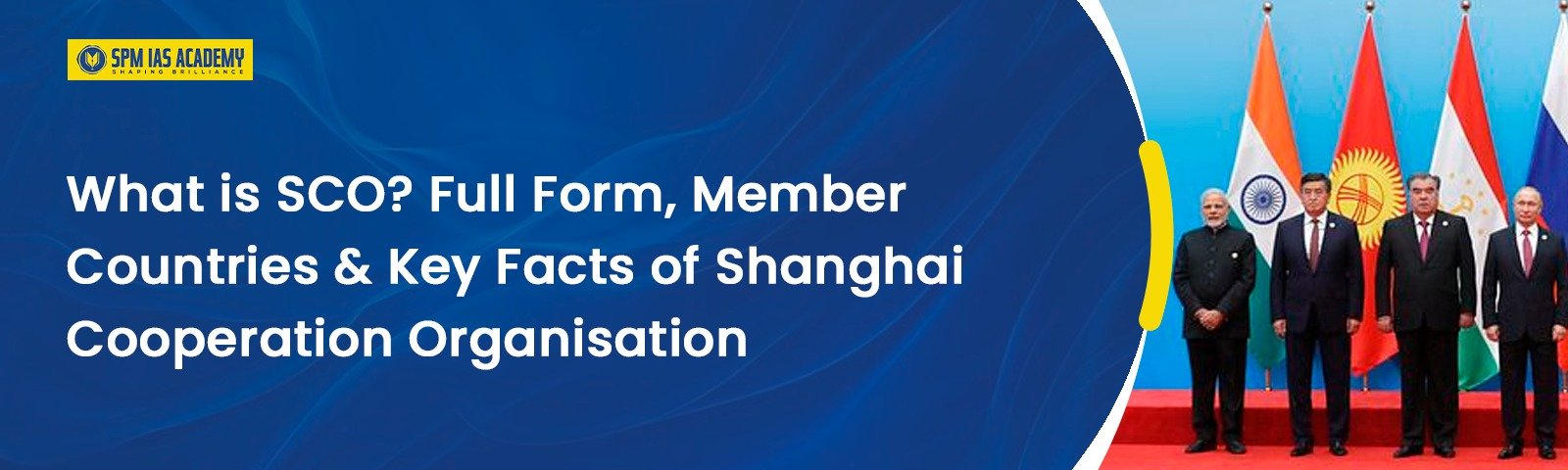
The Shanghai Cooperation Organisation (SCO) is one of the largest regional organisations in the world. It covers around 3.4 billion population and over 25% of global GDP. Moreover, the SCO focuses on security, economic cooperation, and cultural ties in the Eurasian region. It currently has 10 member states, and India became a full member in 2017. Therefore, understanding the SCO, its members, objectives, and global role is very important for UPSC, APSC, APPSC, and other State PCS exams.
For aspirants preparing for UPSC, APSC, and other State PCS exams, structured guidance is essential. Joining a reputed institute like SPM IAS Academy helps in building strong conceptual clarity, answer writing skills, and exam-focused preparation strategies.
Shanghai Cooperation Organisation (SCO): What Is It?
The Shanghai Cooperation Organisation (SCO) is a permanent regional intergovernmental organisation. Six countries founded it on 15 June 2001 in Shanghai, China. These founding members were Kazakhstan, China, Kyrgyzstan, Russia, Tajikistan, and Uzbekistan. Today, SCO has ten full member states and represents a powerful Eurasian grouping. The SCO Secretariat is headquartered in Beijing, China.
The SCO is not an alliance directed against any other state or region. Instead, it follows an open and inclusive approach. It cooperates with other international and regional organisations. The SCO covers a combined territory of about 36 million square kilometres. Its member states have a total population of over 3.4 billion people.
SCO Full Form and Key Facts at a Glance
- Full Form: Shanghai Cooperation Organisation.
- Founded: 15 June 2001, in Shanghai, China.
- Preceded by: The Shanghai Five (formed in 1996).
- SCO Charter signed: 7 June 2002, in St. Petersburg, Russia. Entered into force: 19 September 2003.
- Headquarters (Secretariat): Beijing, China.
- Regional Anti-Terrorist Structure (RATS) HQ: Tashkent, Uzbekistan.
- Official Languages: Chinese and Russian.
- Current Secretary-General: Nurlan Yermekbayev of Kazakhstan (since 1 January 2025).
- Total Member States: 10 (as of 2024).
- Combined Territory: About 36 million square kilometres.
- Combined Population: Over 3.4 billion people.
- Share of Global GDP: About 25 percent.
- Share of International Trade: Over 15 percent.
Origin of SCO: From Shanghai Five to Ten-Member Organisation
To begin with, the origins of SCO go back to 1996. China, Kazakhstan, Kyrgyzstan, Russia, and Tajikistan came together that year. They signed two important agreements on confidence-building in the military sphere. Moreover, they also agreed on the mutual reduction of armed forces in border areas. These agreements were historic for the Asian region. The five countries then formed a regular meeting mechanism called the Shanghai Five.
The Dushanbe Declaration of 4 July 2000 noted the need to transform the Shanghai Five into a regional multilateral organisation. Later that year, Uzbekistan joined the group. Therefore, all six countries met in Shanghai on 15 June 2001. They formally established the Shanghai Cooperation Organisation at that historic meeting. The SCO Charter was signed on 7 June 2002 at a summit in St. Petersburg, Russia. The Charter entered into force on 19 September 2003. The UN Secretariat registered it on 1 February 2013.
How Many Members Does SCO Have? Complete List of Members
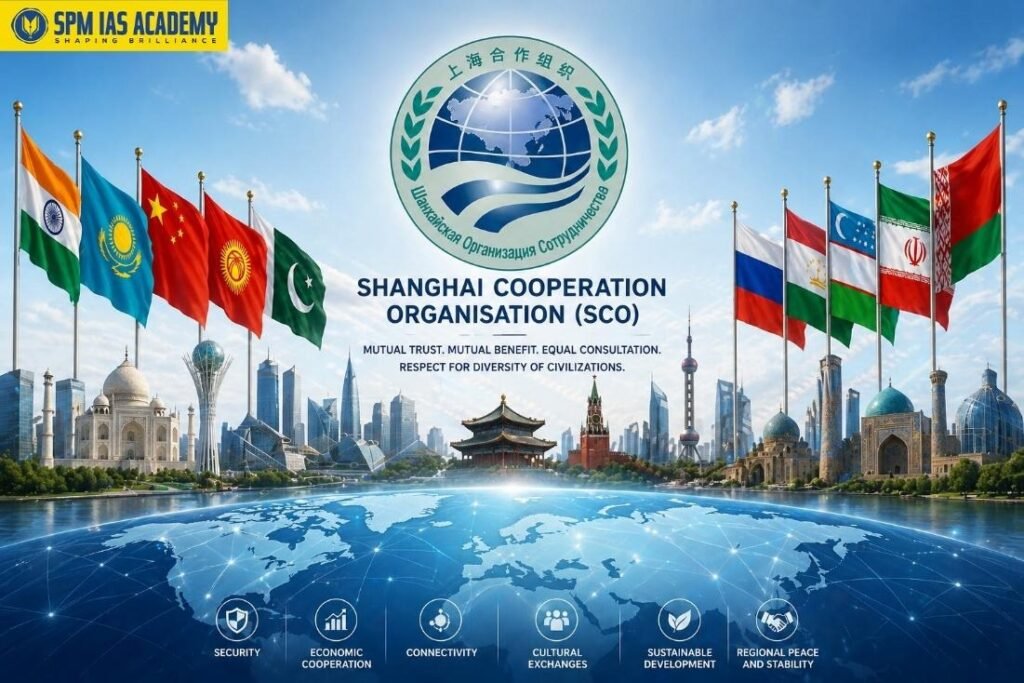
SCO has expanded steadily over the years. Today it has 10 full member states. The following is the complete list:
- China (Founding member, 2001)
- Russia (Founding member, 2001)
- Kazakhstan (Founding member, 2001)
- Kyrgyzstan (Founding member, 2001)
- Tajikistan (Founding member, 2001)
- Uzbekistan (Joined 2001, at the time of SCO’s founding)
- India (Joined as full member in 2017 at the Astana Summit, Kazakhstan)
- Pakistan (Joined as full member in 2017 at the Astana Summit, Kazakhstan)
- Iran (Joined as full member in 2023)
- Belarus (Joined as full member in 2024 at the Astana Summit)
In addition to full members, SCO has Observer States and Dialogue Partners. At the SCO Summit 2025 in Tianjin, these two categories were merged into a single category called SCO Partners. There are now 17 SCO Partners. Observers include Afghanistan and Mongolia. Dialogue Partners include Turkey, Sri Lanka, Saudi Arabia, UAE, Qatar, and others.
Main Goals and Objectives of the Shanghai Cooperation Organisation
The SCO Charter defines the main objectives of the organisation clearly. These goals guide all SCO activities:
- Firstly, member states strengthen mutual trust, friendship, and good-neighbourliness.
- Moreover, they promote multilateral cooperation to ensure peace, security, and regional stability.
- Additionally, they jointly address new challenges and threats such as terrorism, separatism, and extremism.
- Furthermore, they encourage effective and mutually beneficial cooperation in areas like politics, trade, economy, science, technology, culture, education, energy, transport, tourism, and environmental protection.
- In addition, they promote economic growth along with social and cultural development in the region.
- Also, they work towards building a democratic, fair, and rational international order.
- Finally, they support universally recognised principles of international law, including respect for sovereignty and non-interference in internal affairs.
The Three Evils: SCO’s Core Security Focus
SCO focuses especially on fighting what it calls the Three Evils. This is one of the most important concepts for competitive exams. The Three Evils are terrorism, separatism, and extremism. SCO member states cooperate closely to combat these threats. The Regional Anti-Terrorist Structure (RATS) is the key body for this purpose.
SCO established the RATS at the Tashkent Summit in June 2004. RATS is headquartered in Tashkent, Uzbekistan. It facilitates intelligence sharing and coordinates anti-terrorism operations among member states. SCO also conducts joint military exercises called Peace Mission drills. These exercises build the operational readiness of member nations to jointly fight terrorism.
SCO Organisational Structure: Key Bodies and Their Functions
The SCO has a well-defined organisational framework. The key bodies are:
1. Council of Heads of State (CHS)
The Council of Heads of State is the supreme decision-making body of SCO. It meets once every year. This annual meeting is known as the SCO Summit. Heads of all member states attend this summit. The summit sets priorities, resolves key issues, and adopts declarations.
2. Council of Heads of Government (Prime Ministers)
The Council of Prime Ministers discusses strategies for economic and humanitarian cooperation. It approves the budget and key financial matters of the organisation. This council also meets annually.
3. Other Important Bodies
- Council of Ministers of Foreign Affairs: Prepares meetings of the Council of Heads of State and handles external relations.
- SCO Secretariat (Beijing): The primary executive body. It coordinates activities, drafts documents, and promotes information about the SCO. The Secretary-General leads the Secretariat.
- Regional Anti-Terrorist Structure (RATS) (Tashkent): A permanent organ dedicated to combating terrorism, separatism, and extremism.
- SCO Business Council: A non-governmental body that promotes economic cooperation and trade among member states. Founded on 14 June 2006 in Shanghai.
- SCO University, SCO Youth Council, and SCO Women’s Forum: Bodies that promote cultural, educational, and people-to-people cooperation.
- The Chairmanship of SCO rotates annually among member states.
Current affairs play a very important role in UPSC and APSC exams. Regular updates help aspirants stay informed about international organisations, global events, and recent developments that are frequently asked in competitive examinations.
Shanghai Spirit: The Guiding Principles of SCO
The SCO follows a unique approach to international relations called the Shanghai Spirit. This set of core values guides all its activities and interactions.
- It includes mutual trust, mutual benefit, equality, consultation, respect for cultural diversity, and common development. Therefore, these principles play an important role in shaping modern international politics.
- Moreover, the SCO has developed a strong legal framework with more than 25 agreements and regulations. These cover areas such as privileges, budget procedures, and anti-terrorism measures.
- Additionally, the SCO became an observer in the United Nations General Assembly in 2004. It has also built cooperation with organisations like ASEAN, CSTO, and the Economic Cooperation Organization.
As a result, the SCO has strengthened its role in global and regional cooperation.
What Is the SCO Summit? Important Summits You Must Know
The SCO Summit is the annual meeting of heads of all member states. It is formally called the Meeting of the Council of Heads of State. The summit adopts key declarations and decides on the future direction of the organisation. Here are the most important summits for exam preparation:
- Shanghai Summit 2001: SCO formally established on 15 June 2001.
- St. Petersburg Summit 2002: SCO Charter signed. Also signed the Agreement on Regional Anti-Terrorist Structure.
- Tashkent Summit 2004: RATS formally established.
- Astana Summit 2017: India and Pakistan joined as full members.
- Qingdao Summit 2018: First summit with all eight members (including India and Pakistan).
- Dushanbe Summit 2021 and Samarkand Summit 2022: Key summits during global geopolitical shifts.
- New Delhi (Virtual) Summit 2023: India chaired SCO. Theme was SECURE SCO. Iran formally inducted as 9th member.
- Astana Summit 2024: Belarus admitted as the 10th member.
- Tianjin Summit 2025: 25th Meeting of the Council of Heads of State. Held in Tianjin, China. Adopted the Tianjin Declaration. PM Modi attended, marking his first visit to China in seven years. Observer and Dialogue Partner categories merged into a single SCO Partners category. 17 SCO Partners recognised.
Is India a Member of SCO? India’s Role and Importance
Yes, India is a full member of the Shanghai Cooperation Organisation. India first received Observer status at the Astana Summit in July 2005. It formally applied for full membership in 2014. The SCO officially started the accession process for India and Pakistan at the Ufa Summit in 2015. India then became a full member on 9 June 2017 at the Astana Summit in Kazakhstan.
Why SCO Is Important for India
- Counter-terrorism cooperation: RATS helps India address cross-border terrorism concerns. India pushes for strong SCO action against state-sponsored terrorism.
- Access to Central Asia: SCO provides India a multilateral platform to pursue its Connect Central Asia policy. India lacks direct land access to Central Asia due to Pakistan blocking transit routes.
- Energy security: Central Asian members like Kazakhstan, Turkmenistan, and Uzbekistan have large oil, gas, and uranium reserves. SCO helps India explore energy projects in the region.
- Economic and trade opportunities: SCO provides access to a large Eurasian market. India participates in the SCO Business Council and Business Forum.
- Multilateral diplomacy: SCO gives India a forum to engage directly with China and Russia together. It helps India maintain strategic autonomy.
- Cultural diplomacy: India promotes yoga, Buddhism, Ayurveda, and other soft-power initiatives within SCO. Varanasi was designated the first SCO Tourism and Cultural Capital.
- India chaired SCO in 2023 and hosted the summit virtually under the theme SECURE SCO.
Challenges India Faces in SCO
- India-Pakistan tensions: Both countries are SCO members. Bilateral tensions often affect discussions on terrorism and regional stability.
- China-Pakistan alignment: China and Pakistan often coordinate positions within SCO. This limits India’s ability to push certain agendas.
- BRI/CPEC issue: India consistently refuses to endorse China’s Belt and Road Initiative (BRI) in SCO joint statements. India cites sovereignty concerns over the China-Pakistan Economic Corridor (CPEC) passing through Pakistan-occupied Kashmir (PoK).
- No direct land access: Pakistan blocks India’s land transit routes to Central Asia. This limits India’s connectivity benefits from SCO.
- Consensus-based decision-making: SCO decisions require consensus. This often leads to watered-down outcomes on sensitive issues.
Significance of SCO in Global Politics
- SCO represents a significant share of global geography, population, and economy. Together its members cover about 40 percent of the world’s population and nearly 25 percent of global GDP.
- SCO promotes multipolarity. It supports a democratic, fair, and rational new international order. This makes it a counterpart to Western-led institutions.
- SCO has expanded from 6 to 10 member states over two decades. This growth shows its rising importance in global politics.
- SCO bridges East Asia, South Asia, Central Asia, and parts of the Middle East and Eastern Europe under one framework.
- SCO is an observer in the UN General Assembly. It has formal ties with ASEAN, CSTO, and other major international organisations.
- The COVID-19 pandemic highlighted the importance of regional cooperation in health and supply chains. SCO has taken up such new areas of cooperation.
Conclusion
In conclusion, the Shanghai Cooperation Organisation (SCO) has emerged as a major regional body that promotes security, economic cooperation, and cultural ties across Eurasia. It follows the Shanghai Spirit, which emphasises mutual trust, equality, and shared development. Moreover, SCO plays a key role in addressing global challenges like terrorism, extremism, and regional instability.
Furthermore, with expanding membership and strong cooperation with global organisations, the SCO’s global role continues to grow. Therefore, it contributes to building a multipolar world order and strengthening international cooperation.
Overall, understanding the Shanghai Cooperation Organisation, its members, objectives, and significance is very important for UPSC, APSC, and other competitive exams.
Choosing the right institute also plays a key role in consistent preparation. Expert mentorship and regular practice sessions help candidates stay focused and improve their chances of success in competitive exams like APSC UPSC coaching in Guwahati.
Source:
Frequently Asked Questions
The Shanghai Cooperation Organisation (SCO) is a regional intergovernmental organisation. Moreover, it promotes security, economic cooperation, and cultural ties among member countries.
The SCO currently has 10 member states. Furthermore, countries like India, China, Russia, and Iran are important members.
The SCO aims to promote peace, security, and regional stability. Additionally, it focuses on economic growth and cooperation among member states.
The SCO aims to promote peace, security, and regional stability. Additionally, it focuses on economic growth and cooperation among member states.
The Shanghai Spirit is the guiding principle of SCO. It includes mutual trust, equality, cultural respect, and common development.