India-Bangladesh relation is one of the most important partnerships in South Asia. Recently, foreign policy experts described this bond as “Golgappa Diplomacy” or “Fuchka Diplomacy”. This term reflects a sweet and tangy relationship that helps both countries maintain warmth even during challenges.
Moreover, India and Bangladesh share historical ties, cultural connections, and a long land border. They actively cooperate in areas like trade, connectivity, security, and water sharing. Moreover, Bangladesh has a crucial role in India’s Neighbourhood First Policy, Act East Policy, SAGAR doctrine and the development of the northeastern region of India.
In recent years, both countries have strengthened ties through infrastructure projects, energy cooperation, and regional initiatives. Therefore, India-Bangladesh relations play a key role in regional stability, economic growth, and neighbourhood diplomacy.
Hence, understanding India-Bangladesh relations, key agreements, challenges, and recent developments is very important for UPSC, APSC, and other competitive exams.
India Bangladesh Relations: A Historical Overview
India and Bangladesh share a unique bond deeply rooted in history, culture, and geography. It is widely known that India played a decisive role in the liberation of Bangladesh in 1971. The Indian Army actively helped Bangladesh gain independence from Pakistan. Since then, the two nations have built a strong foundation of friendship and cooperation.
Both countries share a 4,096.7 km long border, making it one of the longest land borders in the world. Among the neighbours, India shares the longest international border with Bangladesh. Moreover, they share rivers, language, and cultural heritage. As a result, India Bangladesh diplomatic relations have grown stronger over the decades.
Students preparing for international relations can join the best upsc coaching in north east india for expert guidance.
India Bangladesh Bilateral Relations: Key Pillars
India Bangladesh bilateral relations rest on several important pillars. These pillars include political diplomacy, trade and economic cooperation, security cooperation, water sharing, connectivity, and cultural exchange. Moreover, the issue of illegal migrants also dominates the table while we discuss India Bangladesh relations. Together, these pillars make the relationship one of the most dynamic in South Asia.
India Bangladesh Diplomatic Relations
India and Bangladesh maintain strong diplomatic ties. High-level meetings between the two governments happen regularly. After the Bangladesh Liberation War, 1971, India was among the first countries to recognize Bangladesh as an independent nation in 1971. Furthermore, both countries are active members of SAARC and BIMSTEC. They also cooperate closely within the Bay of Bengal Initiative.
India Bangladesh diplomatic relations received a major boost when India and Bangladesh signed the Land Boundary Agreement (LBA) in 2015. This agreement finally resolved the long-standing border dispute and exchanged over 160 enclaves between the two countries. Therefore, the LBA stands as a landmark achievement in India Bangladesh bilateral relations.
India Bangladesh Trade Relations
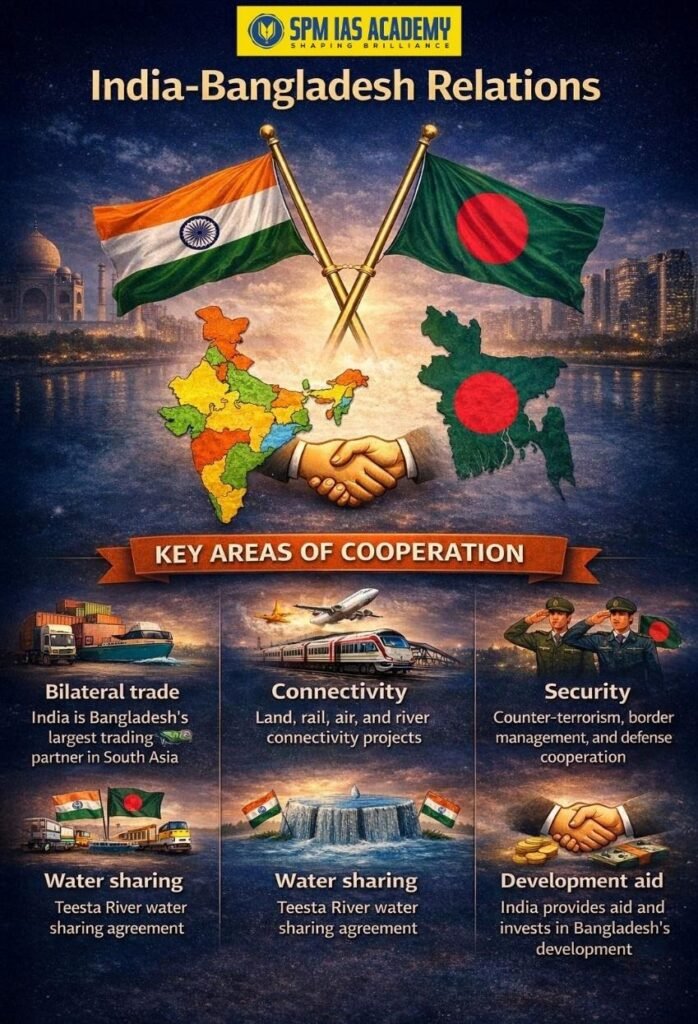
India Bangladesh trade relations have grown significantly over the years. Bangladesh is India’s largest trade partner in South Asia. India exports goods worth billions of dollars to Bangladesh every year. Bilateral trade between India and Bangladesh exceeded US $13.5 billion in Financial Year 2025. Moreover, India exports cotton, machinery, iron and steel, vehicles, and chemical products to Bangladesh.
On the other hand, Bangladesh exports garments, jute products, leather goods, and seafood to India. However, the trade balance remains heavily in favour of India. Consequently, Bangladesh has consistently raised concerns about the trade deficit. India has responded by giving duty-free access to most Bangladeshi goods under the South Asian Free Trade Area (SAFTA) framework.
In addition, India extended a Line of Credit (LoC) worth USD 7.36 billion to Bangladesh for infrastructure projects. This is the largest LoC India has given to any country. These funds support railway, road, port, and energy projects in Bangladesh.
Connectivity Between India and Bangladesh
Another important dimension in India Bangladesh relations is Connectivity. It is a major area of progress in India Bangladesh trade relations. Both countries have restored train services, including the Maitree Express and Bandhan Express. Moreover, India and Bangladesh launched the Haldibari-Chilahati rail link in 2020 after a gap of over 55 years. The Akhaura-Agartala rail link further strengthens northeast India’s connectivity.
Both countries also cooperate on inland waterways. They use the Protocol on Inland Water Transit and Trade (PIWTT). This agreement allows goods from India’s northeast to pass through Bangladesh by river, which reduces transportation costs and time.
India Bangladesh Cultural Relations
India Bangladesh cultural relations are deep and longstanding. Both nations share the Bengali language and literary heritage. Notably, the works of Rabindranath Tagore connect millions of people across both countries. The national anthem of Bangladesh, Amar Sonar Bangla, was written by Tagore. Therefore, culture forms a strong bridge between the two nations.
Both countries actively promote people-to-people contacts. India offers scholarships to Bangladeshi students through ICCR (Indian Council for Cultural Relations). Educational exchanges, cultural festivals, and joint programs strengthen India Bangladesh cultural relations further.
Medical tourism also plays an important role. Thousands of Bangladeshi patients travel to India every year for medical treatment. As a result, India remains one of the top destinations for Bangladeshi medical tourists. This further deepens the people-to-people bond.
Water Sharing and River Disputes Between India and Bangladesh
Water sharing is one of the most sensitive issues in India Bangladesh relations. Both countries share over 54 common rivers. The Teesta River water-sharing agreement remains the most contentious unresolved issue between the two nations. India and Bangladesh almost finalised a Teesta River water-sharing deal in 2011. However, West Bengal Chief Minister Mamata Banerjee opposed the deal, and it has remained pending ever since.
On the positive side, India and Bangladesh signed the Ganga Water Treaty in 1996. This treaty regulates the sharing of Ganga River waters at the Farakka Barrage point. Both countries renewed this treaty in 2026 for another 30 years, which marked a significant milestone in bilateral water cooperation.
India Bangladesh Security Cooperation
Security cooperation forms another crucial aspect of India Bangladesh bilateral relations. Both countries cooperate closely to combat terrorism, insurgency, and transnational crime. Bangladesh has helped India by handing over several northeastern insurgent leaders who had taken shelter in Bangladesh.
The Border Security Force (BSF) of India and Border Guard Bangladesh (BGB) conduct regular coordination meetings. These meetings address issues like border killings, smuggling, and illegal migration. Furthermore, both countries cooperate on cybersecurity and maritime security in the Bay of Bengal.
India Bangladesh Relations: Recent Issues and Problems
Despite the strong relationship, India Bangladesh relations face several recent issues and challenges. Understanding these problems is extremely important for UPSC and state PCS exam preparation.
Political Transition in Bangladesh (2024) and Its Impact on India
In August 2024, Bangladesh witnessed a major political upheaval. Mass student protests led to the resignation and exile of Prime Minister Sheikh Hasina, who fled to India. Subsequently, the Bangladesh Nationalist Party (BNP) and Jamaat-e-Islami gained political influence. An interim government, led by Nobel laureate Muhammad Yunus, took charge of Bangladesh.
This political transition created uncertainty in India Bangladesh relations. India shared warm ties with Sheikh Hasina’s Awami League government. However, the new interim government has taken a more cautious approach toward India. Anti-India sentiments surfaced in parts of Bangladesh after the change in power.
Attacks on Hindu Minorities in Bangladesh
Reports of attacks on Hindu minorities in Bangladesh emerged after the political transition in 2024. Hindu temples, homes, and businesses faced attacks in several parts of Bangladesh. India expressed serious concern over the safety of the minority community. The Indian government urged Bangladesh to protect the rights of its Hindu citizens.
The Teesta River Water Sharing Dispute
The Teesta water-sharing dispute continues to be a major irritant in India Bangladesh relations. Bangladesh urgently needs Teesta waters for irrigation during the dry season. India has not been able to finalise the agreement because of domestic political opposition, especially from West Bengal. China has offered to help Bangladesh with the Teesta river management project, which adds a geopolitical dimension to this issue.
India Bangladesh Relations: Recent Developments (2024-2025)
Several important developments have taken place in India Bangladesh relations in 2024 and 2025.
- India and Bangladesh continued high-level diplomatic consultations despite political changes in Dhaka.
- The Akhaura-Agartala cross-border rail link became fully operational, connecting Tripura with Bangladesh’s rail network.
- Bangladesh continued to be one of the largest recipients of Indian development assistance in South Asia.
- Power cooperation intensified, with India supplying over 1,160 MW of electricity to Bangladesh through transmission lines.
- Both countries signed new agreements under BIMSTEC to enhance sub-regional cooperation.
- India renewed the Ganga Water Treaty with Bangladesh for another 30 years, reinforcing long-term cooperation on shared rivers.
Stay updated with daily currentaffairs to understand the latest India-Bangladesh diplomatic developments and international relations topics.
Conclusion:
In conclusion, India-Bangladesh relations continue to evolve as one of the most important partnerships in South Asia. Over the time, both countries have strengthened cooperation in trade, connectivity, security, and cultural exchange. Moreover, agreements like the Land Boundary Agreement and Ganga Water Treaty highlight their commitment to peaceful collaboration.
However, challenges such as the Teesta water dispute, political changes in Bangladesh, and border issues still require careful management. Therefore, both nations must focus on dialogue, trust-building, and mutual respect to sustain long-term cooperation.
Overall, understanding India–Bangladesh bilateral relations, key agreements, recent developments, and challenges is very important for UPSC, APSC and other State PCS exams. Hence, strong India-Bangladesh relations remain essential for regional stability, economic growth, and neighbourhood diplomacy.
Source:
Assistant High Commission of India
Frequently Asked Questions:
India–Bangladesh relations refer to the bilateral ties between India and Bangladesh. Moreover, both the countries
cooperate in areas like trade, connectivity, security, and cultural exchange.
India–Bangladesh relations are important because they promote regional stability, economic growth, and neighbourhood diplomacy. Therefore, they play a key role in South Asia.
The Land Boundary Agreement (2015) resolved long-standing border disputes between India and Bangladesh. Under this agreement, both countries exchanged enclaves and improved border management.
India-Bangladesh relations face challenges like the Teesta water dispute, illegal migration, and political changes in Bangladesh. Moreover, it is reported that many insurgency groups of Northeast India are sheltering in Bangladesh. This also creates gaps in their bilateral relations. Therefore, both countries must manage these issues carefully.
“Golgappa Diplomacy” describes the friendly and flexible nature of India–Bangladesh ties. Moreover, it highlights how both countries maintain warmth even during difficult times.
Yes, Bangladesh maintains strong and friendly relations with India. Bangladesh is India’s largest trading partner in South Asia. Moreover, both countries cooperate in trade, connectivity, security, and cultural exchange. However, some issues still require careful handling.
India supports Bangladesh to ensure regional stability, economic growth, and strategic cooperation. Moreover, strong India–Bangladesh relations benefit both countries in trade, security, and connectivity.
The Teesta River water-sharing dispute remains the major issue between India and Bangladesh. Additionally, concerns like border management and illegal migration also affect relations.
India maintains close relations with countries like the United States, France, Russia, Japan, and Bangladesh. Moreover, India also strengthens ties through groups like QUAD and BRICS.

Behind every article at SPM IAS Academy is a team of skilled content writers and subject experts committed to making preparation easier for aspirants. From answering common doubts to breaking down complex issues and current affairs, we create content that is accurate, easy to understand, and directly useful for UPSC, APSC, and other competitive exams.