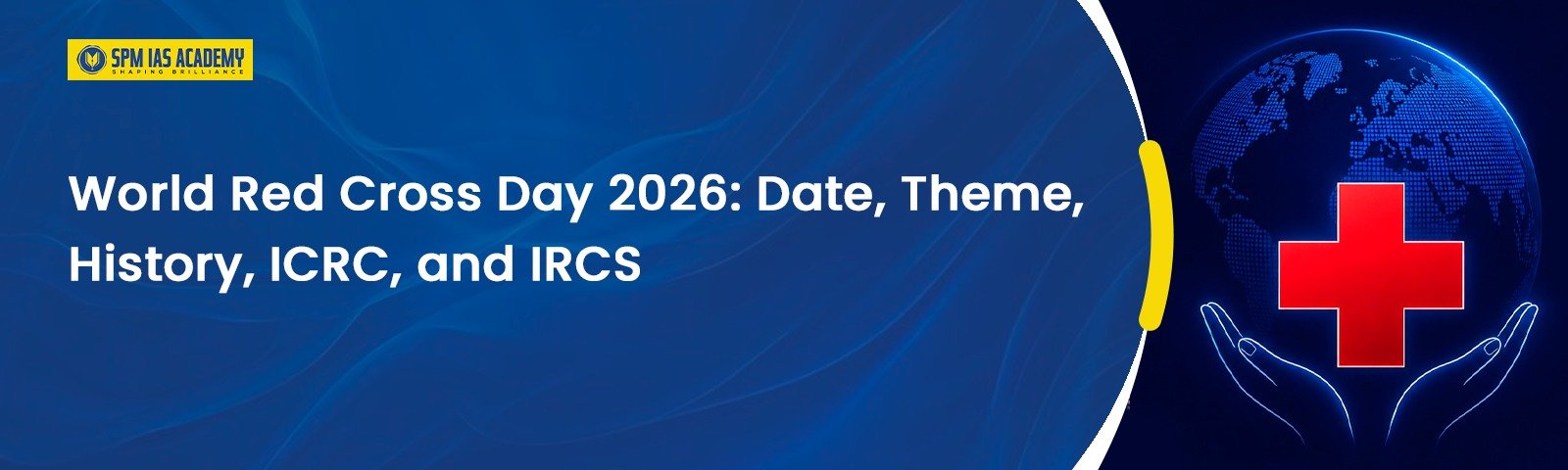
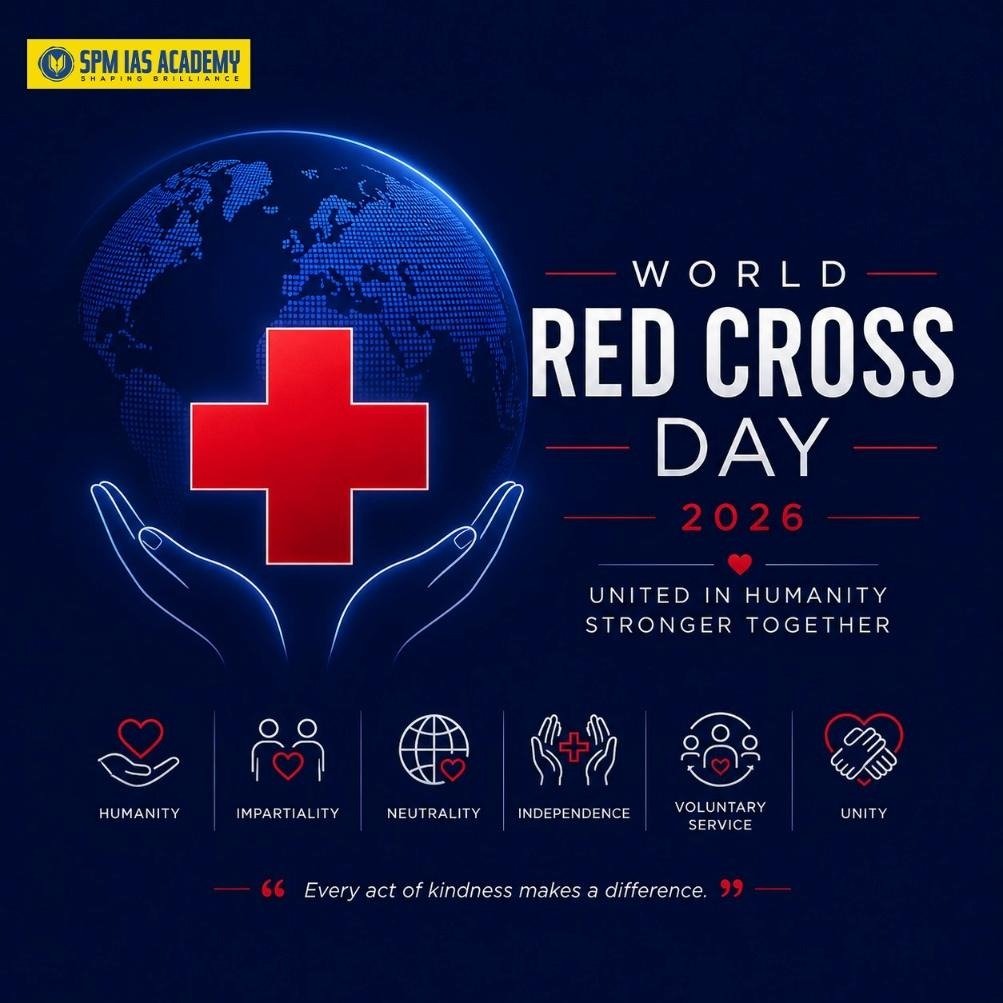
World Red Cross Day is observed every year on 8th May. It honours the birth anniversary of Henry Dunant, the founder of the International Committee of the Red Cross (ICRC). World Red Cross Day 2026 carries the theme ‘Keeping Humanity Alive.’
This article covers the full history, significance, 2026 theme, key facts about the ICRC, and important notes for UPSC, APSC, and all state PCS exams.
World Red Cross Day: Date and Basic Facts
World Red Cross Day falls on 8th May every year. The full official name is World Red Cross and Red Crescent Day. The day celebrates the values of humanity, compassion, and voluntary service. Moreover, it also recognises the millions of volunteers and staff who work tirelessly around the world.
The Red Cross and Red Crescent Movement operates in more than 190 countries. It is one of the largest humanitarian networks in the world. Therefore, World Red Cross Day has great global importance. It reminds every citizen of the duty to help others in times of need.
What Is World Red Cross Day? History and Origin
World Red Cross Day is an annual global observance dedicated to recognising the humanitarian work of the Red Cross and Red Crescent Movement. It celebrates volunteers, field workers, and professionals who serve humanity in the most difficult conditions.
The day has its roots in the life and work of Henry Dunant. He was a Swiss businessman and social activist. In June 1859, Dunant witnessed the brutal Battle of Solferino in northern Italy. Tens of thousands of soldiers lay wounded on the battlefield with no medical help. Dunant was deeply moved by this tragedy.
After this experience, Dunant took decisive action. He organised local volunteers to provide care to the wounded soldiers. He did not discriminate between friend and foe. This act of humanity planted the seed of the Red Cross Movement. As a result, Dunant wrote a book called ‘A Memory of Solferino’ in 1862. The book proposed the creation of a permanent international relief organisation.
Consequently, the International Committee of the Red Cross was founded in 1863. The first Geneva Convention was also adopted in 1864. World Red Cross Day was officially established in 1948 to commemorate Dunant’s birthday on 8th May 1828.
Henry Dunant: Father of the Red Cross Movement
Henry Dunant was born on 8th May 1828 in Geneva, Switzerland. He was the co-founder and driving force behind the International Committee of the Red Cross. Additionally, Dunant became the first-ever Nobel Peace Prize winner in 1901. He shared the prize with French peace activist Frederic Passy.
Dunant’s life teaches us that one person with a strong humanitarian vision can change the world. His work continues to save millions of lives even today. For this reason, World Red Cross Day is observed on his birthday to honour his legacy.
World Red Cross Day 2026 Theme: Keeping Humanity Alive
The theme for World Red Cross Day 2026 is ‘Keeping Humanity Alive.’ This powerful theme reflects the urgent need for humanitarian action in today’s world. Natural disasters, armed conflicts, and health emergencies are increasing in number and intensity.
The 2026 theme reminds the world of the essential role played by Red Cross and Red Crescent volunteers. These men and women put themselves in danger to protect others. They operate in conflict zones, disaster areas, and disease-hit regions. Furthermore, they provide medical care, food, shelter, and emotional support to those who need it most.
The theme ‘Keeping Humanity Alive’ also highlights the values of compassion, solidarity, and impartiality. It sends a clear message: no matter what crisis arises, humanity must always find a way to care for one another.
Regularly reading current affairs helps aspirants stay updated with important humanitarian and international developments for competitive exams.
Previous Themes of World Red Cross Day
Tracking past themes helps in understanding the evolution of humanitarian priorities. Here are some recent themes of World Red Cross Day:
- 2025: Keeping Humanity Alive
- 2024: I Give With Joy, I Am Alive
- 2023: Everything We Do Comes From The Heart
- 2022: Be Human Kind
International Committee of the Red Cross (ICRC): All You Need to Know
The International Committee of the Red Cross (ICRC) is the founding organisation of the global Red Cross Movement. It was established in 1863 in Geneva, Switzerland. The ICRC is a neutral, impartial, and independent humanitarian organisation.
The ICRC’s main role is to protect the lives and dignity of victims of armed conflict and other violence. It also promotes and strengthens humanitarian law, including the Geneva Conventions. Furthermore, the ICRC coordinates relief operations in crisis zones around the world.
Key Facts About the ICRC
Here are the most important facts about the International Committee of the Red Cross:
- Founded: 1863, Geneva, Switzerland
- Founded by: Henry Dunant and four other Geneva citizens
- Headquarters: Geneva, Switzerland
- Legal basis: Based on the four Geneva Conventions of 1949
- Emblems used: Red Cross, Red Crescent, and Red Crystal
- Mandate: Protection and aid to victims of armed conflicts and disasters
- Members of the International Movement: ICRC + 191 National Societies
- Nobel Peace Prize: The ICRC has won the Nobel Peace Prize three times – in 1917, 1944, and 1963
Structure of the International Red Cross and Red Crescent Movement
The International Red Cross and Red Crescent Movement has three main components. Together, they form the world’s largest humanitarian network.
- The first component is the ICRC. It leads humanitarian work in conflict zones.
- The second component is the International Federation of Red Cross and Red Crescent Societies (IFRC). It coordinates disaster response and development activities globally.
- The third component is the National Red Cross and Red Crescent Societies. There are 191 such national societies, and each one works in its own country.
What are the Seven Fundamental Principles of the Red Cross Movement?
The Red Cross and Red Crescent Movement operates on seven core principles. These principles guide all its actions and decisions. Every volunteer and worker must follow these principles.
Here are the seven fundamental principles:
- Humanity: The movement aims to prevent and relieve human suffering without discrimination.
- Impartiality: It helps people solely based on need, without any discrimination.
- Neutrality: The movement does not take sides in conflicts or political debates.
- Independence: It remains independent from governments and other authorities.
- Voluntary Service: It is a voluntary relief movement not driven by profit.
- Unity: Only one Red Cross or Red Crescent society exists in each country.
- Universality: The movement is worldwide, and all national societies have equal status.
These seven principles ensure that the Red Cross serves all people fairly. They also ensure that politics and personal interests never interfere with humanitarian work.
Indian Red Cross Society (IRCS): Role and Importance
- The Indian Red Cross Society (IRCS) is India’s national Red Cross organisation. It was founded in 1920 under the Indian Red Cross Society Act. The IRCS plays a vital role in disaster relief, blood donation, first aid training, and public health promotion across India.
- The IRCS has a clear leadership structure. The President of India serves as the President of the Indian Red Cross Society. The Union Health Minister serves as its Chairman. This strong government backing allows the IRCS to respond swiftly to national emergencies.
- The IRCS collaborates with state and district branches all over India. It also works closely with international bodies like the ICRC and IFRC. Thus, the IRCS forms a critical link between global humanitarian work and local community service.
What are the key activities of the Indian Red Cross Society?
The Indian Red Cross Society carries out several humanitarian activities across India.
- Firstly, the organization provides disaster relief during floods, earthquakes, cyclones, and other natural calamities. It supplies food, shelter, medical aid, and rescue support to affected people.
- Moreover, the society organizes blood donation camps and manages blood banks across the country to ensure timely medical support.
- In addition, the Indian Red Cross Society conducts first aid training programmes for volunteers and ordinary citizens. These programmes improve emergency response skills during accidents and disasters.
- Furthermore, the organization runs health awareness campaigns on disease prevention, sanitation, hygiene, and public health.
- The society also supports refugees, migrants, and displaced people during humanitarian crises and emergencies.
- Meanwhile, its tracing services help reconnect families separated during conflicts, disasters, or migration.
Therefore, the Indian Red Cross Society plays a major role in humanitarian assistance and disaster management in India.
Conclusion:
In conclusion, World Red Cross Day reminds the world about the importance of humanity, compassion, and voluntary service. Moreover, organizations like the International Committee of the Red Cross and the Indian Red Cross Society continue to save lives during disasters, conflicts, and health emergencies. The theme “Keeping Humanity Alive” highlights the need for collective humanitarian action in today’s crisis-driven world. Therefore, understanding topics like World Red Cross Day 2026 is highly important for UPSC, APSC, and other State PCS examinations.
Students preparing for civil services can explore apsc upsc coaching in guwahati for expert guidance and preparation.
Source:
Frequently Asked Questions:
World Red Cross Day is celebrated every year on 8th May. This day honours the birth anniversary of Henry Dunant, who was the founder of the Red Cross Movement.
The theme of World Red Cross Day 2026 is “Keeping Humanity Alive.” The theme highlights the importance of compassion, humanitarian service, disaster relief, and global solidarity during crises and emergencies.
The International Committee of the Red Cross protects victims of armed conflicts and humanitarian crises. Moreover, it provides medical aid, emergency relief, and support for affected populations while promoting international humanitarian law and the Geneva Conventions.
The Indian Red Cross Society conducts disaster relief operations, blood donation camps, first aid training, health awareness programmes, and humanitarian support for migrants and refugees. Furthermore, it helps reconnect families separated during conflicts and disasters.
World Red Cross Day is observed on 8th May to honour the birth anniversary of Henry Dunant. He founded the Red Cross Movement after witnessing the suffering of wounded soldiers during the Battle of Solferino in 1859. Therefore, the day recognises his humanitarian vision and contribution to global relief work.