
When is National Endangered Species Day 2026?
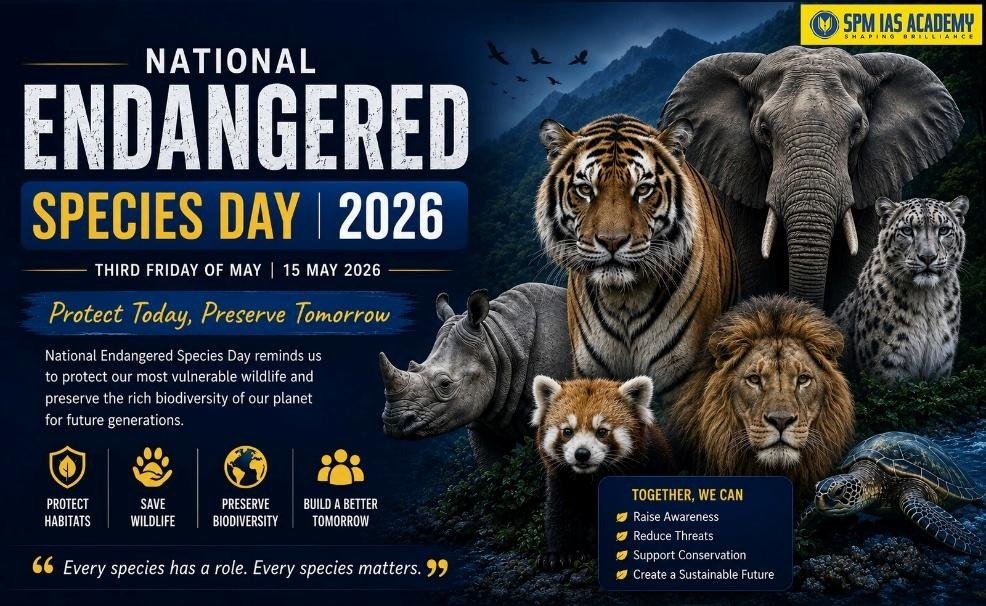
National Endangered Species Day is celebrated on the third Friday of May in every year. This year, the National Endangered Species Day 2026 falls on Friday, 15 May 2026. This day raises awareness about endangered species across the world. It also celebrates wildlife conservation efforts and encourages people to protect biodiversity.
For UPSC, APSC, and State PCS aspirants, National Endangered Species Day is an important topic. It links environment and ecology with current affairs. This article covers everything you need to know about this day.
What is National Endangered Species Day?
National Endangered Species Day is an annual observance. It highlights the importance of protecting endangered animals, plants, and marine species. An endangered species is a plant or animal at serious risk of extinction. When all members of a species die, we loss the species forever. Therefore, protecting these species is very important for our planet.
The IUCN Red List currently identifies more than 44,000 species as threatened with extinction. This number continues to rise every year. National Endangered Species Day reminds us to take action before it is too late.
History of National Endangered Species Day
National Endangered Species Day was first observed in 2006. The Endangered Species Coalition launched this observance in the United States. The US Senate passed a resolution to support this day. Since then, it has grown into a worldwide event every year. In 2026, it marks its 21st annual celebration.
The day closely relates to the US Endangered Species Act (ESA) of 1973. President Richard Nixon signed this landmark law on 28 December 1973. The ESA protects over 1,680 species in the United States alone. It is one of the most effective conservation laws in history. Fewer than 1% species of the list have gone extinct since the passing of ESA.
Important Milestones in the History of Endangered Species Protection
- 1948: IUCN (International Union for Conservation of Nature) was founded in Fontainebleau, France.
- 1963: IUCN published the first IUCN Red List to classify species at risk of extinction.
- 1973: The US Congress passed the Endangered Species Act (ESA) – a landmark conservation law.
- 1973: CITES (Convention on International Trade in Endangered Species) was adopted in Washington D.C.
- 2006: US Congress designated the third Friday in May as National Endangered Species Day.
What is the theme of National Endangered Species Day 2026?
The 2026 theme for National Endangered Species Day is — “Celebrating America’s Wildlife Comeback Stories. Championing the Endangered Species Act.”
This theme focuses on successful wildlife recovery stories made possible by the ESA. Species like the southern sea otter, whooping crane, and American alligator have recovered. These success stories show that strong laws and community action can save wildlife. The theme also encourages people to defend the Endangered Species Act.
Why is National Endangered Species Day Important?
- National Endangered Species Day raises awareness about endangered animals and plants. It helps people understand why biodiversity conservation matters.
- Moreover, this day highlights the major threats to wildlife. These threats include climate change, deforestation, habitat loss, pollution, and illegal hunting.
- It also promotes eco-friendly habits and sustainable living. People learn how small daily actions can help protect nature.
- Furthermore, National Endangered Species Day supports wildlife protection laws. It encourages stronger conservation efforts at national and international levels.
- The day motivates schools, communities, NGOs, and organisations to take action. They can conduct awareness drives, plantation campaigns, and wildlife education programmes.
- In addition, it educates students and citizens about their role in conservation. Everyone can help protect endangered species by saving habitats and reducing harm to nature.
Overall, National Endangered Species Day reminds us that protecting endangered species is essential for maintaining ecological balance and preserving biodiversity for future generations.
Major Causes of Species Extinction
- Deforestation and habitat destruction push many species towards extinction. When forests disappear, animals lose their shelter, food sources, and breeding grounds.
- Moreover, climate change disrupts natural ecosystems. Rising temperatures, irregular rainfall, floods, droughts, and changing seasons affect the survival of many species.
- Pollution also harms wildlife directly. Air, water, and soil pollution damage the health of animals, birds, marine life, and plants.
- Furthermore, illegal hunting and wildlife trafficking reduce animal populations rapidly. Poaching especially threatens rare and endangered species.
- Overfishing creates another major threat to marine biodiversity. Excessive fishing removes fish faster than they can reproduce.
- Invasive species disturb the balance of ecosystems. Non-native species compete with native species for food, space, and survival.
- Low reproduction rates make recovery difficult for some species. Many endangered animals reproduce slowly, so their population cannot grow quickly after a decline.
- Overall, human activities remain the biggest reason behind species extinction. Therefore, strong conservation laws, habitat protection, and sustainable living are essential to protect biodiversity.
What are the top endangered species in India?
India is one of the world’s 17 megadiverse countries. It is home to 7 to 8 percent of the world’s species in just 2.4 percent of Earth’s land area. However, habitat loss, poaching, and climate change have pushed many species to the edge. The IUCN Red List classifies India’s species into Critically Endangered (CR), Endangered (EN), and Vulnerable (VU). Here are the top 5 endangered species in India that are important for competitive exams.
1. Great Indian Bustard (Ardeotis nigriceps) – Critically Endangered
- The Great Indian Bustard is India’s most critically endangered large bird. Fewer than 150 individuals remain in the wild today.
- It is found mainly in the arid grasslands of Rajasthan. It is also the state bird of Rajasthan.
- The biggest threat is collision with overhead power lines. The Supreme Court of India ordered underground cabling in GIB habitat areas in 2021.
- A captive breeding programme operates at Desert National Park, Jaisalmer.
2. Bengal Tiger (Panthera tigris tigris) – Endangered
- The Bengal Tiger is India’s national animal and one of the most iconic endangered species.
- India is home to about 3,682 tigers as per the 2022 census — nearly 74% of the world’s wild tiger population.
- Project Tiger was launched in 1973 under Prime Minister Indira Gandhi. There are 58 Tiger Reserves across India as of 2026.
- Key threats include habitat fragmentation, poaching, and human-tiger conflict.
3. Indian Pangolin (Manis crassicaudata) – Endangered
- The Indian Pangolin is the world’s most trafficked wild mammal. Its scales are made of keratin and are illegally used in traditional medicine.
- It is a nocturnal animal that feeds on ants and termites. The Indian Pangolin is listed under Schedule I of the Wildlife Protection Act, 1972. It rolls into a ball when threatened, making it easy to capture by poachers.
4. Asiatic Lion (Panthera leo persica) – Endangered
- India is the world’s only home for wild Asiatic Lions. They are found exclusively in Gir National Park and Wildlife Sanctuary in Gujarat.
- The 2025 census recorded around 891 Asiatic Lions – a significant recovery. They were critically endangered in the early 1900s with fewer than 200 individuals.
- Key threats include open irrigation wells, illegal electric fencing, and disease.
5. Gangetic River Dolphin (Platanista gangetica) – Endangered
- The Gangetic River Dolphin is India’s National Aquatic Animal since 2009. It is functionally blind and uses echolocation to navigate and find food.
- It lives in the Ganga, Brahmaputra, and Meghna river systems.
- Key threats include river pollution, dams, sand mining, and accidental fishing net entanglement. The Gangetic Dolphin Conservation Programme was launched in 2020.
India’s Wildlife Laws and Conservation Programmes
India has several strong laws and programmes to protect endangered species.
What are the key wildlife laws in India?
- Wildlife Protection Act, 1972 — India’s primary law for wildlife conservation. Lists species under different Schedules based on their protection level.
- Forest Conservation Act, 1980 — Restricts diversion of forest land for non-forest purposes.
- Environment Protection Act, 1986 — Provides an umbrella framework for environmental protection in India.
- Biological Diversity Act, 2002 — Regulates access to biological resources and protects biodiversity.
What are the key conservation programmes in India?
- Project Tiger (1973) — Launched to protect the Bengal Tiger. Now has 58 Tiger Reserves across India.
- Project Elephant (1992) — Aims to protect Asian Elephants and their corridors.
- Crocodile Conservation Project (1975) — Protects the Gharial, Mugger, and Saltwater Crocodile.
- Snow Leopard Conservation Programme (2009) — Protects the snow leopard in Himalayan regions.
- Project Dolphin (2020) — Launched to conserve Gangetic River Dolphins.
- Cheetah Reintroduction Project (2022) — Government introduced African cheetahs at Kuno National Park.
IUCN Red List categories
The IUCN Red List classifies species according to their risk of extinction. It helps scientists, governments, and conservationists identify which species need urgent protection. The IUCN categories are as follows:
- Extinct (EX) means no individual of that species exists anywhere in the world.
- Extinct in the Wild (EW) means the species survives only in captivity, cultivation, or controlled environments.
- Critically Endangered (CR) means the species faces an extremely high risk of extinction in the wild.
- Endangered (EN) means the species faces a very high risk of extinction in the wild.
- Vulnerable (VU) means the species faces a high risk of extinction if threats continue.
- Near Threatened (NT) means the species may become threatened in the near future.
- Least Concern (LC) means the species currently faces a low risk of extinction.
- Data Deficient (DD) means experts do not have enough information to assess the species properly.
- Not Evaluated (NE) means the IUCN has not yet assessed the species.
Therefore, the IUCN Red List categories help track biodiversity loss and guide wildlife conservation efforts worldwide. For UPSC, APSC, and State PCS exams, these categories are important under environment, ecology, biodiversity, and conservation topics.
Endangered Species in Assam for APSC
Assam is home to several endangered and threatened species. Therefore, this topic is important for APSC, UPSC, and State PCS exams, especially under environment, ecology, biodiversity, and conservation.
- Pygmy Hog is one of the rarest mammals found in Assam. It lives mainly in tall grassland habitats, especially in areas linked with Manas National Park. Moreover, habitat loss, grazing, fire, and grassland degradation threaten its survival. Its IUCN status is Critically Endangered.
- Greater Adjutant Stork, locally known as Hargila, is an important bird species of Assam. Assam supports one of its key breeding populations. In addition, community-led conservation efforts like the Hargila movement by Dr. Purnima Devi Barman have helped improve its protection. Recently, IUCN reclassified is IUCN status from Endangered to Near Threatened.
- Western Hoolock Gibbon is another important endangered species found in Assam. Notably, it is India’s only ape and lives in forested areas of Northeast India. However, habitat loss, forest fragmentation, and human pressure threaten its population. Its IUCN status is Endangered.
- Bengal Florican is a critically endangered grassland bird found in Assam. It depends on undisturbed grasslands, especially in protected areas like Manas and Kaziranga landscapes. Therefore, grassland conservation is essential for its survival.
- Gangetic River Dolphin is also found in Assam’s Brahmaputra river system. It faces threats from river pollution, sand mining, dams, boat traffic, and fishing net entanglement. Its IUCN status is endangered.
- Golden Langur is an important primate species found near the Assam-Bhutan region. It faces threats from habitat fragmentation, deforestation, and shrinking forest corridors. Its IUCN status is Endangered.
- White-winged Wood Duck is another rare bird associated with Assam’s wetlands and forested water bodies. Its IUCN status is Critically Endangered.
Overall, endangered species in Assam show the importance of grasslands, wetlands, forests, and river ecosystems. Therefore, APSC aspirants should connect this topic with Manas National Park, Kaziranga National Park, Orang National Park, Dibru-Saikhowa National Park, IUCN Red List, Wildlife Protection Act 1972, and biodiversity conservation in Assam.
Major Threats to Endangered Species in India
- Habitat loss is the biggest threat to endangered species in India. Forest clearing, mining, roads, agriculture, and urbanisation destroy wildlife habitats.
- Moreover, habitat fragmentation breaks forests into smaller patches. As a result, animals lose safe corridors for movement, food, shelter, and breeding.
- Climate change also threatens endangered species. Rising temperatures, irregular rainfall, floods, and droughts disturb ecosystems and breeding cycles.
- Furthermore, poaching and illegal wildlife trade reduce animal populations rapidly. Tigers, pangolins, elephants, and rare birds face serious risks from hunting and trafficking.
Therefore, India needs stronger conservation action. Habitat protection, anti-poaching patrols, pollution control, wildlife corridors, and community participation can help protect endangered species.
Conclusion:
In conclusion, National Endangered Species Day 2026 reminds us that every species plays an important role in maintaining ecological balance. From the Great Indian Bustard to the Pygmy Hog, India’s endangered wildlife needs urgent protection. Moreover, laws like the Wildlife Protection Act, 1972 and programmes like Project Tiger and Project Elephant support biodiversity conservation.
For UPSC, APSC aspirants, this topic connects current affairs with environment, ecology, IUCN Red List and wildlife conservation schemes. Therefore, students must study National Endangered Species Day as an important exam topic and understand its link with India’s biodiversity protection.
Source:
National Endangered Species Day 2026 falls on Friday, 15 May 2026. People observe this day every year on the third Friday of May. Moreover, the day spreads awareness about endangered species, biodiversity conservation, and wildlife protection.
The theme of National Endangered Species Day 2026 is “Celebrating America’s Wildlife Comeback Stories. Championing the Endangered Species Act.” This theme highlights successful wildlife recovery efforts and shows how strong conservation laws can protect endangered species.
National Endangered Species Day is important because it raises awareness about endangered animals, plants, and biodiversity loss. Moreover, it highlights threats like climate change, deforestation, habitat loss, pollution, illegal hunting, and wildlife trafficking. Therefore, the day encourages citizens, schools, NGOs, and governments to support wildlife conservation.
The major causes of species extinction include deforestation, habitat destruction, climate change, pollution, illegal hunting, wildlife trafficking, overfishing, invasive species, and low reproduction rates. Furthermore, human activities remain the biggest reason behind biodiversity loss. Therefore, habitat protection and sustainable living are essential for conservation.

Behind every article at SPM IAS Academy is a team of skilled content writers and subject experts committed to making preparation easier for aspirants. From answering common doubts to breaking down complex issues and current affairs, we create content that is accurate, easy to understand, and directly useful for UPSC, APSC, and other competitive exams.