
Recently, rare earth metals came into the news after Russia reportedly offered India access to the Tomtor rare earth deposit in Siberia. These metals have become one of the most important topics in global geopolitics, technology, and economic security. Rare earth elements are used in electric vehicles, wind turbines, defence systems, electronics, batteries, missiles, satellites, and high-performance magnets. This makes them an important area of study in Current Affairs, especially for understanding global supply chains, strategic resources, and emerging technology trends.
Why are Rare Earth Metals in News?
Rare earth metals are in news because India is reportedly exploring access to Russia’s Tomtor rare earth deposit in the Sakha region of Siberia. Tomtor is considered one of the world’s largest undeveloped rare earth deposits.
Reports suggest that India’s state-owned mining company IREL is holding talks with Rosneft to obtain samples from the Tomtor deposit. These samples may undergo preliminary processing in Russia before being shipped to India for analysis.
What are Rare Earth Metals?
Rare earth metals are a group of 17 metallic elements. These include 15 lanthanides along with scandium and yttrium. They are called “rare earth” not because they are always rare in nature. Rather, it is difficult to find these metals in economically useful concentration and hard to separate from ores.
These metals have special magnetic, optical and chemical properties. Because of this, they play a key role in modern technology. In simple words, these metals are the backbone of many advanced industries.
List of 17 Rare Earth Metals
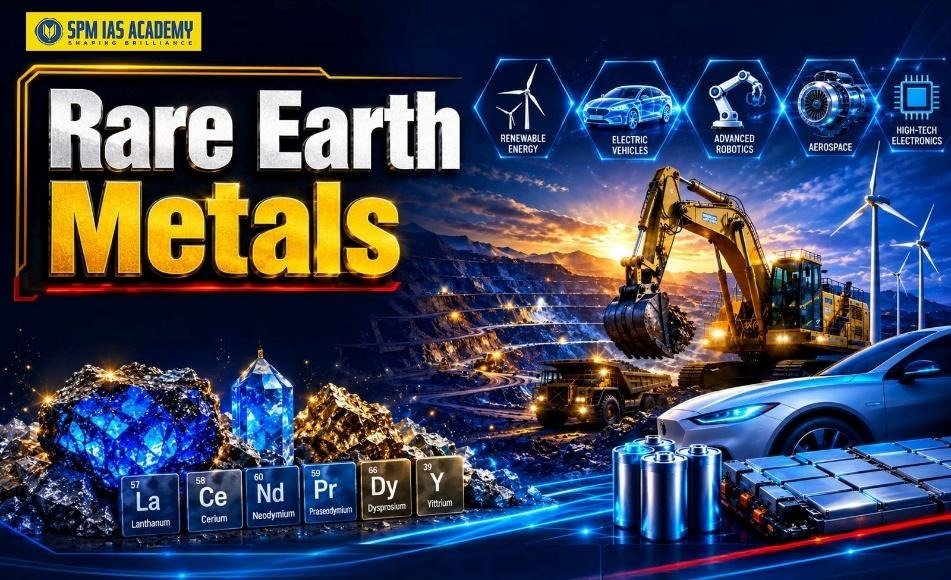
The 17 rare earth metals include 15 lanthanides along with scandium and yttrium. The major elements are lanthanum, cerium, praseodymium, neodymium, promethium, samarium, europium, gadolinium, terbium, dysprosium, holmium, erbium, thulium, ytterbium, lutetium, scandium and yttrium.
What is the Tomtor Rare Earth Deposit?
The Tomtor deposit is located in the Sakha or Yakutia region of Russia. It is considered one of the largest undeveloped sources of rare earth metals in the world.
The deposit is strategically important because it can support industries linked with clean energy, defence and advanced manufacturing. Russia’s offer to India can strengthen bilateral cooperation in critical minerals.
Moreover, this development comes at a time when countries across the world are trying to reduce dependence on China for rare earth metals supply chains.
Why are Rare Earth Metals Important?
Rare earth metals play an important role in both civilian and strategic sectors. Industries use them in electric vehicle motors, wind turbine generators, smartphones, laptops, and clean energy technologies. Understanding such topics is essential for UPSC aspirants because they connect with areas like environment, economy, science & technology, and international relations. Students preparing through the Best UPSC Coaching in Assam focus on such current affairs topics to develop better conceptual understanding and improve their mains answer writing skills.
They are also important for national security. Defence systems, missiles, radar systems, satellites and aerospace technologies depend on rare earth metals for better performance and precision.
Moreover, these metals are widely used in permanent magnets and medical equipment. These uses make them highly valuable for modern technology and advanced manufacturing.
Therefore, rare earth metals are not just ordinary industrial raw materials. They are strategic resources that support national security, energy transition and technological leadership.
India and Rare Earth Metals
India has significant reserves of rare earth metals, especially in monazite-bearing beach sands. However, India still faces major challenges in processing, refining and manufacturing rare earth magnets at scale.
This is the main reason India is looking for overseas partnerships. India wants to build a secure supply chain from mining to processing and magnet manufacturing.
India has also approved a major programme to boost domestic rare earth permanent magnet production. This is important because permanent magnets are used in electric vehicles, defence systems, renewable energy and electronics.
Why India Wants to Reduce Dependence on China?
China dominates the global rare earth supply chain. It has strong control over mining, processing, refining and magnet manufacturing. China accounts for around 70% of global mining operations. Moreover, it accounts for over 90% of the world’s refining and processing capacity.
This creates a strategic risk for countries like India. If supply gets disrupted, industries such as electric vehicles, renewable energy, electronics and defence can face serious challenges.
Therefore, India is trying to diversify its sources of rare earth metals. Talks with Russia, Japan, South Korea and other countries show India’s broader strategy to secure critical minerals.
Domestic Efforts by India
India has started taking strong domestic steps to reduce dependence on foreign sources for rare earth metals. As part of this effort, the Union Budget 2026-27 announced Dedicated Rare Earth Corridors in Odisha, Kerala, Andhra Pradesh and Tamil Nadu. These corridors will focus on mining, processing, research and manufacturing of rare earth metals. Moreover, they will use the mineral-rich base of these coastal states to build a stronger domestic supply chain.
The initiative will also support local industries and generate employment opportunities. At the same time, it will improve India’s research and development capacity in advanced materials.
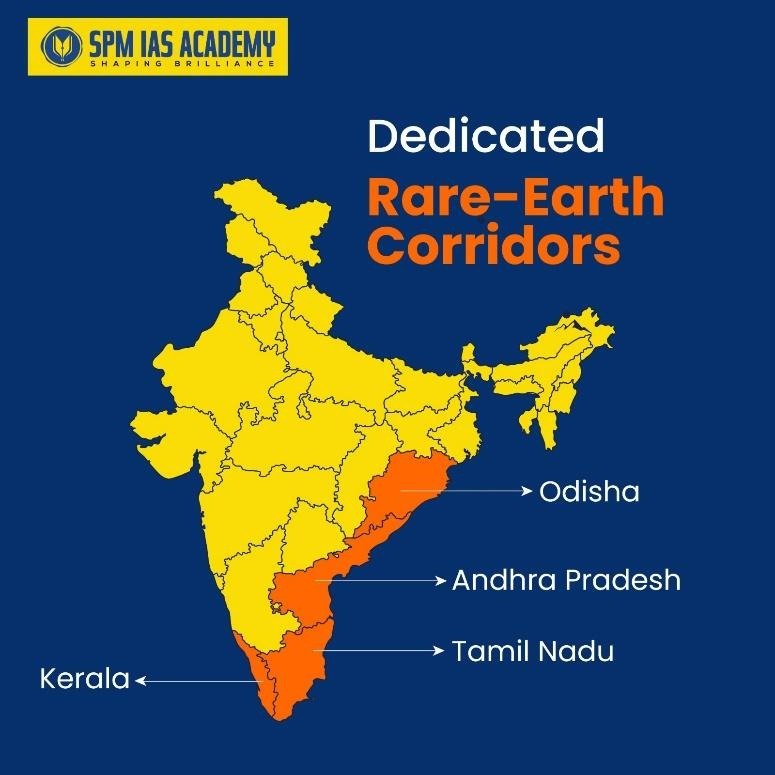
Therefore, these Rare Earth Corridors can help India become more self-reliant in critical minerals. They can also connect India more strongly with global advanced-materials value chains.
Rare Earth Metals Reserves in India
- According to the USGS Mineral Commodity Summaries 2025, India holds the world’s third-largest rare earth resources.
- The Atomic Minerals Directorate for Exploration and Research has identified major rare earth resources in coastal beach and red sand deposits of Kerala, Tamil Nadu, Odisha, Andhra Pradesh, Maharashtra and Gujarat. Moreover, it has also found resources in inland alluvium areas of Jharkhand, West Bengal and Tamil Nadu.
- India has around 7.23 million tonnes of Rare Earth Oxide equivalent in monazite resources. It also has rare earth oxide deposits in hard rock terrains of Gujarat and Rajasthan.
- In addition, riverine placer deposits in Chhattisgarh and Jharkhand contain heavy mineral concentrates with xenotime, which carries yttrium and heavy rare earth elements.
- However, rare earth resources are mostly low-grade and linked with radioactivity. Therefore, extractiIndia’s on becomes long, complex and expensive. Moreover, monazite deposits mainly contain light rare earth elements, while heavy rare earth elements are not available in large economically extractable quantities.
- India already has facilities for mining, separation, refining and oxide production. It has also developed metal extraction capability. However, the country still lacks large-scale midstream and downstream facilities for alloys, magnets and advanced rare earth products. As a result, India has adequate rare earth resources, but its production capacity remains limited due to gaps in the rare earth value chain.
Rare Earth Metals and Clean Energy
The global shift towards clean energy has increased the demand for critical minerals and rare earth metals. Wind turbines need powerful magnets. Electric vehicles also require rare earth-based permanent magnets for efficient motors.
As India moves towards renewable energy and electric mobility, the demand for these metals will rise further. Without a reliable supply chain, India’s clean energy transition may face bottlenecks.
So, rare earth security is directly linked with India’s climate goals and green economy.
Rare Earth Metals and Defence
These metals are also critical for defence technology. They are used in precision-guided weapons, fighter aircraft, drones, submarines, radar systems and missile guidance systems.
This makes them important for India’s defence preparedness. A strong domestic rare earth ecosystem can reduce import dependence and support Atmanirbhar Bharat in defence manufacturing.
Thus, India’s interest in the Tomtor deposit has a clear strategic dimension.
What are the Challenges for India in this sector?
India faces several challenges in this sector.
- First, India has reserves but lacks enough high-end refining capacity.
- Second, rare earth separation requires advanced technology and environmental safeguards.
- Third, the supply chain is capital-intensive.
- Fourth, India needs stronger private sector participation.
Moreover, rare earth mining and processing can cause environmental damage if not regulated properly. So, India must balance industrial growth with ecological protection.
Conclusion
Rare earth metals are central to the future of clean energy, defence, electronics and advanced manufacturing. Russia’s reported offer to India for access to the Tomtor deposit has made the topic even more important for current affairs.
For India, the challenge is clear. The country has reserves, but it must build strong processing and manufacturing capacity. If India succeeds, rare earth deposits can become a major pillar of Atmanirbhar Bharat, energy security and strategic autonomy.
For UPSC, APSC and State PCS aspirants, this topic is important because it connects science, economy, geopolitics and national security in one frame.
UPSC Mains Practice Question:
India has significant rare earth metals deposits, yet it remains dependent on external supply chains for advanced rare earth products. Examine the reasons behind this gap. (250 words)
Source:
Rare earth metals are 17 metallic elements used in advanced technologies such as electric vehicles, wind turbines, defence systems, satellites and permanent magnets.
Rare earth metals are important for India because they support clean energy, defence manufacturing, electric mobility, electronics and strategic autonomy.
China dominates the global rare earth supply chain, especially processing and refining.
India has rare earth resources in Kerala, Tamil Nadu, Odisha, Andhra Pradesh, Maharashtra, Gujarat, Jharkhand, West Bengal, Rajasthan and Chhattisgarh.
The Tomtor deposit in Siberia is in the news because Russia reportedly offered India access to this major undeveloped rare earth deposit.

Behind every article at SPM IAS Academy is a team of skilled content writers and subject experts committed to making preparation easier for aspirants. From answering common doubts to breaking down complex issues and current affairs, we create content that is accurate, easy to understand, and directly useful for UPSC, APSC, and other competitive exams.