The Global Peace Index 2026 shows how global peace is declining amid rising conflicts, militarisation and geopolitical tensions. The Global Peace Index, published by the Institute for Economics & Peace, ranks countries on the basis of peacefulness. It provides a comparative picture of safety, conflict and militarisation across the world.
The 2026 edition is especially significant because global peacefulness has declined for the 12th consecutive year. The report also highlights the rise of active conflicts, the economic cost of violence and the growing impact of AI-enabled warfare.
For exam aspirants, the Global Peace Index 2026 are relevant under International Relations, Internal Security, Global Governance, Peace and Conflict Studies, Human Security and Current Affairs.
What is the Global Peace Index?
The Global Peace Index is one of the world’s leading measures of peacefulness. It ranks 163 countries and territories according to their level of peace.
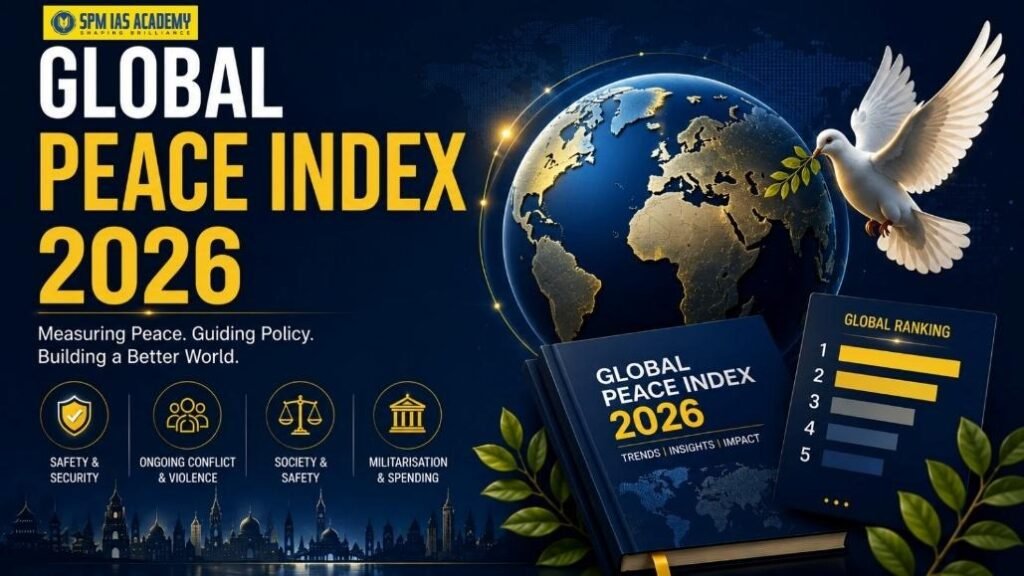
The index measures peacefulness through 23 qualitative and quantitative indicators. These indicators are grouped into three broad domains:
- Societal Safety and Security
- Ongoing Domestic and International Conflict
- Militarisation
A lower score means a country is more peaceful, while a higher score means a country is less peaceful. Therefore, the Global Peace Index 2026 help readers compare countries on measurable peace indicators rather than general perception.
Why is the Global Peace Index 2026 in News?
The Global Peace Index 2026 is in the news because the report shows that the world has become less peaceful again. The 2026 report states that global peacefulness declined by 0.7% over the past year.
This marks the 12th consecutive annual deterioration in global peace. It also reflects a wider global shift where conflicts are becoming more interconnected, more internationalised and more difficult to resolve.
The report links this trend with three major factors: the redistribution of global power, the transnational spread of conflict, and the rapid diffusion of AI-enabled warfare. Understanding these developments is essential for current affairs and international relations, making them important topics for aspirants preparing with the best UPSC coaching in Assam for UPSC, APSC, and other competitive examinations.
Which are the Top 10 Most Peaceful Countries in Global Peace Index 2026?
The 2026 rankings show that Iceland is the most peaceful country in the world. It has held this position for 19 consecutive years.
List of Top 10 Most Peaceful Countries
| Rank | Country |
| 1 | Iceland |
| 2 | New Zealand |
| 3 | Switzerland |
| 4 | Slovenia |
| 5 | Ireland |
| 6 | Austria |
| 7 | Portugal |
| 8 | Singapore |
| 9 | Finland |
| 10 | Japan |
These countries generally perform well due to low levels of internal conflict, strong institutions, social trust, low crime rates and relatively stable political systems.
Which are the Least Peaceful Countries in Global Peace Index 2026?
The bottom of the index shows countries affected by war, political instability, internal conflict and militarisation.
| Rank Category | Country |
| Least Peaceful | Russia |
| Second Least Peaceful | Sudan |
| Third Least Peaceful | Democratic Republic of Congo |
| Fourth Least Peaceful | Ukraine |
| Fifth Least Peaceful | Israel |
For the first time, Russia ranked as the least peaceful country in the world. The ranking reflects the impact of conflict, militarisation and international tensions.
What is India’s Rank in Global Peace Index 2026?
India ranked 127th out of 163 countries in the Global Peace Index 2026. This makes India a lower-middle performer in terms of global peacefulness.
The report places South Asia among the regions that recorded major deterioration. India’s decline is linked with factors such as tensions along borders, internal security concerns and regional instability.
South Asia in Global Peace Index 2026
South Asia recorded one of the sharpest declines in peacefulness in the 2026 index. The decline was driven by worsening conditions in countries such as Nepal, India and Pakistan.
Bhutan remained the most peaceful country in South Asia and ranked 16th globally. This makes Bhutan a strong regional performer.
South Asia’s poor performance shows that peace in the region remains affected by border disputes, internal conflicts, political instability, terrorism, refugee flows and ethnic tensions.
For India, this regional context is important because internal security and neighbourhood stability are closely connected.
What are the Key Findings of Global Peace Index 2026?
The Global Peace Index 2026 presents several major findings.
- First, 99 countries witnessed deterioration in peacefulness in the past year. This is the highest number since the index began.
- Second, 119 countries are now less peaceful than they were when the index was first published.
- Third, the number of countries engaged in external conflict has nearly doubled since 2008.
- Fourth, the global economic impact of violence increased to about US$21.81 trillion in 2025. This is equal to 10.5% of global GDP.
- Fifth, global conflict deaths remained historically high, with more than 181,000 deaths in 2025.
These findings show that peace is not only a political issue. It also has economic, humanitarian and developmental consequences.
What are the Three Domains of the Global Peace Index?
The Global Peace Index measures peace through three major domains.
1. Societal Safety and Security
This domain looks at factors such as crime, political instability, violent demonstrations, terrorism impact and public safety.
2. Ongoing Domestic and International Conflict
This domain studies internal and external conflicts, deaths from conflict, relations with neighbouring countries and involvement in wars.
3. Militarisation
This domain measures military expenditure, access to weapons, armed personnel and military capability.
Together, these domains give a broad picture of a country’s peacefulness.
Global Peace Index 2026 and AI Warfare
- One of the most important themes of the 2026 report is the rise of AI-enabled warfare. The report highlights that drones and AI-based targeting systems are changing the nature of conflict.
- Drone attacks have increased sharply in recent years. At the same time, AI-enabled systems have reduced the time between target identification and attack decisions.
Global Peace Index 2026 and Economic Cost of Violence
The economic impact of violence reached about US$21.81 trillion in 2025. This shows that violence affects not only lives but also economies.
Conflict disrupts trade, increases defence spending, weakens infrastructure, displaces populations and reduces development outcomes. Therefore, peacebuilding should be seen as an economic necessity.
Conclusion
The Global Peace Index 2026 shows that the world is becoming less peaceful amid rising conflicts, military expenditure and technological changes in warfare. Iceland remains the most peaceful country, while Russia ranks as the least peaceful country.
India’s 127th rank highlights the need to address internal security challenges, border tensions and social instability. For UPSC, APSC and State PCS aspirants, this topic is highly useful. It connects international relations, governance, internal security, ethics, economy and technology.
The Global Peace Index 2026 should therefore be studied not just as a ranking list, but as a larger indicator of global peace, security and development challenges.
Source:
Frequently Asked Questions
The Global Peace Index is published by the Institute for Economics & Peace.
Iceland ranked first in the Global Peace Index 2026 and remained the world’s most peaceful country.
India ranked 127th out of 163 countries in the Global Peace Index 2026.
Russia ranked as the least peaceful country in the Global Peace Index 2026.

Behind every article at SPM IAS Academy is a team of skilled content writers and subject experts committed to making preparation easier for aspirants. From answering common doubts to breaking down complex issues and current affairs, we create content that is accurate, easy to understand, and directly useful for UPSC, APSC, and other competitive exams.