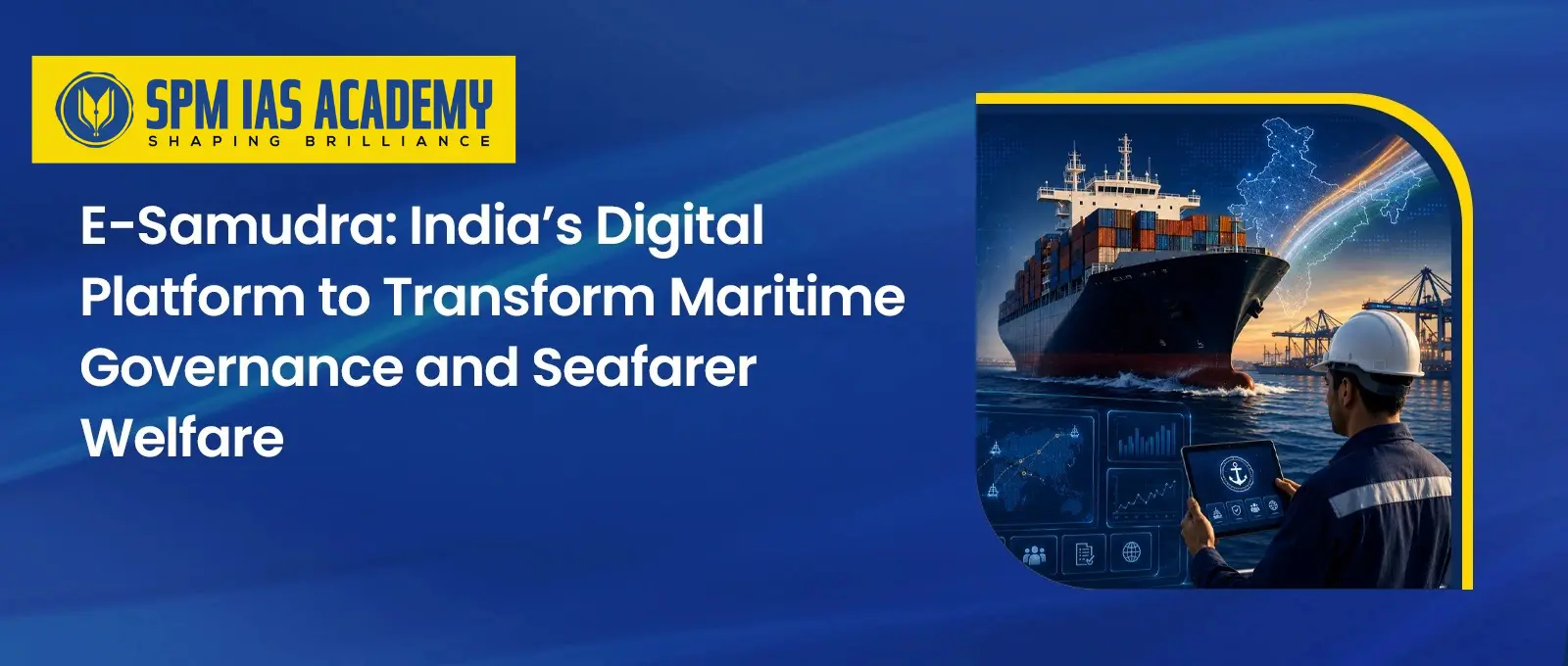
E-Samudra is India’s new digital platform designed to upgrade and modernise maritime governance. It will bring services for seafarers, shipping companies, ports and other maritime stakeholders under one digital window. Union Minister for Ports, Shipping and Waterways Sarbananda Sonowal inaugurated E-Samudra at a national stakeholder interaction on “Seafarer Security, Safety and Welfare and Inauguration of E-Samudra” in Mumbai.
For UPSC, APSC and other State PCS aspirants, E-Samudra is important under GS II – Governance, GS III – Infrastructure, Digital India, Maritime Security, Ease of Doing Business, and Seafarer Welfare.
E-Samudra: Why is it in the News?
E-Samudra came into focus because India launched it as a comprehensive digital platform to make maritime administration simpler, transparent and stakeholder-centric. The platform aims to reduce physical, office-based procedures. It aims to shift maritime services towards a Digital First and Faceless Governance model.
Moreover, the launch reflects India’s broader effort to use technology for improving public service delivery. The government expects the platform to promote Ease of Living for seafarers and Ease of Doing Business for the maritime sector.
What is E-Samudra?
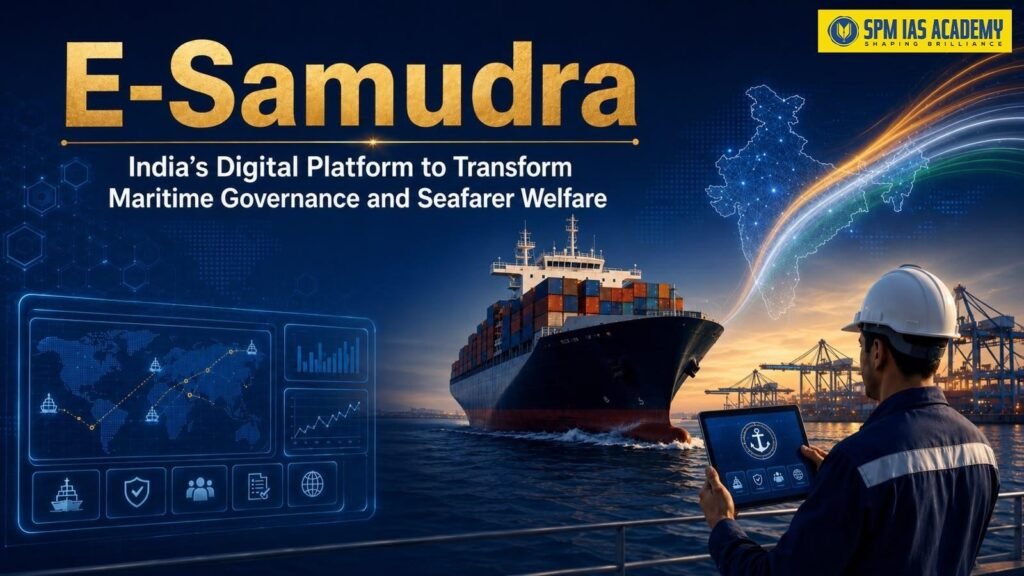
E-Samudra is a single-window digital platform for maritime governance. It integrates services related to seafarers, shipping companies, ports and other maritime stakeholders.
The platform will provide End-to-end digital workflows, Online payments and Real-time tracking. Moreover, it will facilitate digitally issued certificates, time-bound maritime services. All these will promote transparent service delivery in India’s maritime sector.
Therefore, E-Samudra does not merely put existing processes online. Instead, it aims to make maritime administration predictable, transparent and easier to access.
E-Samudra and Seafarer Welfare
The launch of E-Samudra gives special importance to seafarer welfare. India has a large and growing seafarer workforce. According to the Ministry, India’s active seafarer workforce increased from around 1.03 lakh in 2013 to more than 3.23 lakh in 2025. This sharp rise created the need for better digital regulation, service delivery and welfare support.
Along with E-Samudra, the Directorate General of Maritime Administration showcased important initiatives such as:
- e-NAVIK: 24×7 grievance redressal system
- Seafarer Tracking Dashboard: upcoming tracking support for seafarers
- Digital Seafarers Employment Agreement (d-SEA): digital employment agreement system
- Seafarers Welfare Fund Society measures: stronger welfare support
- Sagar Mein Yog: physical and mental well-being of seafarers
- Sagar Mein Samman: support and opportunities for women seafarers
These initiatives show that maritime governance now focuses not only on ships and ports but also on the dignity, safety and welfare of people working at sea.
E-Samudra and India’s Maritime Ambition
E-Samudra also supports India’s ambition to become a global maritime power. Union Minister Sarbananda Sonowal said that India has emerged as the second-largest supplier of seafarers globally. He also expressed confidence that India could soon become the world’s largest supplier of seafarers.
In addition, India has become the world’s leading ship recycling destination and is working towards entering the world’s top five shipbuilding nations. These developments connect E-Samudra with larger goals such as Maritime India Vision 2030 and Maritime Amrit Kaal Vision 2047.
Thus, the platform has both administrative and strategic importance. It can strengthen India’s maritime workforce, improve regulatory efficiency and support India’s long-term maritime economy.
E-Samudra and Digital Governance
E-Samudra reflects the principle of Minimum Government, Maximum Governance. It reduces paperwork, cuts delays and improves accountability through digital tracking. Moreover, it helps seafarers access government services from vessels with the same ease as people on shore.
Conclusion
E-Samudra marks a significant step in India’s digital transformation of maritime governance. It brings maritime services under a single digital window and makes service delivery more transparent, predictable and time-bound. Moreover, it strengthens seafarer welfare through grievance redressal, tracking, digital employment agreements and welfare initiatives. For UPSC, APSC and other State PCS aspirants, E-Samudra is a strong example of digital governance, maritime infrastructure development, seafarer welfare and India’s journey towards becoming a global maritime power.
Read More:
Source:
FAQ:
E-Samudra is India’s single-window digital platform for maritime governance. It brings services for seafarers, shipping companies, ports and other stakeholders onto one digital system. Moreover, it supports online payments, real-time tracking, digital certificates and time-bound service delivery. Therefore, E-Samudra can improve transparency, reduce paperwork and promote Ease of Doing Business in India’s maritime sector.
E-Samudra improves seafarer welfare by making maritime services faster, more accessible and more transparent. In addition, initiatives such as e-NAVIK, the Seafarer Tracking Dashboard, Digital Seafarers Employment Agreement (d-SEA), Sagar Mein Yog and Sagar Mein Samman strengthen grievance redressal, employment security, safety and well-being. As a result, seafarers can access important services with fewer delays and less dependence on physical offices.

Behind every article at SPM IAS Academy is a team of skilled content writers and subject experts committed to making preparation easier for aspirants. From answering common doubts to breaking down complex issues and current affairs, we create content that is accurate, easy to understand, and directly useful for UPSC, APSC, and other competitive exams.