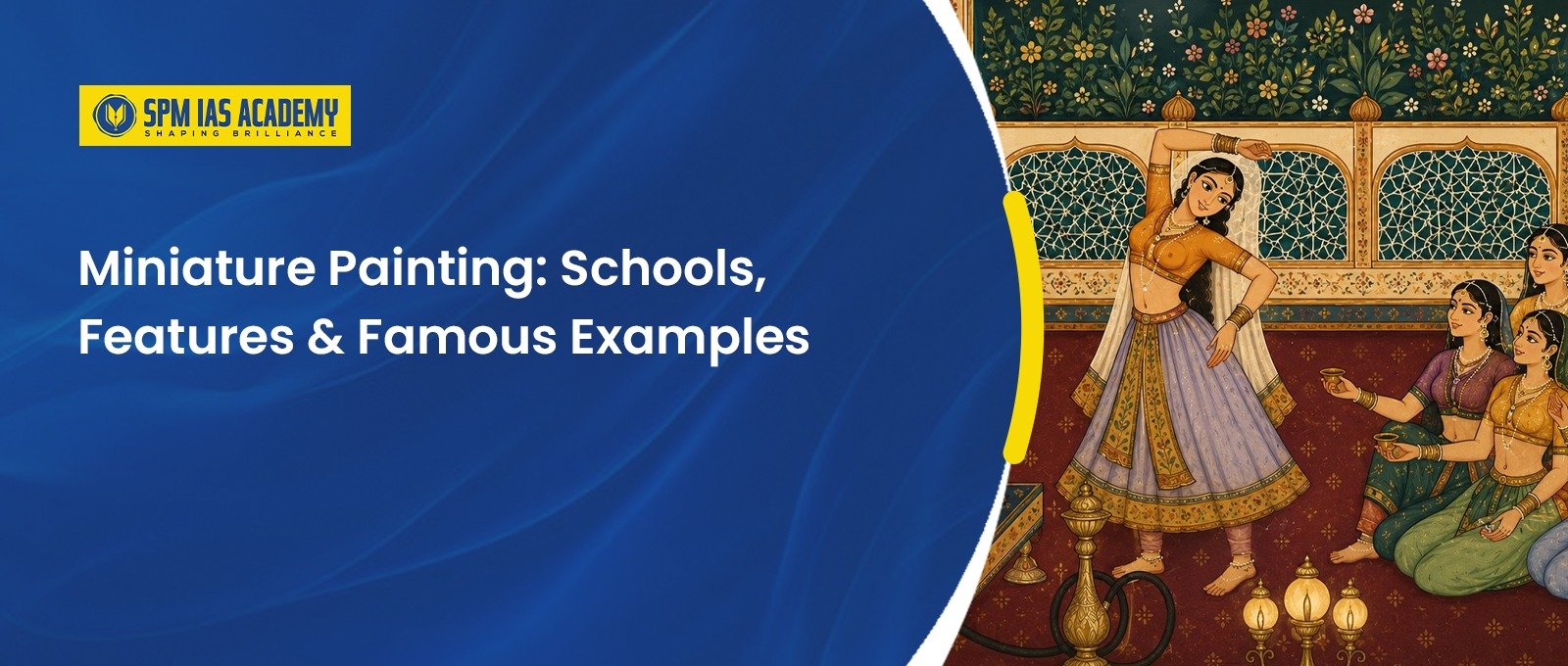
Miniature Painting represents one of India’s finest visual art traditions. Artists created these small-scale paintings with fine brushwork, intricate details, natural colours and carefully composed figures on materials such as paper, palm leaves and cloth. Early traditions appeared in Buddhist and Jain manuscripts, while Mughal, Rajasthani, Pahari and Deccani courts later transformed the art into distinctive regional styles.
For UPSC, APSC and other State PCS examinations, Miniature Painting forms an important part of Indian Art and Culture. Aspirants should particularly understand the schools, patrons, themes, techniques and famous works. because UPSC has directly asked questions on Mughal influence and the Kishangarh School.
What is Miniature Painting?
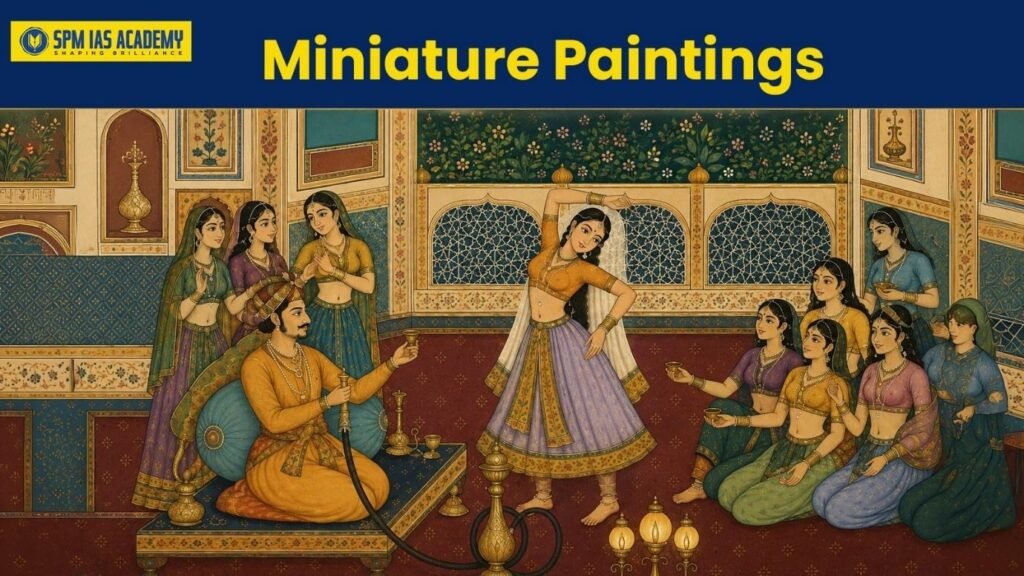
Miniature Painting refers to highly detailed painting executed on a relatively small surface. Early Indian examples often illustrated religious manuscripts. Subsequently, royal patronage expanded their subjects to court scenes, portraits, hunting, battles, nature, mythology, love and devotional themes.
Artists traditionally used fine brushes and pigments derived from minerals, plants and other natural materials. Mughal miniatures also employed opaque watercolour, gold and sophisticated manuscript illumination.
Miniature Painting Features:
Important Miniature Painting Features include:
- Small-scale composition with extremely fine detailing
- Precise and delicate brushwork
- Bright or carefully balanced colours
- Use of natural pigments, gold and mineral colours
- Frequent use of paper, palm leaf and cloth
- Stylised human figures in several regional schools
- Religious, literary, royal and natural-history themes
- Manuscript illustration as an important early function
- Distinct regional variations in landscape, colour and facial representation
Thus, aspirants should identify paintings not merely by size but through their theme, patronage, technique and regional style.
Miniature Painting Schools in India
The evolution of Indian miniature art produced several important traditions.
| Miniature Painting School | Region/Period | Important Features & Examples |
| Pala School | Eastern India, 8th–12th centuries | Buddhist manuscripts, palm leaves, flowing lines and subdued colours |
| Western Indian/Jain School | Gujarat and western India | Jain manuscripts, strong colours, elongated eyes and angular figures |
| Sultanate School | Delhi, Mandu, Jaunpur | Indo-Persian influence; Nimatnama is an important example |
| Mughal School | Mughal court | Persian-Indian fusion, realism, portraits, court scenes, flora and fauna |
| Rajasthani School | Rajasthan | Radha-Krishna, epics, Ragamala, bright colours and regional court styles |
| Pahari School | Himalayan hill states | Bhakti, Radha-Krishna, lyrical landscapes; Basohli and Kangra traditions |
| Deccani School | Ahmadnagar, Bijapur, Golconda | Rich colours, elongated figures, decorative settings and Persian-Deccan influences |
The Pala tradition represents one of the earliest surviving traditions of Indian miniature manuscript painting. Meanwhile, the Western Indian tradition developed strongly around Jain religious texts.
Mughal Miniature Painting School: Akbar to Aurangzeb
- The Mughal Miniature Painting School became one of the most influential traditions of Indian painting.
- Under Akbar, the imperial workshop brought Persian-trained and Indian artists together. Large illustrated projects such as the Hamzanama encouraged complex compositions and narrative painting. Mughal artists gradually combined Persian refinement with Indian colours, figures and landscapes.
- Under Jahangir, artists developed exceptional portraiture and natural-history painting. Jahangir closely observed art and encouraged realistic representations of birds, animals and plants. Ustad Mansur became particularly famous for natural-history studies.
- Under Shah Jahan, painting became more formal and decorative, with luxurious portraits, court scenes and increased use of elaborate ornamentation.
- However, imperial patronage weakened under Aurangzeb. Consequently, many artists found patrons in regional courts, contributing to the growth of provincial and Rajput traditions.
Rajasthani Miniature Painting: Major Schools and Features
- The Rajasthani Miniature Painting tradition flourished in different Rajput kingdoms. Consequently, it developed several regional schools, including Mewar, Marwar/Jodhpur, Bikaner, Bundi, Kota, Jaipur and Kishangarh.
- Artists frequently depicted Ramayana and Mahabharata episodes, Krishna bhakti, Ragamala, hunting, royal life and romantic themes. Moreover, each court developed its own colour palette and treatment of figures.
Kishangarh School and Bani Thani
- The Kishangarh School became famous for highly stylised faces, elongated eyes, pointed noses, graceful figures and devotional Radha-Krishna imagery.
- Bani Thani remains its best-known visual icon. The National Museum identifies Bani Thani as an 18th-century Kishangarh-style painting, while works by Nihal Chand illustrate the highly refined Krishna-Radha imagery associated with the school.
Pahari Miniature Painting: Basohli and Kangra Features
Pahari Miniature Painting developed in the Himalayan hill kingdoms from the 17th century onward.
- The early Basohli style used bold colours, expressive faces and strong visual intensity. In contrast, the later Kangra School became softer and more lyrical. Kangra artists frequently portrayed Radha-Krishna, Bhagavata themes, romantic poetry, forests, rivers and delicate landscapes.
- Artists such as Nainsukh and Manaku became major names in the Pahari tradition. Art historian B. N. Goswamy’s research also demonstrated the importance of artist families, challenging the idea that miniature styles developed only according to geographical regions.
Miniature Painting and Assam Connection for APSC
For APSC aspirants, Indian miniature art should also connect with Assam’s illustrated manuscript tradition.
- From the Neo-Vaishnavite period, Assam’s Satras developed a distinctive tradition of manuscript illustration. Artists painted religious narratives on sanchipat, prepared from the bark of the sanchi tree, and also used tulapat. Traditional pigments included hengul for vermilion, haital for yellow, indigo and black pigments.
- The Chitra Bhagavata, associated with Bali Satra in Nagaon and traditionally dated to 1539 CE, ranks among the earliest surviving illustrated manuscripts of the Sattriya tradition. Its paintings display simple composition, narrative force and vivid colours.
Therefore, APSC candidates should connect Miniature Painting with Sankaradeva, Neo-Vaishnavism, Satras, Assamese manuscript painting and Chitra Bhagavata.
Conclusion
Miniature Painting reflects centuries of interaction among religion, literature, royal patronage and regional culture. From the early Pala and Jain manuscripts to Mughal naturalism, Rajasthani devotional art and Pahari landscapes, every school developed a distinctive visual vocabulary.
Read More:
| Articles |
| Indian Art and Culture – UPSC/State PCS Preparation |
| History and Culture – UPSC Preparation |
| APSC Mains GS-1 Preparation (History & Culture) |
| UPSC History Optional Preparation Resources |
Source:
Frequently Asked Questions
1. What are the main features of Miniature Painting?
The main features of Miniature Painting are fine brushwork, intricate details, natural pigments, small-scale compositions and vibrant colours. Moreover, artists used these paintings to depict religious themes, court scenes, portraits, nature and literary stories.
2. What are the major schools of Miniature Painting in India?
The major Miniature Painting schools include the Mughal, Rajasthani, Pahari, Deccani, Pala and Western Indian Jain schools. Each school developed unique styles based on regional culture, royal patronage and artistic techniques.
3. Why is Mughal Miniature Painting important in Indian art history?
Mughal Miniature Painting played a major role in transforming Indian painting traditions by combining Persian techniques with Indian themes. Furthermore, rulers like Akbar and Jahangir promoted portrait painting, manuscript illustration and realistic depiction of flora and fauna.

Behind every article at SPM IAS Academy is a team of skilled content writers and subject experts committed to making preparation easier for aspirants. From answering common doubts to breaking down complex issues and current affairs, we create content that is accurate, easy to understand, and directly useful for UPSC, APSC, and other competitive exams.