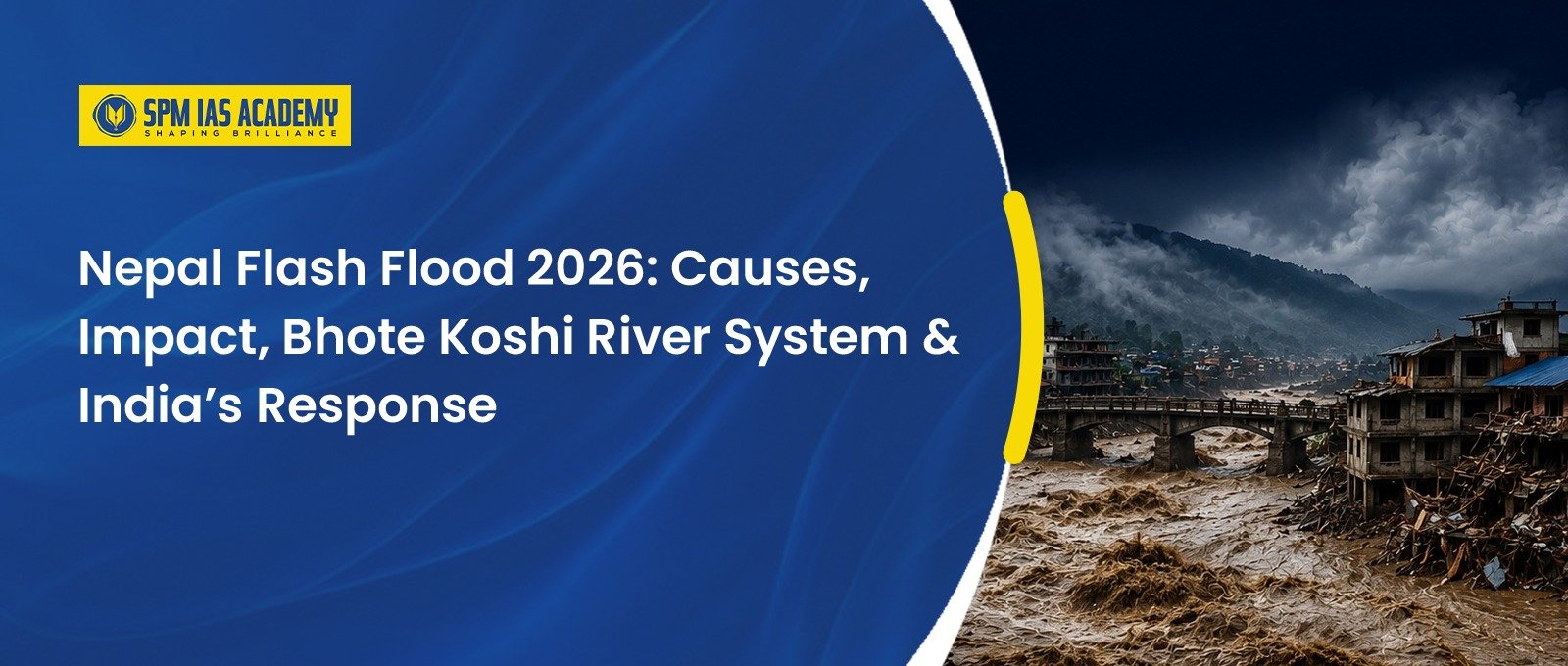
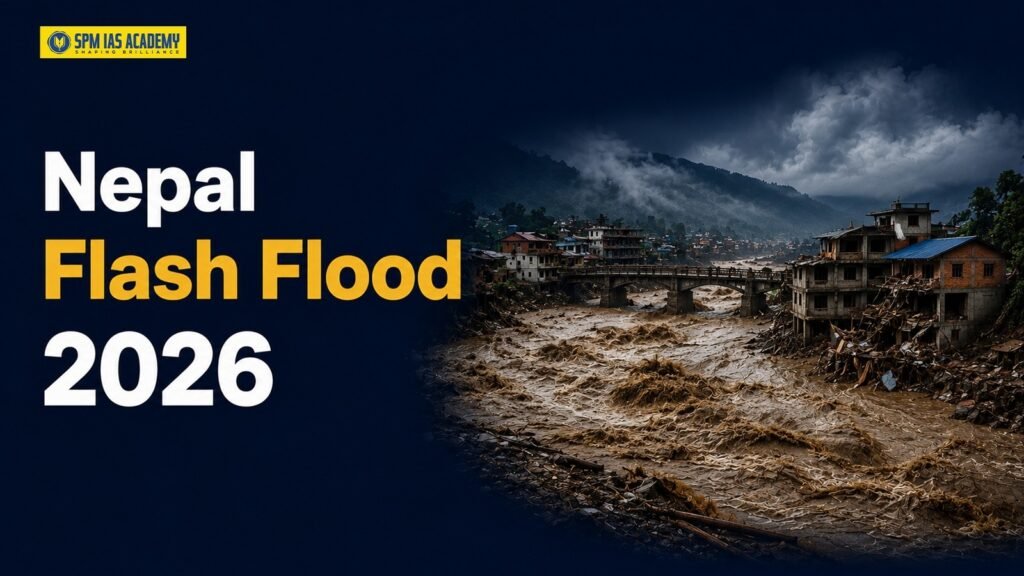
The Nepal Flash Flood of August 2026 has emerged as a major Himalayan disaster, causing extensive loss of life and infrastructure along the Nepal-Tibet border. The disaster struck Rasuwa district, where a sudden surge entered the Lhende Khola and moved through the Bhote Koshi and Trishuli river systems.
The latest reports available on August 28 put the death toll at 469, while 1,468 people remain missing across Nepal and Tibet. Nepal accounts for 910 missing people, while Chinese authorities have reported 558 missing in Tibet. More than 290 Indian nationals remain uncontactable, prompting an urgent response from India.
Nepal Flash Flood: What Happened in Rasuwa?
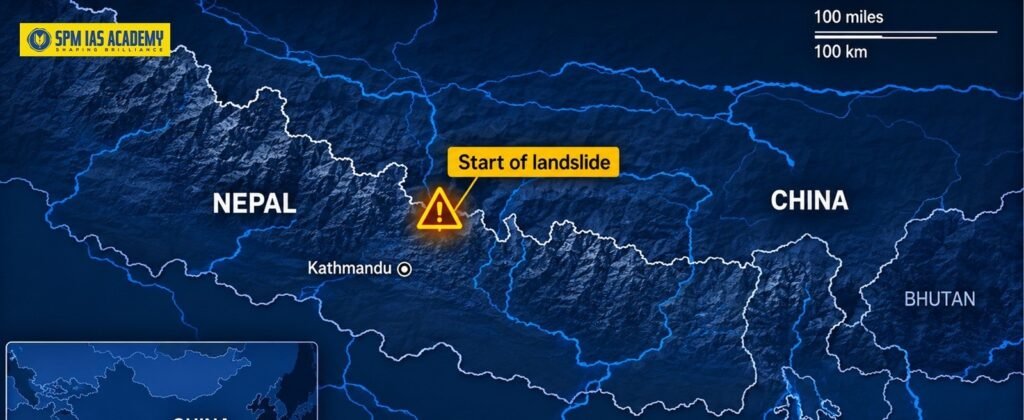
The Nepal Flash Flood struck on 26 August 2026 in the mountainous Rasuwa region near the Tibet border. The sudden surge devastated settlements and infrastructure along the Bhote Koshi–Trishuli corridor.
The affected areas include Timure, Rasuwagadhi and Syabrubesi, while the flood also caused severe damage farther downstream. Roads, bridges, hydropower facilities, homes and communication infrastructure suffered extensive destruction.
The flood also disrupted the Gyirong Port, an important Nepal-China border crossing and trade route.
What Triggered the Nepal Flash Flood?
- Initial reports suggested that an earthquake may have triggered an avalanche. However, subsequent scientific analysis changed this explanation.
- A large section of glacier reportedly collapsed at high altitude and plunged into the Lhende Khola catchment, carrying ice, rocks and debris into the river system. The impact generated seismic waves that initially created confusion over whether an earthquake had occurred. USGS later interpreted the seismic signal as being generated by the collapse itself rather than by a tectonic earthquake.
What Is a Flash Flood and How Is It Different from a GLOF?
- A flash flood is a sudden and rapidly developing flood that can inundate an area within minutes or hours. In mountainous regions, steep slopes accelerate the water and allow it to carry enormous quantities of rocks, mud and debris.
- A Glacial Lake Outburst Flood (GLOF) occurs when water stored behind an unstable glacial or moraine dam suddenly escapes.
- The recent Nepal flash floods appear to involve a glacier-collapse and debris-flow mechanism, rather than a conventional GLOF as the primary trigger. However, the region contains potentially unstable glacial lakes, and a newly formed barrier lake has created an additional downstream risk.
Why Is Nepal Vulnerable to Such Disasters?
Nepal’s Himalayan geography can greatly intensify sudden floods:
- Firstly, steep gradients rapidly accelerate floodwater downhill.
- Moreover, narrow river gorges concentrate water and debris, increasing their destructive force.
- In addition, heavy sediment loads increase the destructive force of the flood.
- Furthermore, settlements and infrastructure often occupy vulnerable river valleys.
- At the same time, difficult terrain can delay rescue and evacuation.
- Besides, glacial instability and rising temperatures can increase high-altitude hazards.
- Consequently, communities get very little warning when water levels rise rapidly.
The Trishuli River reportedly rose by nearly 9 metres within 30 minutes. This clearly shows how quickly conditions can become dangerous in Himalayan valleys.
Nepal Flash Flood: Impact on India
- Firstly, the Bhote Koshi river system connects the affected region with downstream rivers that enter India.
- Moreover, the rivers like Bhote Koshi, Trishuli and Narayani join the Gandak system.
- Consequently, the Gandak carries the downstream flow into India, particularly affecting parts of Bihar and Uttar Pradesh.
- Therefore, severe flooding in Nepal can increase flood risks in downstream Indian areas like Bihar and Uttar Pradesh.
What Can India Do to Reduce Future Himalayan Flood Risks?
- Firstly, India and Nepal should strengthen real-time river monitoring across shared river basins.
- Moreover, both countries can develop transboundary early-warning systems for flash floods and GLOFs.
- In addition, satellite-based monitoring can track glaciers, landslides and unstable glacial lakes.
- Furthermore, authorities should share real-time hydrological data between upstream and downstream regions.
- Meanwhile, joint disaster-response exercises can improve coordination during emergencies.
- Similarly, both countries should develop clear evacuation protocols for vulnerable communities.
- Finally, India should promote climate-resilient infrastructure in vulnerable Himalayan valleys.
Conclusion
The Nepal Flash Flood demonstrates how a high-altitude geological event can rapidly develop into a transboundary disaster. The combination of glacial instability, steep Himalayan terrain, unstable river systems and vulnerable infrastructure can dramatically amplify its impact.
For India, the event reinforces the importance of early warnings, scientific monitoring and cross-border cooperation. More importantly, the disaster shows why Himalayan disaster management must focus not only on emergency response but also on anticipating hazards before they reach downstream communities.
Read More:
Source:
Frequently asked question
1. What caused the Nepal Flash Flood in 2026?
Initial reports suggested an earthquake-triggered avalanche. However, later analysis indicated a high-altitude glacier collapse that sent ice, rocks and debris into the Lhende Khola catchment.
2. How did the Nepal Flash Flood affect India?
The flood affected the Bhote Koshi-Trishuli-Narayani-Gandak river system. Therefore, it increased downstream flood risks in parts of Bihar and Uttar Pradesh.
3. Why is the Nepal Flash Flood important for India?
The event highlights the need for transboundary early-warning systems, real-time river monitoring and Nepal-India data sharing. Moreover, it shows the importance of climate-resilient Himalayan infrastructure.

Behind every article at SPM IAS Academy is a team of skilled content writers and subject experts committed to making preparation easier for aspirants. From answering common doubts to breaking down complex issues and current affairs, we create content that is accurate, easy to understand, and directly useful for UPSC, APSC, and other competitive exams.