Central Asia — the vast landlocked expanse stretching from the Caspian Sea to the Pamirs — is no longer the forgotten backyard of the former Soviet Union. It is rapidly becoming the contested heartland of 21st-century geopolitics, energy competition, connectivity rivalries, and great-power ambitions.
What is Central Asia, and why should you care?
If you’re preparing for UPSC or trying to understand global politics, you might be wondering—why is everyone suddenly talking about Central Asia? Let’s simplify it for you.
Central Asia is a region made up of five countries: Kazakhstan, Uzbekistan, Turkmenistan, Kyrgyzstan, and Tajikistan. At first glance, they may look like distant, landlocked nations with little relevance to your daily life. But in reality, this region sits right at the heart of the world map—connecting Asia, Europe, and the Middle East.
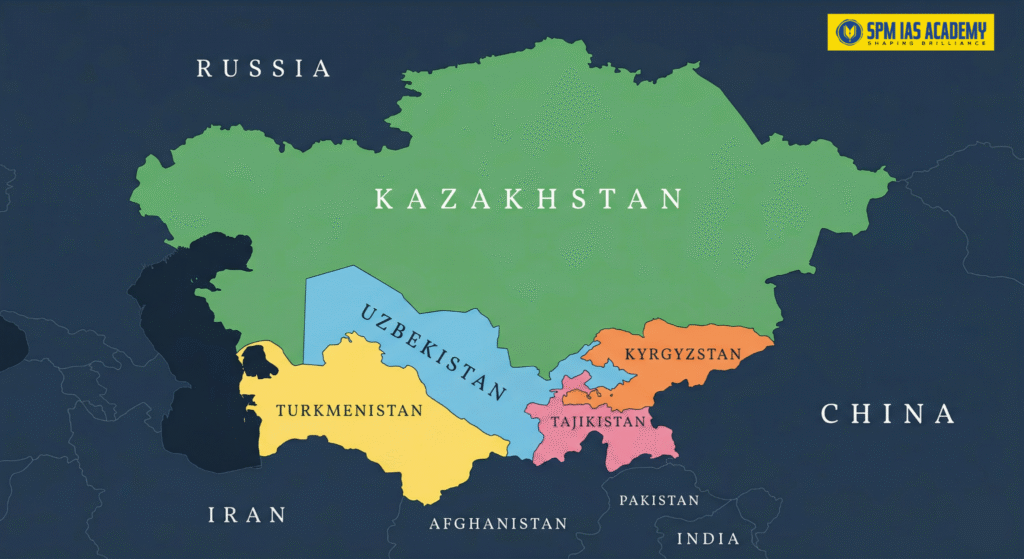
Think of Central Asia as a geographical crossroads. Whoever influences this region gains access to major trade routes, strategic locations, and powerful geopolitical advantages. And that’s exactly why global powers are so interested in it.
Why is Central Asia Geopolitically Important?
Now let’s get to the real question—why are countries like the USA, Russia, China, and even India so focused on Central Asia?
It all comes down to location, location, location.
Central Asia lies at the center of Eurasia, acting as a bridge between the East and the West and also between the North and the South. This makes it extremely important for trade, military movement, and political influence.
You’ll often hear about the Heartland Theory, which suggests that whoever controls this central landmass can potentially control the world. Sounds dramatic? Maybe—but global strategies still reflect this thinking.
Even today:
- Russia sees it as its traditional sphere of influence
- China views it as a key part of its Belt and Road Initiative
- The USA considers it important for military and strategic presence
- India looks at it for connectivity and regional balance
So, when you study geopolitics, Central Asia is not optional—it’s essential.
The “New Great Game” in Central Asia
If this all sounds like a competition, that’s because it is.
Historically, Central Asia was the center of the “Great Game” between the British and Russian Empires. Today, we are witnessing a “New Great Game,” where multiple global and regional powers are competing for influence.
But this time, the players are
- United States
- Russia
- China
- India
- Even regional actors like Pakistan and Iran
Each country wants:
- Access to energy resources
- Strategic military positioning
- Political influence in the region
And because of these overlapping interests, Central Asia often becomes a zone of cooperation as well as conflict.
Role of Central Asia in Modern Conflicts
You might be surprised to know that Central Asia has played a major role in recent global conflicts too.
After the 9/11 attacks, the United States used Central Asian countries as military bases and supply routes during the Afghanistan war. This clearly shows how important the region is, not just economically, but also militarily.
Even today, its location makes it critical for the following:
- Military logistics
- Counter-terrorism operations
- Regional security
So, Central Asia is not just about theory—it has real-world strategic importance.
Hydropower and Future Energy Potential
Here’s something many people overlook—Central Asia is not only rich in oil and gas but also in water resources.
Countries like Kyrgyzstan and Tajikistan have huge potential for hydropower generation. This means they can produce electricity and even export it to neighboring countries.
In the future, as the world shifts towards cleaner energy, this hydropower potential could make Central Asia even more important.
Why Central Asia Matters in the 21st Century
So, what’s the big picture here?
Central Asia is becoming increasingly important because of the following:
- Its central geographical location
- Its abundant energy resources
- Its role in global power competition
- Its importance in trade routes and connectivity
In simple terms, it is a region where geopolitics meets geo-economics.
The Five Republics at a Glance
| Country | Capital | Key Resource | India’s Interest |
|---|---|---|---|
| Kazakhstan | Astana | Oil, Uranium (#1 in the world) | Energy diversification, nuclear fuel |
| Uzbekistan | Tashkent | Gold, Natural Gas | C5+1 hub, trade connectivity |
| Turkmenistan | Ashgabat | Gas (4th largest world) | TAPI pipeline, energy security |
| Kyrgyzstan | Bishkek | Water, Rare Earths | SCO cooperation, hydro-diplomacy |
| Tajikistan | Dushanbe | Aluminium, Water | Farkhor Air Base, Afghan strategy |
Historical & Civilisational Context
The Silk Road Legacy
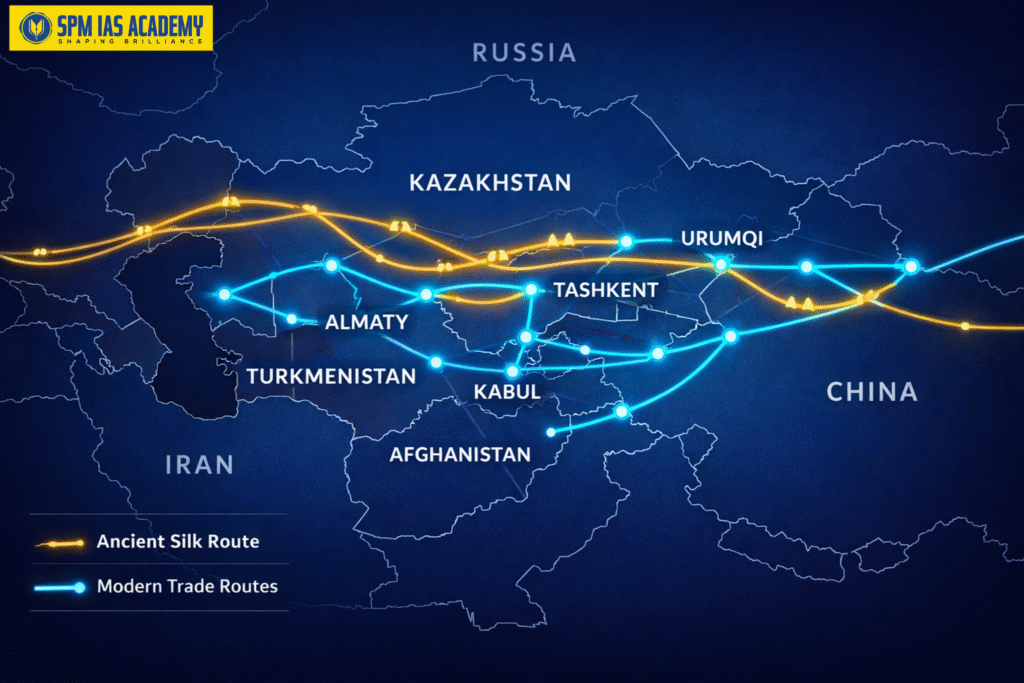
Central Asia plays a pivotal role in world history as the core region of the ancient Silk Road, a vast network of trade routes that connected China, South Asia, Persia, and the Mediterranean world. This network facilitated not only the exchange of goods like silk, spices, and precious metals but also enabled the flow of ideas, culture, religion, and technology, making it a key driver of early globalization.
Major urban centers such as Samarkand, Bukhara, and Merv emerged as thriving hubs of trade, learning, and cultural interaction, especially during the Islamic Golden Age. Scholars and traders in these cities actively contributed to advancements in science, philosophy, mathematics, and literature.
In the contemporary context, countries have revived this historical legacy with renewed geopolitical focus. China promotes the Belt and Road Initiative (BRI), while India advances the International North–South Transport Corridor (INSTC). These initiatives aim to modernize ancient trade routes, strengthen connectivity, expand trade, and enhance strategic influence across Eurasia.
The Great Game & Soviet Legacy
The 19th-century “Great Game” refers to the strategic rivalry between the British Empire and the Russian Empire over control and influence in Central Asia. Both powers actively competed to expand their dominance, driven by geopolitical concerns—especially Britain’s fear that Russian expansion could threaten its control over India. This rivalry laid the foundation for modern great-power competition in the region.
After the Bolshevik Revolution, the Soviet Union absorbed Central Asia and reorganized it into several republics under the Union of Soviet Socialist Republics (USSR). Moscow tightly controlled these republics and integrated them politically and economically into the Soviet system. This arrangement continued until the dissolution of the USSR in 1991, after which these republics emerged as independent nation-states.
However, the post-Soviet transition created several enduring structural challenges:
- Governments continue to maintain authoritarian political systems with limited democratic development
- Economies rely heavily on natural resources such as oil, gas, and minerals
- States face security vulnerabilities, including border conflicts, extremism, and external influence
These historical legacies continue to shape Central Asia’s strategic importance, as major powers like Russia, China, and Western countries actively compete to expand their influence in the region.
| KEY CONCEPT — Mackinder’s Heartland TheoryHalford Mackinder (1904): ‘Who rules the Heartland commands the World-Island; who rules the World-Island commands the world. Central Asia is the core of this heartland. Frequently cited in UPSC Essays and IR optional answers. |
Strategic Importance: A Multi-Dimensional Analysis
Geopolitical Significance — The New Great Game
Central Asia lies at the geopolitical intersection of four major regions and powers—Russia (north), China (east), Iran (southwest), and Afghanistan–Pakistan (south). This unique positioning makes it a zone of overlapping strategic interests, often described as a modern arena of great-power competition.
- Russia considers Central Asia as its “near abroad”, aiming to retain historical influence through security and economic mechanisms like:
- Collective Security Treaty Organization (CSTO)
- Eurasian Economic Union (EAEU)
- Focus: Security dominance, political influence, and regional stability
- China views it as the terrestrial anchor of BRI, an energy source, and a buffer against Uyghur separatism. Their prime focus could be considered as connectivity, energy security, and internal stability
- United States: The U.S. presence has declined after losing the Manas Air Base in 2014. Now relies mainly on diplomatic engagement and limited security cooperation
- Turkey: Leverages cultural and linguistic ties with Central Asian states through the following: Organisation of Turkic States (OTS)
- India: Seeks strategic autonomy, energy access, and counter-Pakistan depth via the ‘Connect Central Asia’ policy (2012) and the SCO framework.
Energy Security—The Resource Treasure House
Let’s talk about what really drives global interest—energy resources.
Central Asia is rich in oil and natural gas, and in today’s world, energy equals power. Countries that control or access energy resources can influence economies, industries, and even global politics.
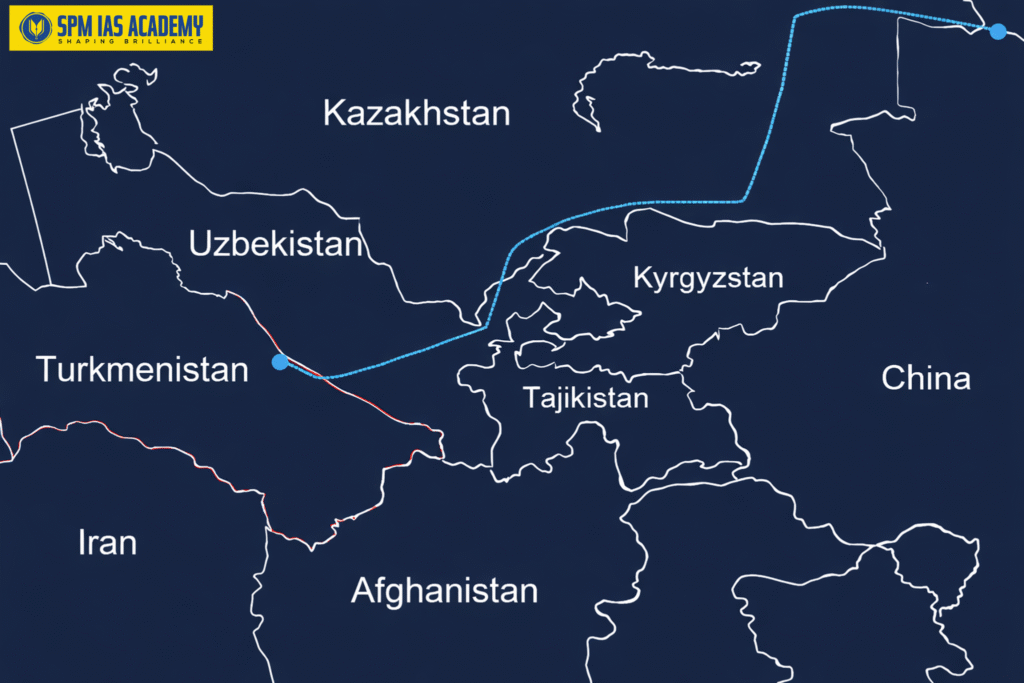
Now imagine this: countries like India and China are rapidly growing and need huge amounts of energy. At the same time, traditional energy sources are becoming unstable or limited. This is where Central Asia becomes a reliable alternative.
| Resource | Key Producer | Global Rank | India’s Interest |
|---|---|---|---|
| Crude Oil | Kazakhstan (Tengiz, Kashagan) | Top 15 globally | Diversify from Gulf dependence |
| Natural Gas | Turkmenistan (Galkynysh) | 4th-largest reserves | TAPI pipeline — energy security |
| Uranium | Kazakhstan | #1 producer (~45% global) | Civil nuclear programme fuel |
| Rare Earths | Kazakhstan, Kyrgyzstan | Significant lithium, cobalt | EV and electronics sector |
| Water | Kyrgyzstan, Tajikistan | Source of Amu/Syr Darya | Regional stability, hydro-diplomacy |
| TAPI PIPELINE — Critical for UPSC GS-III (Energy Security)The Turkmenistan–Afghanistan–Pakistan–India (TAPI) Pipeline is 1,814 km long, designed to carry 33 billion cubic meters of gas per year from the Galkynysh field. Security concerns in Afghanistan remain the primary bottleneck. Frequently asked in UPSC Prelims and Mains. |
Connectivity & Trade Corridors
Connectivity & Trade Corridors
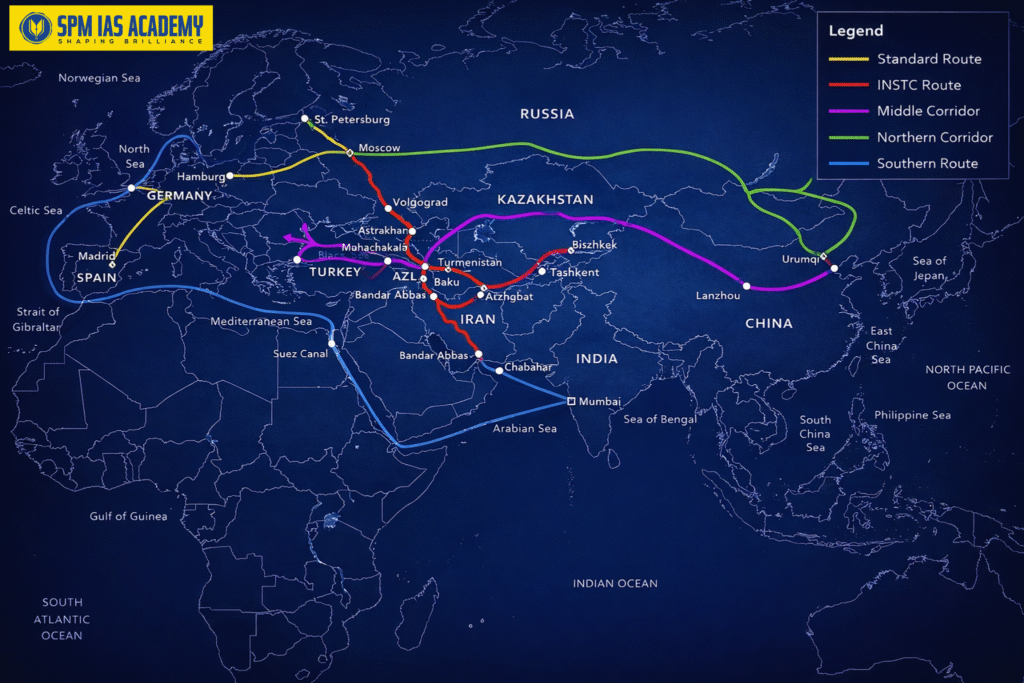
- Central Asia has become a key hub of global connectivity, linking Asia, Europe, and the Middle East and attracting multiple competing infrastructure initiatives.
- China’s Belt and Road Initiative (BRI) dominates the region with $50+ billion investment, focusing on railways, pipelines, and roads; projects like the China–Kyrgyzstan–Tajikistan railway aim to strengthen trade routes and energy security.
- India’s International North–South Transport Corridor (INSTC) is a 7,200 km multimodal corridor (Mumbai–Moscow via Iran and the Caspian Sea) that reduces transit time by around 30%, enhancing trade with Russia and Central Asia.
- The Ashgabat Agreement provides a regional connectivity framework linking India, Iran, Oman, Turkmenistan, Uzbekistan, and Kazakhstan, complementing INSTC and facilitating smoother transit.
- The Trans-Caspian International Transport Route (Middle Corridor) connects China to Europe via Kazakhstan, the Caspian Sea, Azerbaijan, and Georgia; it has gained importance post-Ukraine war as an alternative to Russia-dominated routes.
- Chabahar Port is India’s strategic investment in Iran, providing direct access to Afghanistan and Central Asia while bypassing Pakistan and serving as a gateway for regional trade.
- Overall, these corridors highlight Central Asia as a “geoeconomic battleground,” where connectivity projects are shaping trade, energy flows, and geopolitical influence.
Security Architecture — Terrorism & Afghanistan’s Shadow
The Taliban’s return to power in August 2021 significantly reshaped Central Asia’s security landscape. Regional states now actively reassess their security strategies due to rising risks of terrorism, cross-border extremism, narcotics trafficking, and potential refugee inflows. The ideological influence of groups operating from Afghanistan, such as ISIS-K, has heightened concerns, particularly for Tajikistan and Uzbekistan, which share borders with Afghanistan.
Collective Security Treaty Organization (CSTO)
The CSTO, led by Russia, serves as a key regional security mechanism and includes Kazakhstan, Kyrgyzstan, and Tajikistan from Central Asia. In January 2022, the CSTO deployed troops to Kazakhstan to stabilize internal unrest. This marked the first real operational use of the alliance in a member state, setting a precedent for collective intervention in case of internal or external threats. It also reaffirmed Russia’s role as the primary security guarantor in the region.
Shanghai Cooperation Organisation (SCO)
The SCO acts as the primary multilateral platform for regional cooperation on security, economic, and political issues. Its members include China, Russia, India (since 2017), Pakistan, and Central Asian states. A key institutional mechanism under SCO is the Regional Anti-Terrorist Structure (RATS), headquartered in Tashkent, which facilitates intelligence sharing, counter-terrorism coordination, and monitoring of extremist organizations.
Farkhor Air Base (Tajikistan)
India maintains its only overseas military facility at Farkhor Air Base in Tajikistan, located about 130 km from the Afghan border. India uses this base primarily for humanitarian missions, logistical support, and strategic monitoring of developments in Afghanistan. It enhances India’s strategic reach in Central Asia and strengthens its role in regional security dynamics.
Drug Trafficking and the Northern Route
Afghanistan remains the world’s largest producer of opium, accounting for approximately 85% of global heroin supply. A significant portion of this narcotics trade flows through the “Northern Route,” which passes via Central Asian countries like Tajikistan, Uzbekistan, and Turkmenistan into Russia and Europe. This trafficking network fuels organized crime, corruption, and weak governance, thereby destabilizing the region and posing a major transnational security threat.
Overall, these developments underline Central Asia’s growing importance as a strategic buffer zone and a key arena for regional and global security competition.
India–Central Asia Relations
- Connect Central Asia Policy (2012) – India launched the Connect Central Asia Policy in 2012 to strengthen its engagement with the region across political, economic, security, and cultural dimensions. The policy treats Central Asia as India’s “extended neighborhood” and focuses on high-level political dialogue, strategic partnerships, energy cooperation, and improved connectivity. India also emphasizes capacity-building, education, and IT cooperation under this framework.
- India–Central Asia C5+1 Summit (2022) – In January 2022, Prime Minister Narendra Modi hosted the first India–Central Asia Summit in a virtual format with the leaders of Kazakhstan, Kyrgyzstan, Tajikistan, Turkmenistan, and Uzbekistan. The summit institutionalized the “C5+1” dialogue format. Key outcomes included a commitment to expand bilateral trade to around $2 billion, enhance counter-terrorism cooperation, and support a peaceful and stable Afghanistan. The leaders also agreed to improve connectivity through initiatives like the International North–South Transport Corridor (INSTC) and Chabahar Port.
- Trade and Investment: India’s trade with Central Asia remains modest at approximately $2 billion, especially when compared to China’s trade, which exceeds $70 billion. To boost economic engagement, India announced a $1 billion Line of Credit for infrastructure, energy, IT, and connectivity projects. However, the lack of direct land access remains a major constraint.
- Cultural and Educational Ties—India actively promotes cultural diplomacy in Central Asia. The Indian Council for Cultural Relations (ICCR) offers scholarships to Central Asian students, and thousands pursue higher education in India, particularly in medicine and engineering. Shared historical links, including Sufi traditions and Silk Road exchanges, further strengthen people-to-people connections.
- Counter-Terrorism Cooperation: India collaborates closely with Central Asian countries on counter-terrorism. Both sides engage in intelligence sharing and joint efforts to combat extremist groups such as Lashkar-e-Taiba and Al-Qaeda affiliates. Regional platforms like the SCO also facilitate coordinated responses to terrorism.
- Pharmaceutical Cooperation—India plays a crucial role as a major supplier of affordable and high-quality medicines to Central Asia. During the COVID-19 pandemic, India strengthened this role by supplying vaccines, essential drugs, and medical assistance, thereby enhancing its image as a reliable partner in public health.
Overall, India continues to deepen its engagement with Central Asia despite structural challenges, focusing on strategic connectivity, security cooperation, and soft power diplomacy.
Recent Developments in Central Asia (2022–2025)
Kazakhstan Unrest (January 2022)
Widespread protests erupted in Kazakhstan over rising LPG prices, quickly escalating into violent unrest. President Kassym-Jomart Tokayev requested assistance from the CSTO, which deployed troops for the first time in its history to stabilize the situation. Tokayev used the crisis to consolidate power, sideline former elites linked to Nursultan Nazarbayev, and strengthen his political authority.
Impact of the Ukraine War (2022–Present)
Russia’s involvement in the Ukraine war reduced its strategic focus and influence in Central Asia. In response, Central Asian states adopted more balanced foreign policies and avoided openly supporting Russia. Notably, all five countries refused to recognize Russia’s annexation of Ukrainian territories. At the same time, alternative trade routes gained importance—especially the Trans-Caspian “Middle Corridor,” which connects China to Europe via Central Asia, the Caspian Sea, and the South Caucasus, bypassing Russia.
SCO Astana Summit (2023)
The Shanghai Cooperation Organization (SCO) expanded its scope and membership during this period. Additionally, India hosted a virtual SCO Summit in 2023 and adopted the New Delhi Declaration, which emphasized connectivity, counter-terrorism, and multilateral cooperation. Iran became a full member, while Belarus progressed toward full membership, reflecting the SCO’s growing geopolitical relevance.
Chabahar Port Agreement (2024)
In addition, India and Iran signed a 10-year agreement to develop and operate the Chabahar Port, strengthening India’s connectivity to Afghanistan and Central Asia. This move allows India to bypass Pakistan and enhances its role in regional trade networks, despite challenges posed by US sanctions on Iran. Chabahar also complements the International North–South Transport Corridor (INSTC).
Tajikistan–Kyrgyzstan Conflict (2022)
Tajikistan and Kyrgyzstan engaged in their deadliest border clashes since independence, resulting in significant casualties and displacement. The conflict stems from unresolved Soviet-era border demarcations, competition over water resources, and local disputes. Despite periodic ceasefires, tensions persist, making it a key security concern in the region.
Overall, these developments highlight Central Asia’s evolving geopolitical landscape, marked by shifting power dynamics, rising regional assertiveness, and the increasing importance of connectivity corridors.
| APSC RELEVANCE — Northeast India & Act East Policy– For APSC aspirants: Central Asia connects to Assam’s strategic geography as a gateway to Eurasia via the Act East Policy. INSTC, if fully operational, benefits Assam’s textile, tea, and petrochemical exports. Assam’s oil and gas sector has downstream connections to Central Asian energy diplomacy. Regular theme in APSC GS Paper II and essay paper. |
Key Multilateral Frameworks
| Forum | CA Members | India Status | Founded | Key Function |
|---|---|---|---|---|
| SCO | All 5 | Full Member (2017) | 2001 | Security, RATS, economy |
| CSTO | KZ, KG, TJ | Not a member | 1992 | Collective defence |
| EAEU | KZ, KG | FTA talks | 2015 | Customs union |
| OTS | KZ, UZ, KG | Not a member | 2009 | Turkic cooperation |
| C5+1 | All 5 | Host/Initiator | 2022 | India–CA summit format |
| INSTC | KZ, UZ | Co-founder | 2000 | Multimodal transport |
The China Factor
China’s BRI engagement with Central Asia has been transformative but contested. While Beijing has built roads, railways, and industrial parks, concerns about ‘debt-trap diplomacy’ and labor displacement have grown.
- The China–Central Asia–West Asia economic corridor is one of BRI’s six corridors.
- Xinjiang policy creates diplomatic tensions with Kazakhstan and Kyrgyzstan (significant Uyghur diaspora).
- Post-Ukraine War, Central Asian states deepened China ties, increasing Beijing’s leverage over Moscow.
- India’s concern: BRI footprint narrows India’s strategic autonomy and surrounds it with China-aligned infrastructure.
| STRATEGIC CHALLENGE — Pakistan Transit BlockadeIndia’s biggest structural disadvantage: Pakistan refuses to grant transit rights, forcing India to rely on Iran (Chabahar), sea routes, and air connectivity — raising costs and reducing competitiveness versus China. The ‘Pakistan factor’ is a recurring UPSC Mains answer theme on India’s connectivity challenges. |
UPSC Examination Relevance
| GS Paper II — International Relations: India’s role in Shanghai Cooperation Organisation — UPSC Mains 2021• Assess India’s Connect Central Asia Policy and key impediments• Significance of TAPI pipeline for India’s energy security — UPSC Mains 2019• India’s strategic interests in Afghanistan and Central Asia policyGS Paper III — Energy Security:• INSTC and India’s trade connectivity with Central Asia• Critical minerals (uranium, rare earths) and India’s import strategy• Energy security dimension of TAPI pipelinePrelims Focus:SCO summits, CSTO, EAEU, TAPI route, Farkhor air base, Chabahar port, Ashgabat Agreement, C5+1 format, Mackinder’s Heartland TheoryEssay Topics:“Central Asia: India’s gateway to Eurasia” | “The new Great Game: multipolar competition in Central Asia” | “Energy security and India’s continental connectivity challenge” |
APSC CCE Examination Relevance
| General Studies Paper II (Indian & World Affairs): India–Central Asia summit outcomes and India’s neighbourhood policy• SCO and India’s role in regional security architecture• India’s energy security: TAPI pipeline and implications• Act East Policy and India’s Eurasian strategyAssam-Specific Angle:• Northeast India as a potential Eurasian trade gateway• Assam’s oil sector and Central Asian energy cooperation• INSTC benefits for Assam’s textile, tea, and petrochemical exportsCurrent Affairs for APSC 2024–25:India–Central Asia Summit (2022), Kazakhstan January 2022 unrest, SCO Astana Summit (2023), India’s EAEU FTA talks, Chabahar port 10-year deal (2024) |
Quick Revision Checklist
| Organisations | SCO, CSTO, EAEU, OTS, C5+1 (India–Central Asia format) |
| Pipelines | TAPI, CPC (Caspian Pipeline Consortium), TAP, IPI |
| Corridors | INSTC, BRI (CEWC), Ashgabat Agreement, Middle Corridor (TITR) |
| Military Bases | Farkhor — India (Tajikistan); Manas — US/Kyrgyzstan (closed 2014) |
| Theories | Mackinder’s Heartland Theory, Spykman’s Rimland Theory |
| Key Events | Kazakhstan Jan 2022; Tajik-Kyrgyz conflict 2022; SCO Astana 2023 |
| India Policies | Connect Central Asia 2012; India–CA Summit 2022; Chabahar 10-yr 2024 |
Conclusion
At last, Central Asia sits at the intersection of energy security, connectivity competition, counter-terrorism, and great-power rivalry. For India, the region represents both a strategic opportunity and a structural challenge. However, the opportunity lies in energy access, trade connectivity via INSTC and Chabahar, SCO-based leverage, and counter-balancing China’s growing influence. The challenge lies in the Pakistan transit blockade, China’s overwhelming economic head-start, and Russia’s traditional dominance.
India’s civilizational connection to Central Asia—through Buddhism, the Silk Road, and shared Sufi traditions—provides a foundation that neither China nor Russia possesses. Moreover, the task for Indian foreign policy is to convert this soft-power advantage into hard strategic outcomes.
For UPSC and APSC aspirants, Central Asia is a convergence of multiple syllabus themes: international relations, energy policy, connectivity infrastructure, regional organizations, India’s neighborhood policy, and internal security. A thorough understanding of its five states, individual profiles, and India’s multi-pronged engagement is essential for high-scoring Mains answers.