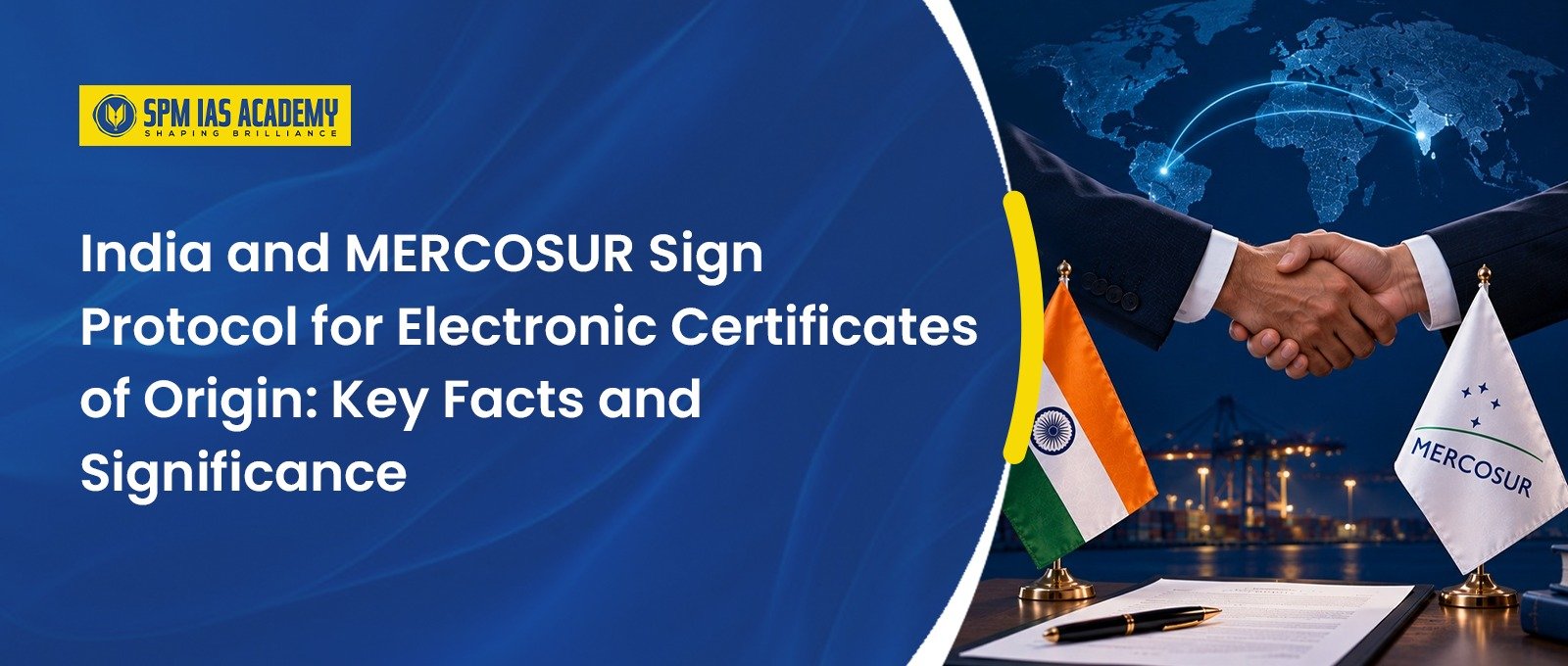
India and MERCOSUR have taken a major step towards paperless trade. Both sides signed the First Additional Protocol to the India-MERCOSUR Preferential Trade Agreement (PTA). The agreement allows both sides to accept Certificates of Origin in electronic form instead of relying only on paper documents.
The move will modernise customs procedures, reduce transaction costs and speed up preferential trade. It also strengthens India’s economic engagement with the major South American trading bloc.
The article discusses PTA, MERCOSUR and its relation with India. It is important for UPSC, APSC and other state PCS Prelims and Mains GS 2 Paper. This development is important for International Relations, Indian Economy, regional trade agreements and digital trade facilitation.
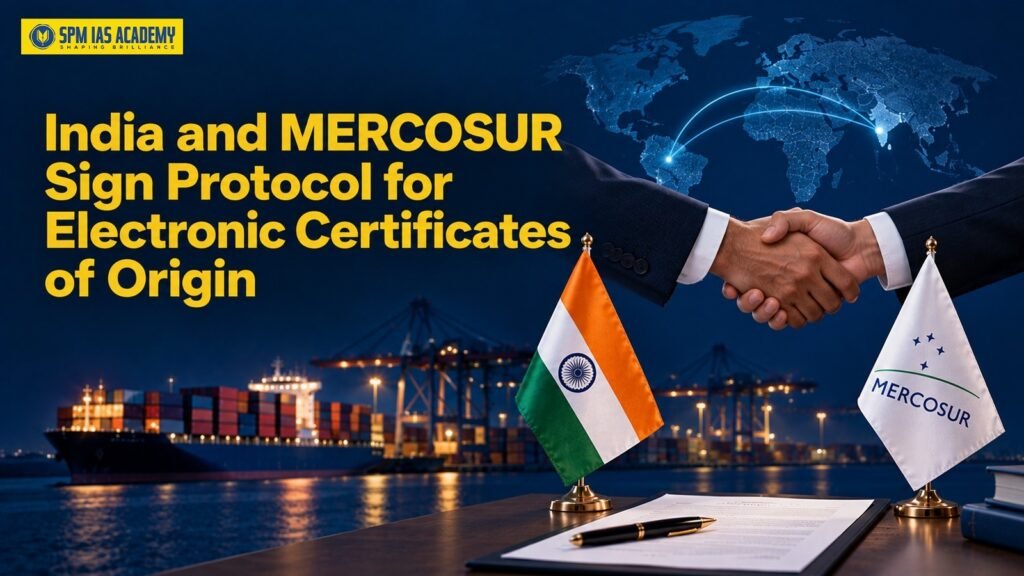
India and MERCOSUR Sign First Additional Protocol
- India and MERCOSUR signed the First Additional Protocol to facilitate the acceptance of electronic Certificates of Origin.
- Under the new arrangement, a Certificate of Origin issued electronically will have the same legal validity and value as a paper certificate.
- However, authorities must issue and electronically sign these certificates according to the respective domestic laws of both sides.
Therefore, the agreement does not change the basic rules of preferential trade. Instead, it makes the documentation process faster and more efficient.
What is MERCOSUR?
- MERCOSUR, or the Southern Common Market, is an important economic and trade grouping in South America.
- The bloc comprises Brazil, Argentina, Paraguay, Uruguay and Bolivia.
- MERCOSUR aims to promote economic integration and trade among its members. For India, the grouping also provides an important platform to deepen economic engagement with South America.
The latest agreement between India and MERCOSUR reflects the growing focus on reducing trade barriers through digital documentation.
What is the India–MERCOSUR Preferential Trade Agreement?
The Preferential Trade Agreement (PTA) came into effect on 1 June 2009. Under the agreement, both sides provide preferential tariff concessions on selected products.
| Key Feature | Details |
| Agreement | India-MERCOSUR PTA |
| Effective from | 1 June 2009 |
| India’s concessions | 450 tariff lines |
| MERCOSUR’s concessions | 452 tariff lines |
| Latest development | Electronic Certificates of Origin |
Unlike a comprehensive FTA, a PTA generally provides tariff benefits on a selected range of products rather than covering substantially all trade between the partners.
Therefore, the India-MERCOSUR Preferential Trade Agreement (PTA) represents a targeted approach to improving bilateral trade.
What are Certificates of Origin?
- Certificates of Origin prove that goods originated in a particular country or trading partner.
- For example, when an importer seeks preferential customs duty under a trade agreement, the importer must establish that the product actually originated in an eligible partner country.
- This prevents goods from a third country from wrongly receiving tariff benefits available under a PTA or FTA.
Thus, Certificates of Origin play an important role in implementing preferential trade agreements.
How Will Electronic Certificates of Origin Help Trade?
Earlier, businesses depended largely on paper-based Certificates of Origin. The new protocol allows both sides to move towards electronic documentation.
This change can provide several benefits like faster customs processing, lower transaction costs for exporters and importers. Moreover, it can reduce processing time for issuing and verifying documents. Furthermore, it will promote paperless trade through greater use of digital systems and better trade efficiency under the existing PTA.
Most importantly, electronic certificates will carry the same legal value as their paper counterparts.
Significance of India and MERCOSUR Agreement
The latest protocol is significant because it combines trade facilitation with digitalisation.
- First, businesses can complete documentation more efficiently. This can make preferential tariffs easier to access.
- Second, digital documentation can simplify customs procedures and reduce administrative delays.
- Third, the agreement strengthens India’s commercial relationship with an important South American economic grouping.
- Finally, the development supports the broader global shift towards paperless and technology-driven international trade.
For India and this South American bloc, the protocol is more than a technical change. It provides a practical mechanism to make their existing trade agreement work more efficiently.
India and MERCOSUR: Key Facts to Remember
- India and the countries of MERCOSUR established their PTA to promote preferential trade between India and the South American bloc. It has been operational since 1 June 2009.
- India provides tariff concessions on 450 tariff lines, while the MERCOSUR side provides concessions on 452 tariff lines.
- The First Additional Protocol now gives electronic Certificates of Origin the same legal validity as paper certificates. Therefore, it marks an important step towards faster, cheaper and more efficient paperless trade.
Conclusion
The latest agreement between India and this South American bloc modernises an important part of their existing trade framework. By recognising electronic Certificates of Origin, both sides can reduce paperwork, transaction costs and processing time.
Moreover, the First Additional Protocol strengthens the India-MERCOSUR Preferential Trade Agreement by adapting it to digital trade practices. The development also highlights India’s growing economic engagement with South America and the wider shift towards efficient, paperless global trade.
Read More:
Source:
Frequently asked questions
1. What is the India-MERCOSUR Preferential Trade Agreement?
It is a preferential trade agreement which provides tariff concessions on selected products. It came into effect on 1 June 2009 and promotes trade between India and MERCOSUR countries.
2. What is MERCOSUR and which countries are its members?
MERCOSUR, or the Southern Common Market, is a South American trade bloc. It includes Brazil, Argentina, Paraguay, Uruguay and Bolivia and promotes regional economic integration.
3. What are Certificates of Origin in international trade?
Certificates of Origin verify where exported goods originate. Therefore, importers use them to claim eligible preferential tariff benefits under agreements such as the India-MERCOSUR PTA.
4. How will electronic Certificates of Origin benefit India and MERCOSUR?
Electronic Certificates of Origin will reduce paperwork, transaction costs and processing time. Moreover, they will simplify customs procedures and promote faster, more efficient paperless trade.

Behind every article at SPM IAS Academy is a team of skilled content writers and subject experts committed to making preparation easier for aspirants. From answering common doubts to breaking down complex issues and current affairs, we create content that is accurate, easy to understand, and directly useful for UPSC, APSC, and other competitive exams.