
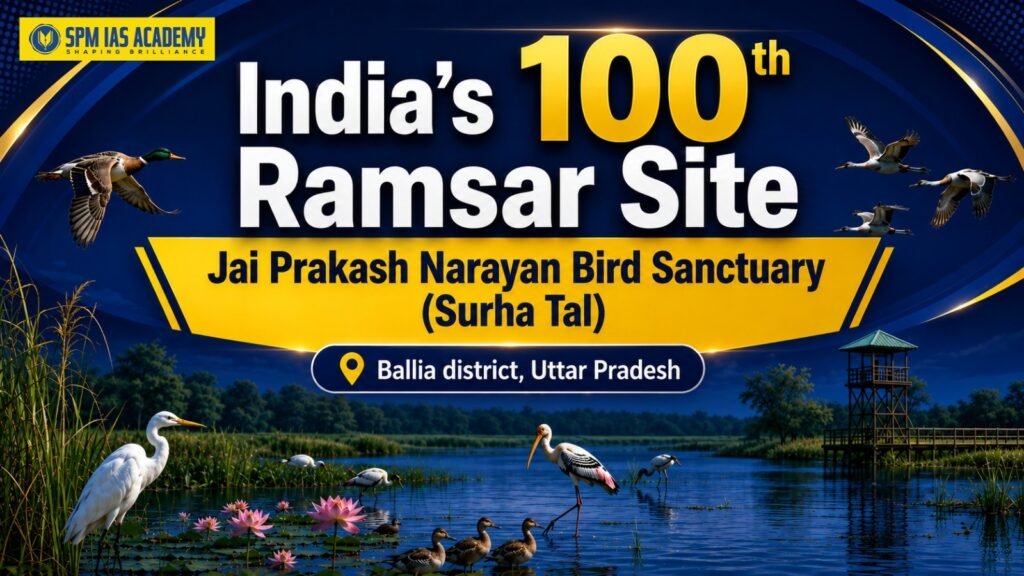
India’s 100th Ramsar site is Jai Prakash Narayan Bird Sanctuary, also known as Surha Tal, located in Ballia district of Uttar Pradesh. India achieved this major wetland conservation milestone on 5 June 2026, when Surha Tal received the Ramsar tag as a Wetland of International Importance. Prime Minister Narendra Modi also welcomed the milestone and said the wetland is rich in avifaunal biodiversity and attracts migratory as well as resident birds.
This is important for UPSC, APSC, State PCS, and other competitive exams. It connects current affairs with environment, ecology, biodiversity, wetland conservation, Ramsar Convention, water security and climate resilience.
What is India’s 100th Ramsar Site?
India’s 100th Ramsar site is Jai Prakash Narayan Bird Sanctuary. It is popularly known as Surha Tal and located in Ballia, Uttar Pradesh. It became India’s 100th Wetland of International Importance under the Ramsar Convention on World Environment Day, 5 June 2026.
Surha Tal is important because it supports rich bird life. It attracts both migratory and resident birds. Moreover, its recognition shows India’s growing focus on wetland protection and biodiversity conservation.
Why is Surha Tal Important?
Surha Tal is important because it supports avifaunal biodiversity and acts as a valuable freshwater wetland ecosystem. The wetland attracts several migratory and resident birds. Therefore, it plays a major role in bird conservation, local ecology and wetland-based livelihoods.
Moreover, Surha Tal lies in the Ganga floodplain landscape. Such wetlands help store water, recharge groundwater, reduce flood impacts, support fisheries and provide habitat for aquatic species.
Key Importance of Surha Tal
- Surha Tal supports both migratory and resident birds. Therefore, it plays an important role in bird conservation and wetland biodiversity.
- Moreover, it strengthens India’s wetland conservation network. Its Ramsar recognition marks an important milestone in India’s environmental protection efforts.
- Surha Tal also contributes to biodiversity protection. It provides habitat to birds, aquatic species, plants, and other wetland organisms.
- In addition, it supports local ecological balance. The wetland helps maintain natural water cycles and supports nearby ecosystems.
- Furthermore, Surha Tal improves water and climate security. It helps in water storage, groundwater recharge, and climate resilience.
Overall, it gives Uttar Pradesh a stronger place in wetland conservation. The Ramsar tag increases the state’s role in protecting important freshwater ecosystems.
Where is Jai Prakash Narayan Bird Sanctuary (Surha Tal) Located?
Surha Tal is located in Ballia district of Uttar Pradesh. It is also known as Jai Prakash Narayan Bird Sanctuary. The wetland lies near Ballia city and forms part of the broader Ganga floodplain system.
According to available geographical descriptions, Surha Tal is a natural lake in Ballia district. It is connected with the Ganga through an outlet channel known as Kathar Nala.
This location gives Surha Tal ecological value because floodplain wetlands support fish, birds, aquatic vegetation and local communities.
India’s 100th Ramsar Site and Uttar Pradesh
With Surha Tal’s inclusion, Uttar Pradesh has gained another important Ramsar site. Reports identify Surha Tal as Uttar Pradesh’s 13th Ramsar site. This makes Uttar Pradesh one of the important Indian states for wetland conservation.
Earlier, Shekha Jheel Bird Sanctuary in Aligarh became a Ramsar site and took India’s total to 99. Surha Tal then became India’s 100th Ramsar site.
What is a Ramsar Site?
A Ramsar site is a wetland recognised as a Wetland of International Importance under the Ramsar Convention. These wetlands get international recognition because they support biodiversity, water security, ecosystem services and sustainable use.
The Ramsar Convention encourages countries to designate wetlands that are rare, representative, unique or important for conserving biological diversity. Once designated, countries commit to conserve and wisely use these wetlands through proper management frameworks.
Ramsar Convention: Key Facts for UPSC and APSC
The Ramsar Convention is an international treaty for wetland conservation. It was adopted in Ramsar, Iran, in 1971. It provides a global framework for the conservation and wise use of wetlands.
India became a party to the Ramsar Convention on 1 February 1982. Since then, India has expanded its Ramsar network steadily.
Important Ramsar Convention Facts
- It was adopted in Ramsar, Iran.
- It was adopted in 1971.
- It focuses on wetlands.
- It promotes conservation and wise use.
- India joined the Convention in 1982.
- Ramsar sites are Wetlands of International Importance.
- World Wetlands Day is observed on 2 February.
Why Are Wetlands Important?
Wetlands are among the most productive ecosystems on Earth. They support plants, birds, fish, reptiles, mammals and microorganisms. Moreover, wetlands help people by providing water, food, livelihood and protection from disasters.
Importance of Wetlands
- Wetlands support rich biodiversity. Many birds, fishes, reptiles, amphibians, aquatic plants, and other species depend on wetlands for survival.
- Moreover, wetlands reduce flood impact. They absorb excess rainwater and slow down floodwater during heavy rainfall.
- Wetlands also recharge groundwater. They help maintain local water tables and support water availability in nearby areas.
- In addition, wetlands improve water quality. They filter pollutants, sediments, and excess nutrients from water.
- Furthermore, wetlands support local livelihoods. Many communities depend on wetlands for fisheries, agriculture, tourism, and other nature-based activities.
- Wetlands also help in climate regulation. They store carbon and reduce the impact of climate change.
- Finally, wetlands support migratory birds. Many wetlands act as feeding, breeding, and resting sites for birds during migration.
Therefore, wetland conservation is essential for biodiversity protection, climate action, water security, and sustainable development.
India’s Ramsar Sites: Growth and Conservation Milestone
India reaching 100 Ramsar sites marks a major achievement in wetland conservation. Until 2014, India had 26 Ramsar sites. Since then, the number has increased significantly through new designations across different states and ecosystems.
This growth shows India’s stronger policy focus on wetland mapping, biodiversity conservation and ecosystem protection.
India’s 100th Ramsar Site and World Environment Day 2026
India designated Surha Tal as India’s 100th Ramsar site on 5 June 2026, which is also World Environment Day. This timing adds more symbolic value to the achievement.
World Environment Day focuses on environmental awareness and action. Therefore, the Ramsar recognition of Surha Tal highlights the importance of wetlands in climate action, biodiversity conservation and sustainable living.
What Birds Can I See at Surha Tal?
At Surha Tal, visitors can see both migratory and resident birds, especially during the winter season. The wetland attracts species such as greylag goose, northern pintail, common teal, bar-headed goose, sarus crane, herons, and cormorants. Moreover, its rich wetland ecosystem provides feeding and resting space for birds coming from regions like Central Asia and Siberia. Therefore, Surha Tal is important for birdwatching, avifaunal biodiversity, and wetland conservation in Uttar Pradesh.
What Makes Surha Tal a Ramsar Site?
Surha Tal qualifies as a Ramsar site because it has high ecological and biodiversity value. It supports many migratory and resident birds, making it important for avifaunal biodiversity. Moreover, this freshwater wetland helps maintain local ecological balance by supporting aquatic plants, fishes, birds, and other species. It also contributes to water storage, groundwater recharge, and climate resilience. Therefore, Surha Tal’s designation as India’s 100th Ramsar site highlights its importance in wetland conservation, biodiversity protection, and sustainable ecosystem management.
What is Special About India’s 100th Ramsar Site?
- India’s 100th Ramsar site marks a historic milestone in wetland conservation. It shows India’s growing commitment to protecting important wetlands.
- Jai Prakash Narayan Bird Sanctuary, also known as Surha Tal, became India’s 100th Ramsar site. It is located in Ballia district of Uttar Pradesh.
- Moreover, this recognition came on 5 June 2026. This made the achievement more meaningful because the date also marks World Environment Day.
- Surha Tal holds special ecological value. It supports rich avifaunal biodiversity and attracts both migratory and resident birds.
- In addition, the Ramsar tag gives Uttar Pradesh a stronger role in India’s wetland conservation network. Surha Tal became one of the important protected wetlands of the state.
Therefore, India’s 100th Ramsar site is special because it combines history, biodiversity, climate action, and wetland protection. It also strengthens India’s global image in environmental conservation.
How Many Ramsar Sites Are There in Uttar Pradesh?
Uttar Pradesh has 13 Ramsar sites after the designation of Jai Prakash Narayan Bird Sanctuary, also known as Surha Tal, in Ballia district. Earlier, Shekha Jheel Bird Sanctuary became Uttar Pradesh’s 12th Ramsar site and India’s 99th Ramsar site. After that, Surha Tal received the Ramsar tag on 5 June 2026, taking India’s total Ramsar sites to 100 and Uttar Pradesh’s count to 13. Therefore, Uttar Pradesh now holds an important place in India’s wetland conservation network.
India’s 100th Ramsar Site for UPSC, APSC and State PCS
India’s 100th Ramsar site is important for Prelims, Mains and interview. Questions may ask direct facts or analytical points.
Important Prelims Facts
- India’s 100th Ramsar site is Surha Tal.
- It is also called Jai Prakash Narayan Bird Sanctuary.
- It is located in Ballia, Uttar Pradesh.
- It was designated on 5 June 2026.
- It is linked with migratory and resident birds.
- It is Uttar Pradesh’s 13th Ramsar site.
- Ramsar Convention was adopted in 1971.
- India joined the Ramsar Convention in 1982.
For APSC, aspirants should also link this topic with Deepor Beel, Assam’s Ramsar site. Deepor Beel can be used as an Assam-specific example in answers on wetland conservation.
What are the Threats to Wetlands in India?
- Encroachment is one of the biggest threats to wetlands in India. Urban expansion, construction, and illegal land use reduce wetland area.
- Moreover, sewage and industrial pollution damage wetland ecosystems. Untreated waste affects water quality and harms aquatic life.
- Plastic waste also creates a serious problem. It blocks water flow, harms birds and fishes, and reduces the ecological health of wetlands.
- In addition, invasive species disturb native biodiversity. They compete with local plants and animals and weaken the natural balance of wetlands.
- Excessive tourism pressure also affects wetlands. Unregulated tourism can cause littering, noise pollution, habitat disturbance, and water pollution.
- Furthermore, overfishing reduces aquatic biodiversity. It affects fish populations and disturbs the food chain.
- Siltation slowly reduces the depth of wetlands. As a result, wetlands lose their water-holding capacity.
- Climate change increases wetland stress. Irregular rainfall, rising temperatures, floods, and droughts affect wetland ecosystems.
- Changes in natural water flow also harm wetlands. Dams, drainage changes, and water diversion reduce their ecological functions.
- Weak local governance makes conservation difficult. Poor monitoring, lack of enforcement, and low community participation increase wetland degradation.
Therefore, Ramsar status alone cannot protect wetlands. India needs effective wetland management, strict pollution control, local monitoring, and active community participation.
India’s 100th Ramsar Site: Quick Facts
| Particulars | Details |
| India’s 100th Ramsar site | Jai Prakash Narayan Bird Sanctuary |
| Popular name | Surha Tal / Surha Taal |
| Location | Ballia district, Uttar Pradesh |
| Ramsar designation date | 5 June 2026 |
| State significance | Uttar Pradesh’s 13th Ramsar site |
| Wetland type | Freshwater wetland linked with the Ganga floodplain |
| Main importance | Bird diversity, migratory birds, wetland ecosystem |
Conclusion
In conclusion, India’s 100th Ramsar site is Jai Prakash Narayan Bird Sanctuary, also known as Surha Tal, in Ballia district of Uttar Pradesh. Its designation on 5 June 2026 marks a major milestone in India’s wetland conservation journey. Moreover, Surha Tal’s rich avifaunal biodiversity, migratory birds and freshwater ecosystem make it important for biodiversity protection. For UPSC, APSC and State PCS exams, students must study about India’s 100th Ramsar site, Ramsar Convention, wetlands of international importance. Therefore, this topic is highly useful for both Prelims facts and Mains answer writing.
Source:
FAQs on 100 Ramsar Site
India’s 100th Ramsar site is Jai Prakash Narayan Bird Sanctuary, also known as Surha Tal, in Ballia district of Uttar Pradesh. It received the Ramsar tag on 5 June 2026.
Surha Tal is located in Ballia district of Uttar Pradesh. It is a freshwater wetland associated with the Ganga floodplain landscape.
Surha Tal is important because it supports rich avifaunal biodiversity. It attracts migratory and resident birds and strengthens India’s wetland conservation network.
A Ramsar site is a Wetland of International Importance designated under the Ramsar Convention. Countries protect these sites for biodiversity conservation and wise use.

Behind every article at SPM IAS Academy is a team of skilled content writers and subject experts committed to making preparation easier for aspirants. From answering common doubts to breaking down complex issues and current affairs, we create content that is accurate, easy to understand, and directly useful for UPSC, APSC, and other competitive exams.