
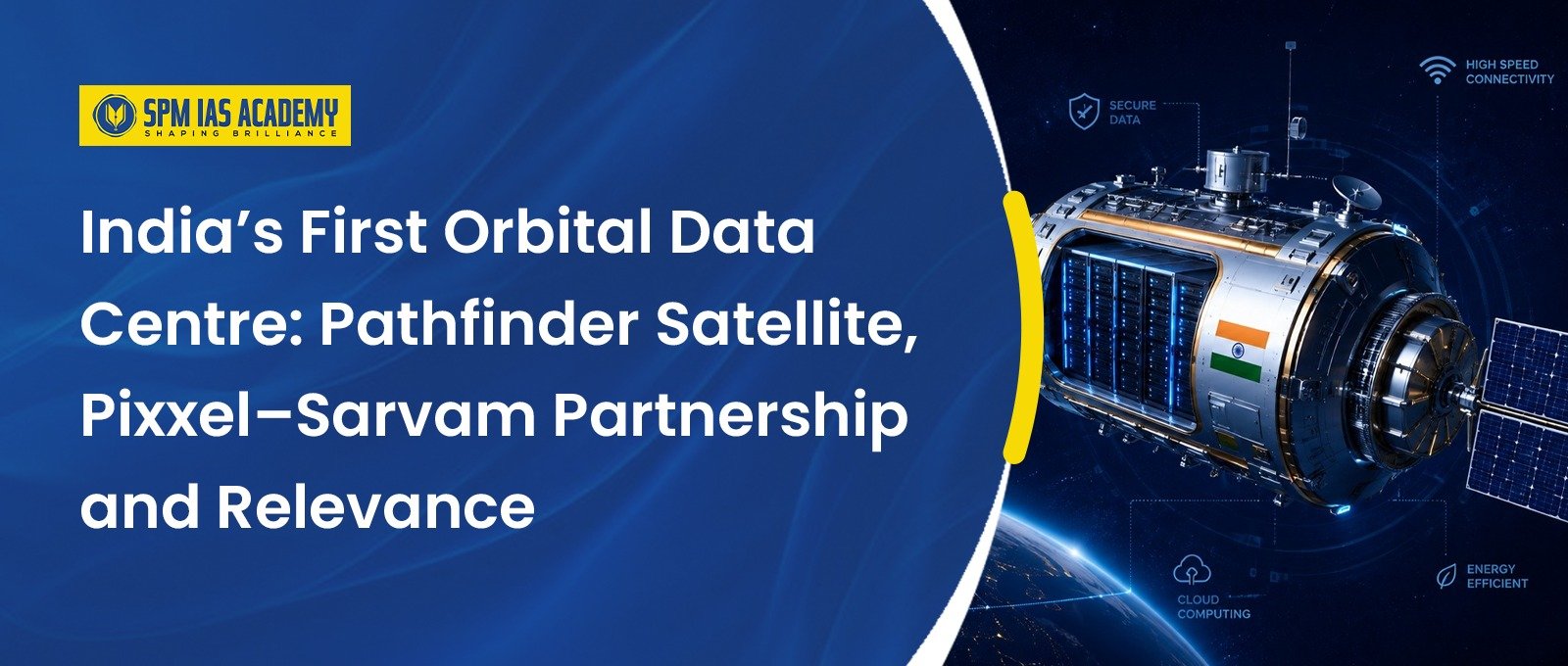
India’s first orbital data centre is a major milestone in India’s space-tech and artificial intelligence journey. Bengaluru-based space-tech company Pixxel and Indian AI company Sarvam AI have partnered to develop a satellite named Pathfinder, which is expected to function as India’s first orbital data centre satellite. The mission aims to place computer infrastructure in orbit so that data can be processed closer to where satellites generate it.
For UPSC, APSC, APPSC and other State PCS aspirants, this topic is important under Science and Technology, Space Technology, Artificial Intelligence, Digital Sovereignty, Data Infrastructure and India’s Private Space Sector.
India’s First Orbital Data Centre: Why is it in News?
- India’s first orbital data centre came into focus after Pixxel announced its partnership with Sarvam AI to build “Pathfinder”. Pathfinder is a satellite designed to carry data-centre-like computing capability in space.
- Pixxel will design, build, launch and operate the satellite, while Sarvam will provide the AI stack for model training and inference directly in orbit.
- This mission is important because satellites usually capture data and send it to Earth for processing. However, this model can create delays, increase bandwidth demand and slow real-time decision-making. Pathfinder tries to change this by processing data onboard the satellite itself.
What is India’s First Orbital Data Centre Satellite?
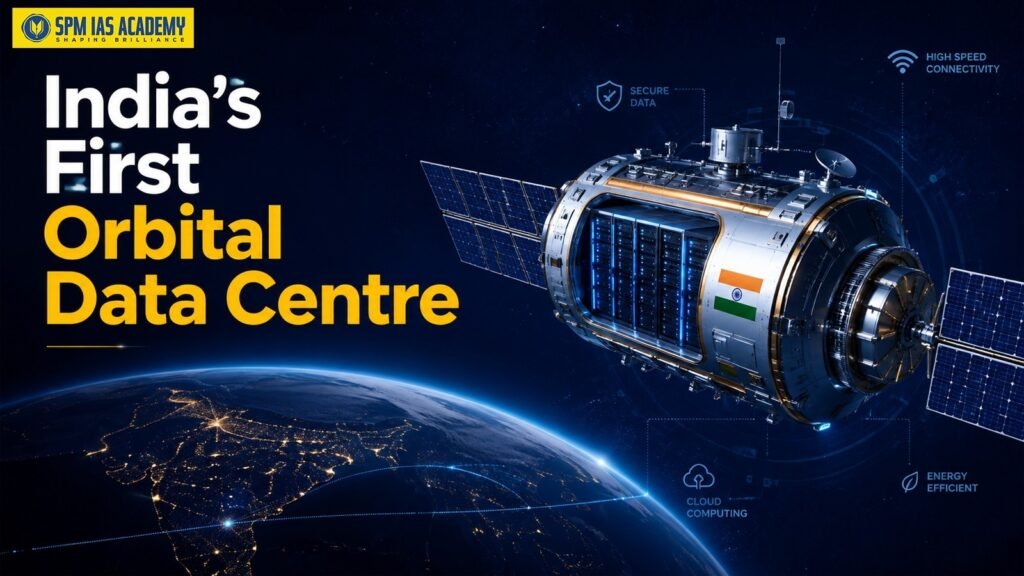
- India’s first orbital data centre refers to a satellite-based computing system that can process data in space instead of sending all raw data to ground stations. In simple terms, it works like a computer in space.
- The Pathfinder satellite will carry onboard computing infrastructure, including GPU-class hardware, to process Earth observation data in orbit.
- It will especially support hyperspectral imaging data, which can generate large volumes of information about land, water, crops, minerals, forests and pollution.
- Therefore, Pathfinder is not just another imaging satellite. It represents a shift from “data collection in space” to “data processing in space.”
How Will India’s First Orbital Data Centre Work?
- India’s first orbital data centre will work by combining satellite imaging with onboard artificial intelligence.
- First, the satellite will collect Earth observation data. Then, instead of sending all raw data to Earth, it will process selected data in orbit. After that, it can send more useful insights or compressed outputs to ground users.
- This process can reduce the need for heavy data transmission. It can also support faster decisions in sectors where time matters.
- For example, if a satellite detects crop stress, oil spills, forest fires or illegal mining, onboard AI can process the data quickly and send alerts. This can help governments, disaster agencies, farmers, defence users and environmental regulators.
Why is India’s First Orbital Data Centre Important?
India’s first orbital data centre matters for several reasons.
- First, it strengthens real-time Earth observation. Traditional satellite systems may take time to send and process data on Earth. In-orbit processing can speed up actionable insights.
- Secondly, it reduces pressure on ground-based infrastructure. Satellites produce massive data, especially hyperspectral satellites. Processing data onboard can reduce bandwidth needs and data-transfer delays.
- Moreover, it supports sovereign AI infrastructure. Sarvam AI has stated that India-built models running aboard an India-built satellite can help India control its own intelligence infrastructure.
In addition, this mission supports India’s private space ecosystem. Companies like Pixxel show how Indian startups can move beyond satellite manufacturing into advanced space-data services.
Applications of India’s First Orbital Data Centre
India’s first orbital data centre can support multiple sectors:
- Agriculture: Orbital data centre can help in crop health monitoring, drought stress detection and pest risk analysis.
- Disaster management: faster alerts for floods, forest fires and landslides. It will help to prepare rescue and rehabilitation measures in advance.
- Environment: Moreover, orbital data centres can help in pollution tracking, wetland monitoring and biodiversity mapping. It will integrate space technology with environmental conservation.
- Urban governance: Furthermore, it can be used in urban governance. It will help in land-use mapping and infrastructure monitoring. Thus, it will strengthen the land records maintenance and land governance system in India.
- Defence and security: It can provide faster satellite intelligence and surveillance support. Moreover, it can play a crucial role in counter-terrorism operations.
Thus, Pathfinder can help convert space data into governance-ready intelligence.
What are the Challenges Before India’s First Orbital Data Centre?
Despite its promise, India’s first orbital data centre will face several challenges.
- The satellite must manage high computing power, heat generation, radiation exposure and limited onboard energy.
- Space hardware must also remain reliable because repairs are difficult after launch.
- Moreover, AI models in orbit need strong cybersecurity, data governance and mission-level reliability.
- There is also a policy challenge. India must develop clear norms for space-based data processing, private-sector participation, AI safety, data access and strategic security.
Conclusion
India’s first orbital data centre marks an important step in India’s journey from being a satellite user to becoming a space-data and AI infrastructure innovator. The Pathfinder mission by Pixxel and Sarvam AI aims to bring computing power into orbit and process data closer to its source. Therefore, it can improve real-time decision-making, reduce data transmission pressure and strengthen India’s sovereign AI capabilities.
Read More:
Source:
Frequently Asked Questions
1. What is India’s first orbital data centre?
India’s first orbital data centre refers to a satellite-based computing system that can process data directly in space. Pixxel and Sarvam AI are developing the Pathfinder satellite to analyse Earth observation data in orbit instead of sending all raw data to ground stations.
2. Why is India’s first orbital data centre important?
India’s first orbital data centre is important because it can reduce data transmission delays, support real-time Earth observation and strengthen India’s sovereign AI infrastructure. Moreover, it can help in agriculture, disaster management, environment monitoring, urban governance and defence.
3. How will the Pathfinder satellite support India’s space-tech ecosystem?
The Pathfinder satellite will support India’s space-tech ecosystem by combining onboard computing, artificial intelligence and hyperspectral imaging. Therefore, it will help Indian startups move beyond satellite manufacturing and build advanced space-data services for governance, security and development.

Behind every article at SPM IAS Academy is a team of skilled content writers and subject experts committed to making preparation easier for aspirants. From answering common doubts to breaking down complex issues and current affairs, we create content that is accurate, easy to understand, and directly useful for UPSC, APSC, and other competitive exams.