
The Fiscal Health Index (FHI) 2026, released by NITI Aayog, evaluates the financial health of Indian states across five pillars. Among the 18 major states, Odisha ranks first. Among the 10 North-Eastern and Himalayan states, Arunachal Pradesh tops the list with a score of 59.5, followed by Uttarakhand and Tripura. Assam ranks fifth in this category. This annual index is a high-priority topic for UPSC, APSC, and all State PCS examinations.
Students preparing for civil services can explore coaching classes for upsc in assam for structured guidance and expert mentorship.
What Is the Fiscal Health Index 2026?
NITI Aayog publishes the Fiscal Health Index (FHI) to give a clear picture of how well Indian states manage their fiscal health. The FHI 2026 is the second edition of this report, and it covers the financial year 2023-24. The report analyses fiscal trends from FY 2014-15 to FY 2023-24, giving a ten-year view of each state’s financial journey.
This edition is especially important because NITI Aayog has now included the 10 North-Eastern and Himalayan states along with the 18 major states. These two groups are assessed separately, because the Northeastern and Himalayan states face unique challenges such as difficult terrain, sparse population, high delivery costs, and heavy dependence on Central government transfers.
Moreover, the Fiscal Health Index draws its data from the Comptroller and Auditor General (CAG). This makes the index one of the most credible and transparent fiscal assessments available.
Regularly following currentaffairs helps aspirants track reports like FHI for UPSC and APSC preparation.
The Five Pillars of the Fiscal Health Index
The FHI assesses every state on five clearly defined parameters. Understanding these pillars helps you answer both factual and analytical questions in the UPSC Prelims and Mains, as well as the APSC and other State PCS exams.
| No. | Pillar | What It Measures |
|---|---|---|
1 | Quality of Expenditure | How much a state spends on development versus non-productive items like salaries and pensions. |
2 | Revenue Mobilisation | How effectively a state generates its own revenue through taxes and non-tax sources. |
3 | Fiscal Prudence | Whether a state keeps its fiscal deficit within manageable limits and follows FRBM norms. |
4 | Debt Index | The level and composition of outstanding liabilities relative to the state’s economy. |
5 | Debt Sustainability | Whether the state can manage its debt repayment obligations without compromising growth. |
FHI 2026 Rankings: 18 Major States
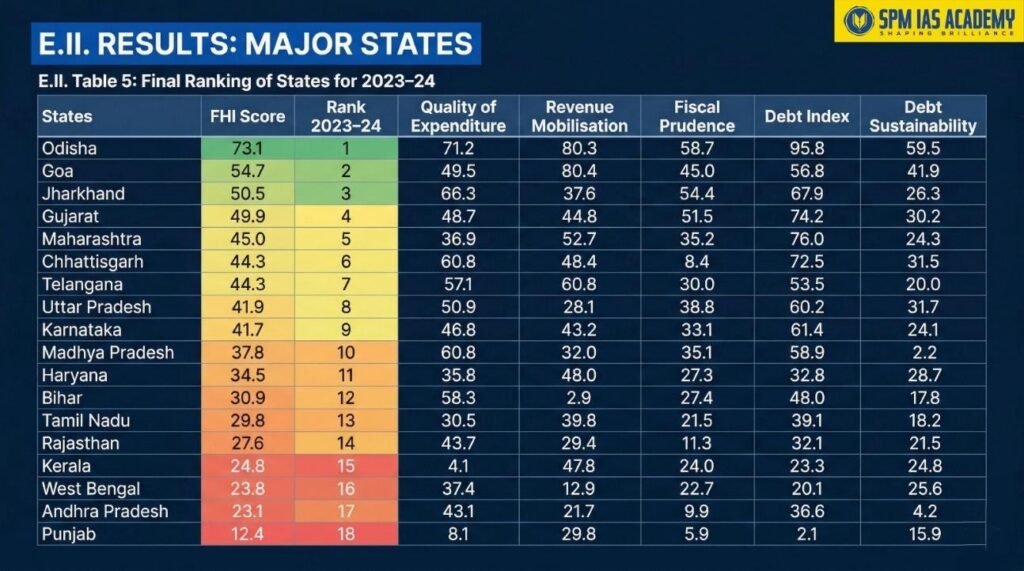
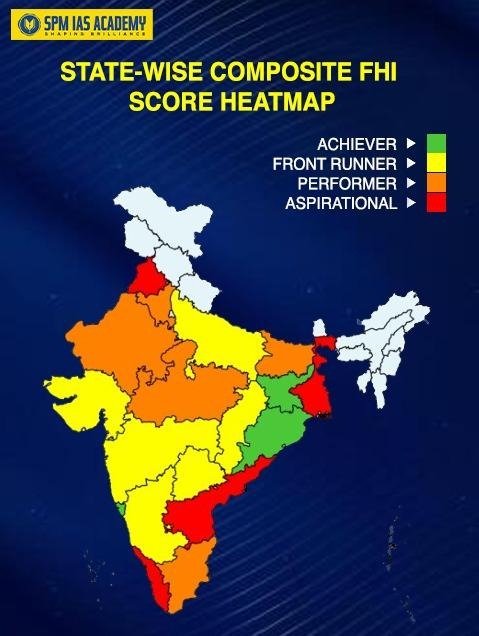
Odisha continues to dominate among the 18 major states. It controls its deficit tightly, maintains stable revenues, and ranks as the top Achiever for the second time in a row. Meanwhile, states like Punjab, Kerala, and West Bengal remain at the bottom because they carry high debt, persistent deficits, and modest revenue growth.
Notable Movers in Major States
Several states changed their positions significantly this year. Bihar improved from Aspirational to Performer – a positive signal of better deficit management. On the other hand, Karnataka and Telangana slipped from Front Runner to Performer, while Kerala and Tamil Nadu moved further down to the Aspirational group, highlighting growing fiscal pressures in these states.
Furthermore, Haryana recorded a notable improvement of three ranks – one of the biggest jumps this year. This kind of data point often appears in UPSC Prelims questions, so keep it handy.
FHI 2026 Rankings: North-Eastern and Himalayan States
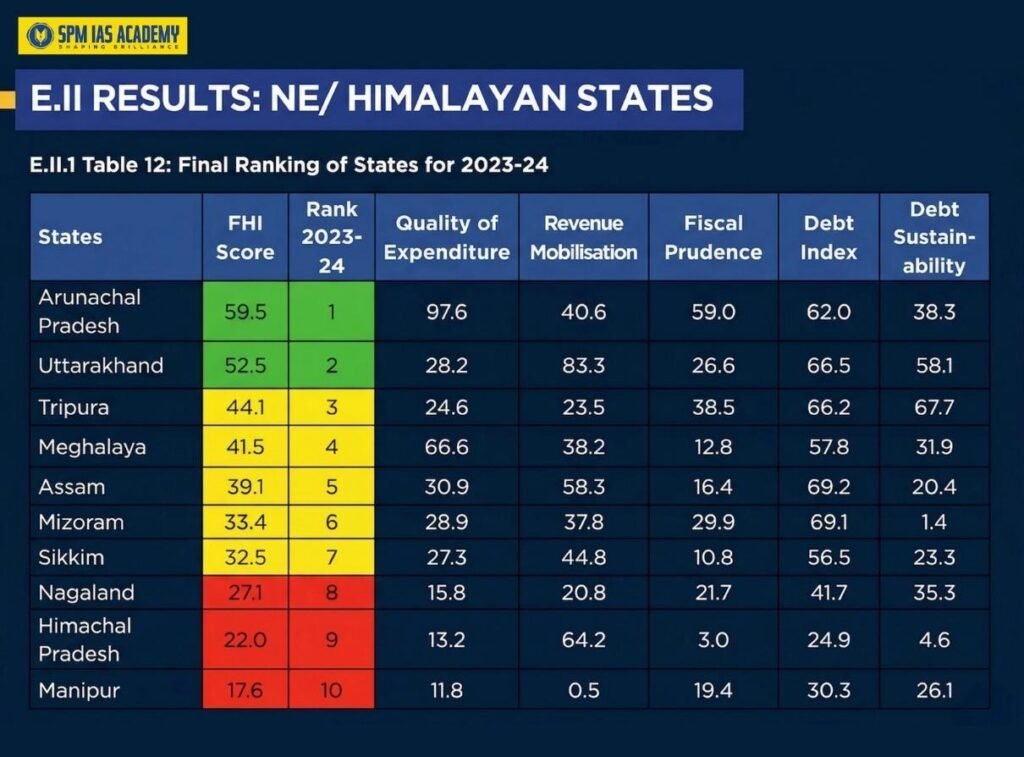
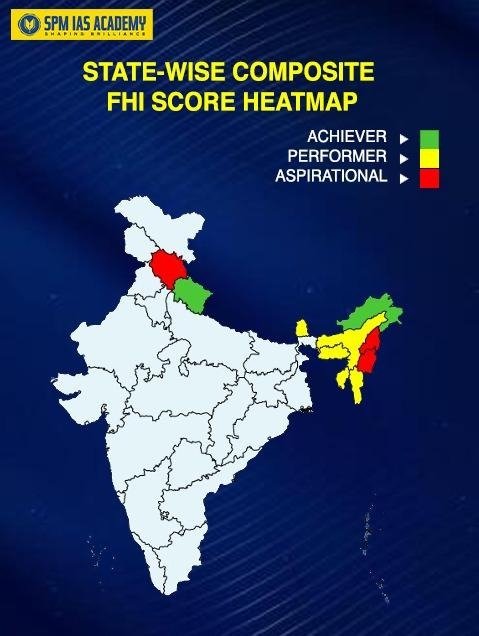
Among the 10 NE and Himalayan states, the rankings reveal wide variation. These states face structural challenges that major states do not. They depend heavily on Central transfers, have lower own-revenue capacity, and operate with higher service delivery costs.
Why Arunachal Pradesh Leads
Arunachal Pradesh earns the top rank because it scores exceptionally well in Quality of Expenditure. Additionally, it maintains strong performance in both Fiscal Prudence and the Debt Index. The state manages to keep deficits low and sometimes even records surpluses – a rare achievement among NE states. Its capital outlay and developmental spending also exceed two-thirds of total expenditure, further strengthening its score.
Why Uttarakhand Ranks Second
Uttarakhand secures second place primarily through very high Revenue Mobilisation. Unlike many other NE and Himalayan states that rely heavily on Central transfers, Uttarakhand generates a comparatively stronger share of its own revenue. This, combined with strong scores in the Debt Index and Debt Sustainability, places it firmly in the Achiever category.
Assam’s Fiscal Profile: Detailed Analysis
Assam currently ranks fifth among the Ten NE/Himalayan states.
Key Statistical Snapshot: Assam 2023-24
| Indicator | Value |
|---|---|
| FHI Score | 39.1 (Rank 5 among NE/Himalayan states) |
| CAGR of Own Revenue (2020-21 to 2023-24) | ~14% |
| Own Revenue (2020-21) | Rs 20,033 crore |
| Own Revenue (2023-24) | Rs 34,081 crore |
| Gross Fiscal Deficit as % of GSDP (2023-24) | 3.7% (2023-24) |
| Gross Fiscal Deficit as % of GSDP (peak, 2022-23) | 5.9% (2022-23) |
| Developmental Spending as % of Total Expenditure | ~64% (2023-24) |
| Dependence on Central Transfers | 38.4% of revenue receipts |
| Growth in Outstanding Liabilities (2020-21 to 2023-24) | ~67% |
| Growth in Interest Payments (2020-21 to 2023-24) | ~57% |
| Interest-to-Revenue Receipts Ratio (2023-24) | ~8-9% |
| Committed Expenditure (% of revenue receipts) | Over 62% |
Assam’s Strengths
- First, Assam has shown solid revenue growth. The state’s own revenue rose from Rs 20,033 crore in 2020-21 to Rs 34,081 crore in 2023-24. It reflected a CAGR of nearly 14 per cent. This clearly shows improving revenue mobilisation capacity over the past few years.
- Second, the state maintained a strong focus on development. Developmental expenditure rose by nearly 39 per cent between 2020-21 and 2023-24. In 2023-24, developmental spending accounted for 64 per cent of total expenditure. It reflected sustained investment in infrastructure, education, health, and welfare schemes.
Assam’s Weaknesses and Challenges
However, Assam carries several structural vulnerabilities. The state still depends heavily on Central transfers, which make up 38.4 per cent of revenue receipts in 2023-24. This limits Assam’s fiscal autonomy and makes it sensitive to changes in Central devolution policies.
Furthermore, committed expenditure – salaries, pensions, and interest payments – consumes over 62 per cent of revenue receipts. This leaves very little room for fresh spending initiatives or emergency responses.
Additionally, Assam’s Gross Fiscal Deficit (GFD) as a share of GSDP spiked sharply to 5.9 per cent in 2022-23, up from 3.6 per cent in 2020-21. Although it partially recovered to 3.7 per cent in 2023-24, this remains a concern. The state’s outstanding liabilities grew by 67 per cent and interest payments grew by 57 per cent between 2020-21 and 2023-24. The interest-to-revenue-receipts ratio also surged back to around 8-9 per cent in 2023-24, after briefly declining to 7.7 per cent.
Therefore, the FHI 2026 places Assam’s weak Fiscal Prudence as its biggest drag – pulling down an otherwise respectable performance in Revenue Mobilisation and Debt Index.
NITI Aayog’s Key Recommendations for Better Fiscal Health
The FHI 2026 report does not just rank states – it also guides them toward reform. According to NITI Aayog, states should focus on the following priority areas:
- First, states must broaden their GST base and strengthen own-tax capacity. Reducing Central transfer dependence is critical for long-term fiscal autonomy.
- Second, states need to rationalise subsidies and curb committed expenditure. Salary and pension bills crowd out developmental spending, so states must reform their pay structures and adopt new pension models.
- Third, improving capital spending quality matters more than just increasing its volume. States should adopt medium-term fiscal plans and transparent budgeting systems.
- Finally, states with persistent stress – especially Punjab, Kerala, and West Bengal – must control off-budget borrowings, implement better cash management, and adopt CAG-verified data for public financial management.
Conclusion:
The Fiscal Health Index 2026 is far more than a ranking exercise. It is a mirror of India’s fiscal federalism. It reveals how states allocate resources, manage debt, and chart their development path. For any serious UPSC, APSC, or State PCS aspirant, the FHI 2026 offers rich content for GS-3 (Indian Economy), GS-2 (Governance and Federalism), and even the Essay paper.
Arunachal Pradesh’s leadership among NE states, Odisha’s sustained excellence among major states, Assam’s mixed but improving trajectory, and the persistent stress in states like Punjab and Kerala – all these data points connect to larger themes of fiscal federalism, cooperative federalism, FRBM compliance, and Viksit Bharat 2047.
As you prepare for the UPSC Civil Services Examination 2026, the APSC Combined Competitive Examination, or any other State Public Service examination, integrate FHI 2026 data into your answer writing. Use it to add factual depth, cite NITI Aayog’s framework, and demonstrate analytical thinking. That is what separates a good answer from a great one.
Source:
Frequently Asked Questions:
The Fiscal Health Index 2026 is a report by NITI Aayog that evaluates the financial performance of Indian states using five key pillars. It helps aspirants understand fiscal trends for UPSC and APSC exams.
Odisha ranks first among major states, while Arunachal Pradesh tops the North-Eastern and Himalayan category due to strong fiscal management and development spending.
The Fiscal Health Index evaluates states based on Quality of Expenditure, Revenue Mobilisation, Fiscal Prudence, Debt Index, and Debt Sustainability. These pillars measure how efficiently states manage their finances.
Assam ranks fifth among the ten North-Eastern and Himalayan states. Although it shows strong revenue growth, challenges like high debt and fiscal deficit affect its ranking.
The Fiscal Health Index is important because it helps aspirants understand fiscal federalism, state finances, and economic governance. Therefore, it is highly relevant for GS papers and essay writing in UPSC and APSC exams.