
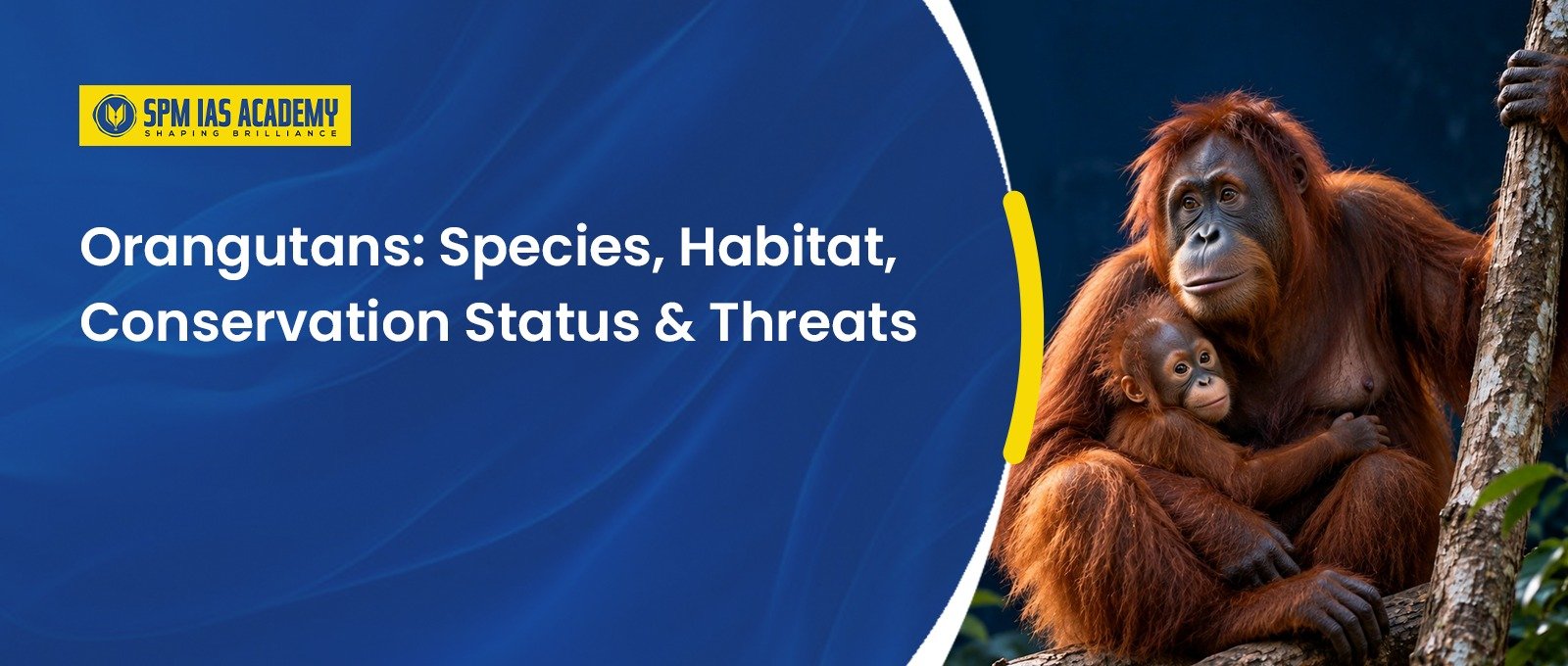
The Orangutans have recently come into the news after five juvenile orangutans were rescued from a forest area in Balasore, Odisha. Since orangutans are not native to India, authorities are investigating how they reached the area. Indonesia has also indicated its interest in their possible repatriation if their origin is confirmed. The case raises important questions about wildlife trafficking, CITES and international cooperation.
For UPSC, APSC and other State PCS exams, the topic is important under Environment & Ecology, Biodiversity, Conservation and International Conventions.

Why Are Orangutans in News?
The Orangutans were rescued from a coastal casuarina plantation in Balasore district. The Wildlife Crime Control Bureau (WCCB) and Odisha Police are investigating the case because orangutans naturally occur only in Borneo and Sumatra.
Preliminary assessments suggest that the rescued animals may be Sumatran orangutans. Therefore, investigators are examining the possibility of an organised transnational wildlife trafficking network.
If the investigation confirms that the animals came from Indonesia, India and Indonesia may need to coordinate their safe repatriation. This case also highlights the role of CITES, which regulates international trade in endangered wild animals and plants.
What Are Orangutans?
- Orangutans belong to the genus Pongo and are great apes, not monkeys. They are native to the tropical forests of Southeast Asia and represent the only great-ape genus found naturally in Asia. Their name comes from Malay and Indonesian words meaning “person of the forest.”
- Orangutans are highly intelligent and spend most of their lives in trees. They use their long arms, grasping hands and feet to move through the forest canopy. They also use tools and build sleeping nests in trees.
What are the Types of Orangutan Species?
Scientists recognise three living species of orangutans:
| Species | Scientific Name | Distribution | IUCN Status |
| Bornean Orangutan | Pongo pygmaeus | Borneo | Critically Endangered |
| Sumatran Orangutan | Pongo abelii | Sumatra | Critically Endangered |
| Tapanuli Orangutan | Pongo tapanuliensis | Sumatra | Critically Endangered |
The Tapanuli orangutan is particularly important because its population is very small and its range is restricted to the Batang Toru ecosystem of North Sumatra. All three species face a very high risk of extinction.
What are the characteristics of Orangutans?
The major characteristics of Orangutans include:
- They are arboreal mammals and spend most of their time in trees.
- They are the largest tree-dwelling mammals.
- Moreover, they have long, powerful arms and grasping hands and feet.
- They generally live a semi-solitary lifestyle.
- Their diet mainly consists of fruits, but they also eat leaves, bark, insects and other food.
- Notably, they play an important role as seed dispersers, supporting forest regeneration.
- Adult males may develop large cheek pads and throat sacs that help produce long-distance calls.
- Orangutans show advanced learning and tool-use abilities.
Orangutans Habitat and Distribution
- Today, wild Orangutans occur only on Borneo and Sumatra. Borneo is shared by Indonesia, Malaysia and Brunei, while Sumatra belongs to Indonesia. They occupy tropical rainforests, including lowland and peat-swamp forests.
- Their dependence on forests makes them highly vulnerable to habitat destruction. Logging, agricultural expansion and conversion of forests for palm oil production have reduced and fragmented their habitat.
Conservation Status and Major Threats
All three species of Orangutans are classified as Critically Endangered on the IUCN Red List.
The major threats for Orangutans include:
- Habitat loss and fragmentation
- Commercial logging
- Conversion of forests for agriculture and palm oil
- Hunting
- Illegal capture
- Wildlife trafficking and the illegal pet trade
- Forest fires and other environmental pressures
Their slow reproduction makes recovery difficult. Female orangutans generally have long intervals between births, while young remain dependent on their mothers for several years.
CITES and Orangutan Conservation
The Convention on International Trade in Endangered Species of Wild Fauna and Flora (CITES) is highly relevant to the Balasore case.
- Orangutans are listed under CITES Appendix I, which provides the highest level of protection under the Convention. The listing covers species threatened with extinction for which international commercial trade is generally prohibited, subject to the Convention’s rules and exceptions.
- Therefore, the Odisha rescue case is not only a wildlife-crime issue. It also demonstrates the importance of international cooperation, wildlife-trafficking investigations and CITES implementation.
Conclusion
The Orangutans are critically endangered great apes found naturally only in Borneo and Sumatra. The rescue of five juveniles in Odisha highlights the growing importance of tackling wildlife trafficking. Moreover, it also highlights the need to address the issue of habitat loss and illegal international trade through stronger domestic enforcement and international cooperation.
Read More:
Source:
Frequently asked questions
1. Why are orangutans in the news?
It is in the news after five juvenile orangutans were rescued from Balasore, Odisha. Authorities are investigating their possible link to Indonesia and a potential wildlife trafficking network.
2. What are the different types of orangutan species?
Scientists recognise three species. These are Bornean orangutan (Pongo pygmaeus), Sumatran orangutan (Pongo abelii), and Tapanuli orangutan (Pongo tapanuliensis). All three species are critically endangered.
3. What is the conservation status of orangutans?
The IUCN Red List classifies all the three types of this species as Critically Endangered. Therefore, protecting their rainforest habitat and preventing illegal wildlife trade remain important conservation priorities.

Behind every article at SPM IAS Academy is a team of skilled content writers and subject experts committed to making preparation easier for aspirants. From answering common doubts to breaking down complex issues and current affairs, we create content that is accurate, easy to understand, and directly useful for UPSC, APSC, and other competitive exams.