The Ozone layer acts as Earth’s natural protective shield against harmful ultraviolet radiation from the Sun. It contains a relatively high concentration of ozone (O₃), a molecule made of three oxygen atoms. Most atmospheric ozone occurs in the stratosphere, which is roughly 15-35 km above Earth’s surface.
It is important for UPSC, APSC and other State PCS examinations. It connects Environment and Ecology with climate change, international environmental agreements, human health and India’s environmental policies.
What Is Ozone Layer and Which Layer of the Atmosphere Contains this?
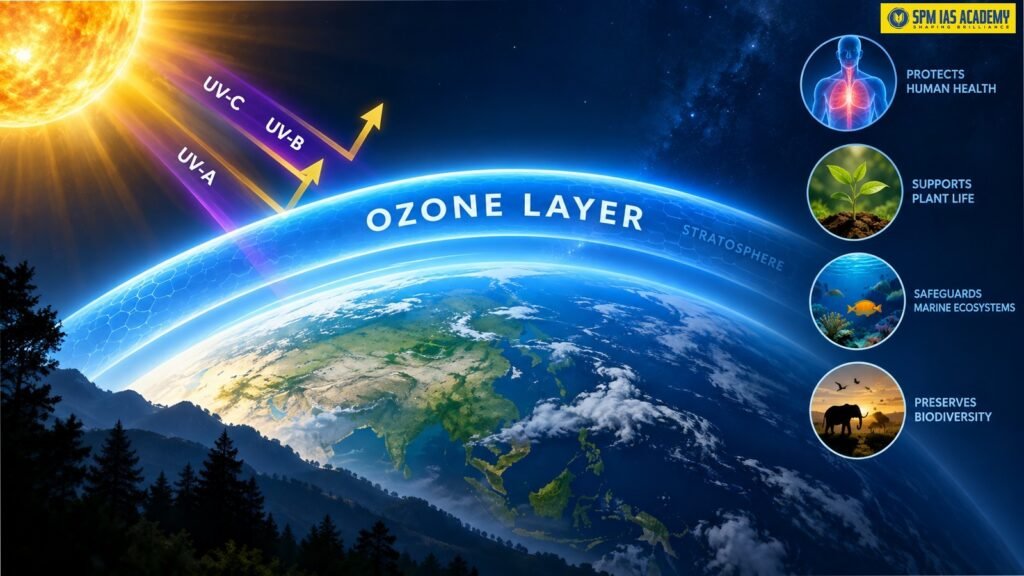
- The Ozone layer is a region of the stratosphere that contains most of Earth’s atmospheric ozone. The stratosphere extends roughly from 10 km to 50 km above Earth’s surface, while most atmospheric ozone is concentrated at around 15-35 km.
- Ozone contains three oxygen atoms (O₃). In contrast, the oxygen that humans breathe mainly exists as molecular oxygen (O₂).
- Most importantly, stratospheric ozone absorbs much of the Sun’s harmful UV-B radiation. Therefore, it protects humans, animals, plants and aquatic ecosystems from excessive ultraviolet exposure.
- French physicists Charles Fabry and Henri Buisson discovered the ozone layer in 1913.
- Later, British scientist Sydney Chapman explained its photochemical formation mechanism in 1930.
How Does the Formation of Ozone Layer Take Place?
The formation of the ozone layer depends mainly on sunlight and oxygen.
First, high-energy ultraviolet radiation breaks an oxygen molecule (O₂) into individual oxygen atoms. Scientists call this process photodissociation.
O₂ + UV radiation → O + O
Next, a free oxygen atom combines with another oxygen molecule to form ozone:
O + O₂ → O₃
At the same time, sunlight also breaks down ozone. Therefore, ozone undergoes a continuous cycle of formation and destruction in the stratosphere.
This natural balance maintains the protective ozone shield. Scientists believe that this protection played an important role in the development of life on land because it reduced exposure to dangerous ultraviolet radiation.
What Is UV Light?
- UV light, or ultraviolet radiation, forms part of the electromagnetic radiation produced by the Sun. Scientists generally divide it into UVA, UVB and UVC.
- The Ozone layer absorbs all UVC and much of the harmful UVB radiation. However, UVA is only weakly absorbed by ozone.
- UV-B is particularly important because excessive exposure can damage DNA and affect human health and ecosystems.
What Is the Impact of UV Light?
Higher exposure to UV-B radiation can create several environmental and health problems.
- Human health: UV-B increases the risk of skin cancer and cataracts. It can also affect the immune system.
- Plants: Excessive UV-B can damage plant tissues and influence crop productivity.
- Biodiversity: Increased UV exposure can change species composition in forests and grasslands.
- Aquatic ecosystems: UV-B can affect phytoplankton, which forms the foundation of many aquatic food webs.
- Aquatic animals: High UV exposure can damage the early developmental stages of fish, shrimp, crabs and amphibians.
- Biogeochemical cycles: Increased UV-B can influence terrestrial and aquatic nutrient and chemical cycles.
Therefore, protecting stratospheric ozone also protects human health, food systems and biodiversity.
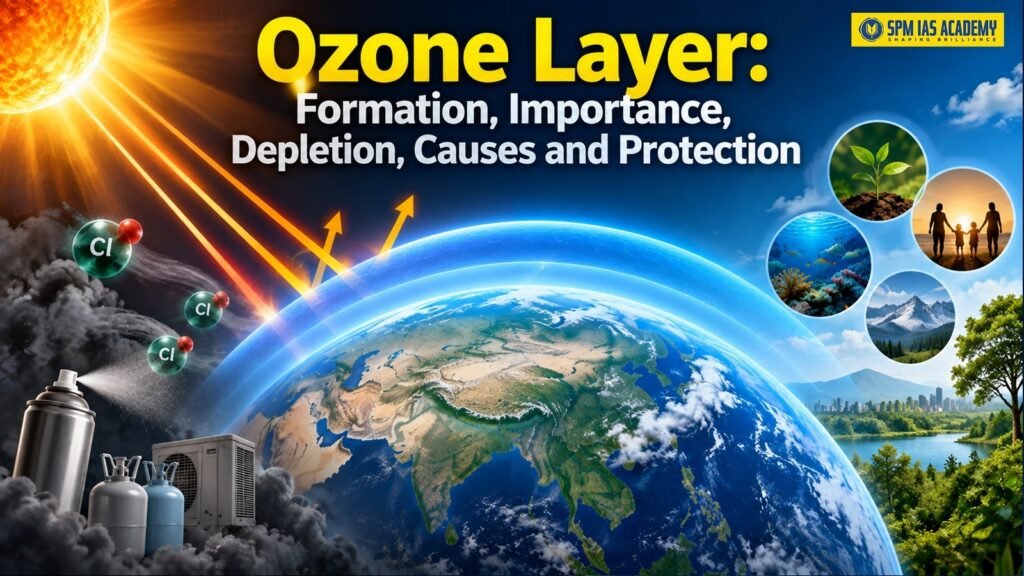
What Is Ozone Layer Depletion?
- Ozone layer depletion refers to the decline in the amount of ozone present in the stratosphere beyond normal natural variations.
- Scientists began detecting significant human-driven depletion during the latter half of the twentieth century. Human-made chemicals containing chlorine and bromine became major causes.
- When these chemicals reach the stratosphere, strong UV radiation breaks them down. They then release chlorine or bromine atoms, which react with and destroy ozone molecules.
- One chlorine atom can destroy more than 100,000 ozone molecules before it is removed from the stratosphere.
What Is the Ozone Hole?
The ozone hole does not mean that the atmosphere develops a physical hole. Instead, it describes an area with extremely low concentrations of stratospheric ozone. The most famous ozone hole develops over Antarctica during the Southern Hemisphere spring. Scientists have observed this recurring phenomenon since the early 1980s.
What Is an Ozone Depleting Substance?
An ozone depleting substance (ODS) is a chemical that contributes to the destruction of stratospheric ozone.
Major ODS include:
- Chlorofluorocarbons (CFCs)
- Hydrochlorofluorocarbons (HCFCs)
- Halons
- Carbon tetrachloride
- Methyl chloroform
- Methyl bromide
- Hydrobromofluorocarbons
Industries historically used CFCs in refrigerators, air conditioners, aerosol propellants, foam production and solvents.
These substances create a special problem because they remain stable in the lower atmosphere and do not easily wash out through rainfall. Eventually, atmospheric circulation carries them into the stratosphere, where UV radiation can release ozone-destroying chlorine or bromine.
What Is the Impact of Ozone Layer Depletion?
Ozone layer depletion allows more UV-B radiation to reach Earth’s surface. Consequently, it can increase risks of skin cancer and cataracts. In the field of agriculture, it can damage crops and other vegetation. Moreover, it can affect marine organisms and phytoplankton and reduce reproductive capacity in some aquatic organisms. Furthermore, it can disturb terrestrial and aquatic ecosystems. It can also influence atmospheric chemistry and air quality and affect important biogeochemical cycles.
Thus, ozone depletion is not simply an atmospheric problem. It directly connects environmental protection with public health, biodiversity and food security.
What Is the International Day for Preservation of the Ozone Layer?
The world observes the International Day for Preservation of the Ozone Layer on 16 September every year. Notably, the date commemorates the signing of the Montreal Protocol on Substances that Deplete the Ozone Layer on 16 September 1987. Later, the UN General Assembly proclaimed 16 September as the International Day for the Preservation of the Ozone Layer in 1994.
What Is the World Ozone Day 2026 Theme?
The official World Ozone Day 2026 theme is “Global action for a cooler planet.” The theme marks 10 years since the adoption of the Kigali Amendment to the Montreal Protocol in 2016. The Kigali Amendment focuses on phasing down hydrofluorocarbons (HFCs). HFCs generally do not deplete stratospheric ozone like CFCs, but they are powerful greenhouse gases. Therefore, reducing their use can support climate-change mitigation.
How Does the Montreal Protocol Protect the Ozone Layer?
Countries adopted the Montreal Protocol in 1987 to control the production and consumption of ozone-depleting substances.
It became one of the world’s most important examples of international environmental cooperation. The framework has achieved universal participation and has driven major reductions in ODS.
The results are visible. Atmospheric levels of nearly all major controlled ozone-depleting substances have declined substantially over the past two decades.
If countries continue complying with the Montreal Protocol, total ozone is expected to return to 1980 levels around 2040 for most of the world, around 2045 in the Arctic and around 2066 over Antarctica.
What Has India Done for Ozone Layer Protection?
- India became a party to the Vienna Convention for the Protection of the Ozone Layer in 1991 and joined the Montreal Protocol in 1992.
- Moreover, the Ministry of Environment, Forest and Climate Change introduced the Ozone Depleting Substances (Regulation and Control) Rules, 2000 to regulate the production, consumption, import and export of controlled substances.
- India has also taken measures to phase out major ODS in accordance with Montreal Protocol commitments.
- Furthermore, India ratified the Kigali Amendment in 2021. The amendment seeks to gradually reduce HFC consumption and encourage cleaner and more energy-efficient cooling technologies.
Conclusion
The Ozone layer protects life by absorbing harmful ultraviolet radiation. However, human-made ozone depleting substances disrupted its natural balance and caused serious depletion during the twentieth century.
The Montreal Protocol shows that coordinated international action can reverse large-scale environmental damage. Moreover, the Kigali Amendment now connects ozone protection with climate action and sustainable cooling. Therefore, continued global cooperation, scientific monitoring and cleaner technologies remain essential for protecting both the ozone shield and the global climate.
UPSC/APSC Prelims Practice Question
Q. With reference to the Ozone layer and its protection, consider the following statements:
- The Ozone layer is mainly concentrated in the stratosphere and absorbs much of the harmful UV-B radiation reaching Earth.
- Chlorofluorocarbons (CFCs) can release chlorine atoms in the stratosphere, which contribute to ozone depletion.
- Hydrofluorocarbons (HFCs) are major ozone-depleting substances controlled under the original Montreal Protocol because they release chlorine.
- The Kigali Amendment aims to phase down HFCs primarily because of their high global warming potential.
Which of the statements given above are correct?
(a) 1 and 2 only
(b) 1, 2 and 4 only
(c) 2, 3 and 4 only
(d) 1, 2, 3 and 4
UPSC/APSC Mains Practice Question
Q. “The recovery of the Ozone layer demonstrates the importance of international cooperation in addressing global environmental challenges.” Discuss the causes and impacts of ozone layer depletion. Also examine the role of the Montreal Protocol and Kigali Amendment in protecting the Ozone layer and climate. (250 words)
Read More:
Source:
Frequently Asked Questions
1. What is the Ozone Layer and why is it important?
The Ozone layer is a region of the stratosphere that contains a high concentration of ozone (O₃). Most importantly, it absorbs harmful UV-B radiation from the Sun. Therefore, it protects humans, plants, animals and aquatic ecosystems.
2. What causes Ozone Layer depletion?
Ozone layer depletion mainly occurs due to human-made chemicals that release chlorine and bromine in the stratosphere. For example, CFCs, HCFCs, halons and methyl bromide damage ozone molecules. Consequently, more harmful UV-B radiation can reach Earth.
3. How does the Montreal Protocol protect the Ozone Layer?
The Montreal Protocol, adopted in 1987, controls the production and consumption of major ozone depleting substances. As a result, countries have significantly reduced the use of harmful ODS. Moreover, continued global action is helping the Ozone layer recover gradually.

Behind every article at SPM IAS Academy is a team of skilled content writers and subject experts committed to making preparation easier for aspirants. From answering common doubts to breaking down complex issues and current affairs, we create content that is accurate, easy to understand, and directly useful for UPSC, APSC, and other competitive exams.