
Sutta Pitaka and Paramitas form two important aspects of Buddhist literature and philosophy. While the Sutta Pitaka preserves the teachings, dialogues and sermons of Gautama Buddha, the Paramitas represent the ethical qualities that a Bodhisattva cultivates to attain enlightenment.
Buddhist literature provides valuable understanding into the religious, social and cultural conditions of ancient India. For UPSC, APSC and State PCS examinations, topics such as the Tripitaka, Buddhist councils, Jataka tales, Sutta Pitaka and Bodhisattva ideals are important parts of Ancient Indian History and Indian Philosophy.
Sutta Pitaka and Paramitas: Meaning and Importance in Buddhist Literature
Sutta Pitaka
The Sutta Pitaka is one of the three sections of the Tripitaka (Three Baskets), the primary canonical literature of Buddhism. However, before understanding Sutta Pitaka and Paramitas, aspirants should first understand the structure of the Tripitaka.
The Tripitaka consists of:
- Vinaya Pitaka – Rules and discipline for Buddhist monks and nuns.
- Sutta Pitaka – Teachings and discourses of Buddha.
- Abhidhamma Pitaka – Philosophical and psychological analysis of Buddhist teachings.
The Sutta Pitaka mainly contains the sermons delivered by Buddha and records his conversations with disciples, rulers and common people.
It was originally preserved in the Pali language and became a major source for understanding early Buddhist teachings.
Sutta Pitaka: Five Nikayas and Their Features
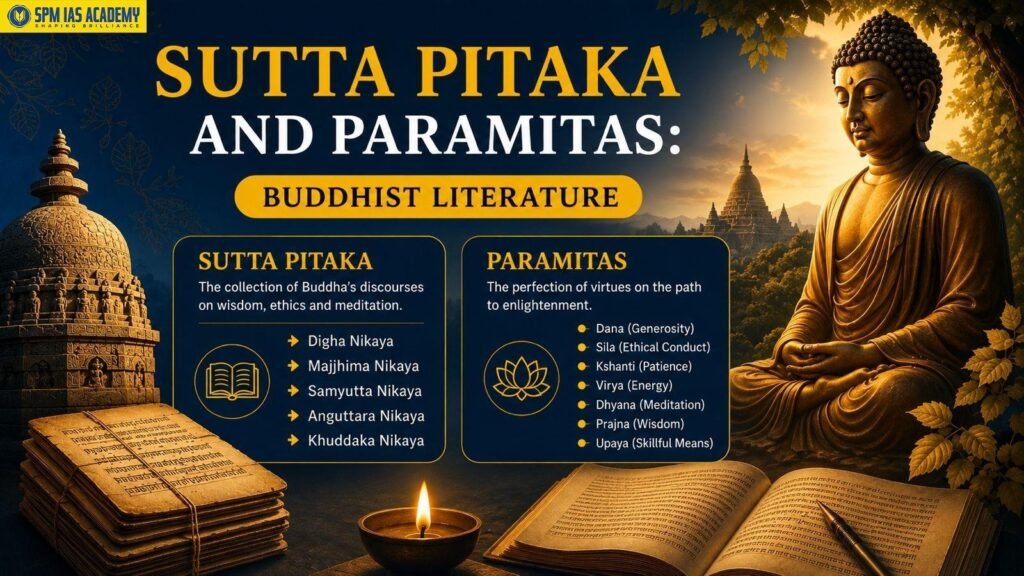
The Sutta Pitaka is divided into five major collections known as Nikayas.
| Nikaya | Main Features |
| Digha Nikaya | Contains long discourses of Buddha, including discussions on ethics, philosophy and society. |
| Majjhima Nikaya | Includes medium-length teachings focusing on practical aspects of Buddhist philosophy. |
| Samyutta Nikaya | Organised according to themes and connected teachings |
| Anguttara Nikaya | Arranges teachings numerically, making concepts easier to remember |
| Khuddaka Nikaya | Contains smaller texts including Jataka tales, Dhammapada and Theragatha |
Among these, the Dhammapada, included in the Khuddaka Nikaya, remains one of the most widely studied Buddhist texts.
Which are the Important Texts Under Sutta Pitaka?
Dhammapada
- The Dhammapada contains verses attributed to Buddha’s teachings.
- It discusses morality, wisdom, self-control and the path towards liberation.
- It is one of the most popular Buddhist ethical texts.
Jataka Tales
- The Jataka Tales describe the previous births of Buddha as a Bodhisattva.
- These stories highlight values such as compassion, sacrifice and righteousness.
- They provide information about ancient Indian society, occupations and cultural practices.
Theragatha and Therigatha
- Theragatha records verses of senior Buddhist monks.
- Therigatha contains verses attributed to Buddhist nuns.
- These texts provide insights into the role and experiences of women in early Buddhism.
Paramitas in Buddhism: Meaning and Significance
The connection between Sutta Pitaka and Paramitas becomes clearer when we examine the development of Buddhist philosophy. The term Paramitas refers to the perfections or virtues that a Bodhisattva develops to attain enlightenment.
The concept became especially important in Mahayana Buddhism, where the Bodhisattva ideal gained prominence.
A Bodhisattva delays personal liberation and works for the welfare of all living beings.
Six Paramitas of Mahayana Buddhism
The traditional Mahayana tradition identifies six major Paramitas:
| Paramita | Meaning |
| Dana Paramita | Perfection of generosity and charity |
| Sila Paramita | Perfection of moral conduct and ethical behaviour |
| Kshanti Paramita | Perfection of patience and tolerance |
| Virya Paramita | Perfection of energy and determination |
| Dhyana Paramita | Perfection of meditation and concentration |
| Prajna Paramita | Perfection of wisdom and understanding |
Among these, Prajna Paramita (perfection of wisdom) holds special importance in Mahayana philosophy.
Difference Between Theravada and Mahayana Buddhism
The distinction between Sutta Pitaka and Paramitas also reflects the broader evolution of Buddhist traditions.
| Aspect | Theravada Buddhism | Mahayana Buddhism |
| Ideal | Arhat who achieves personal liberation | Bodhisattva who works for universal salvation |
| Literature | Mainly Pali Canon including Sutta Pitaka | Includes Mahayana Sutras and Paramita literature |
| Language | Pali | Sanskrit and other languages |
| Focus | Individual enlightenment | Compassion and collective liberation |
Thus, the Sutta Pitaka and Paramitas represent different dimensions of Buddhist thought – one preserving Buddha’s teachings and the other highlighting the path of spiritual perfection.
Importance of Sutta Pitaka and Paramitas
- Sutta Pitaka preserves the Buddha’s teachings: It records the Buddha’s discourses on Dhamma, ethics, meditation and the path to liberation, making it a major source for understanding early Buddhism.
- It explains Buddhist philosophy: The texts discuss key ideas such as the Four Noble Truths, Noble Eightfold Path, Middle Path and Three Marks of Existence.
- It provides historical insights: Sutta Pitaka contains references to social life, political institutions, economy and religious practices of ancient India, helping historians reconstruct the period.
- Paramitas promote ethical conduct: The Paramitas (perfections) emphasise virtues such as generosity, morality, patience, effort, meditation and wisdom, especially in the Bodhisattva ideal.
- They support the path to enlightenment: By cultivating these virtues, practitioners develop compassion, wisdom and self-discipline, which form an important part of Mahayana Buddhist thought.
- They influenced Indian art and culture: Buddhist teachings and Jataka traditions inspired literature, sculpture, painting and architecture across ancient India.
- Help in understanding Buddhist traditions: Together, Sutta Pitaka and Paramitas help aspirants distinguish the early Buddhist textual tradition from the later Bodhisattva-oriented Mahayana tradition.
Conclusion
Therefore, Sutta Pitaka and Paramitas remain important for understanding Buddhist literature, philosophy and ancient Indian society. Sutta Pitaka and Paramitas represent two important pillars of Buddhist literature and philosophy. The Sutta Pitaka preserves Buddha’s teachings through sermons and dialogues, while Paramitas explain the ethical journey of a Bodhisattva towards enlightenment.
Together, they provide valuable insights into Buddhist religious traditions, ancient Indian society and the evolution of philosophical ideas in India.
Read More:
Source:
Frequently asked question
1. What is the Sutta Pitaka in Buddhist literature?
The Sutta Pitaka is one of the three divisions of the Tripitaka. It preserves the Buddha’s sermons, teachings and dialogues and includes five Nikayas, such as the Digha Nikaya, Majjhima Nikaya and Khuddaka Nikaya.
2. What are the Six Paramitas in Buddhism?
The Six Paramitas are the virtues that a Bodhisattva cultivates on the path to enlightenment. They include Dana (generosity), Sila (moral conduct), Kshanti (patience), Virya (effort), Dhyana (meditation) and Prajna (wisdom). Together, they emphasise ethical conduct, compassion and spiritual development.
3. Why are Sutta Pitaka and Paramitas important for UPSC and APSC?
Sutta Pitaka and Paramitas help aspirants understand Buddhist philosophy, literature and the evolution of Buddhist traditions. Moreover, they provide insights into ancient Indian society, ethics, religious movements and the Theravada-Mahayana distinction, making them relevant to Ancient History and Indian Culture.

Behind every article at SPM IAS Academy is a team of skilled content writers and subject experts committed to making preparation easier for aspirants. From answering common doubts to breaking down complex issues and current affairs, we create content that is accurate, easy to understand, and directly useful for UPSC, APSC, and other competitive exams.