Why in the News:
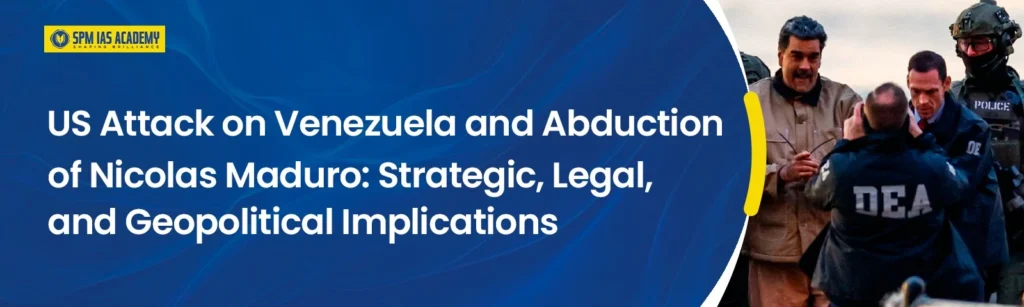
In an extraordinary and unprecedented military operation, the United States announced that it had captured and flown out Venezuelan President Nicolás Maduro. The US attack on Venezuela, reportedly named “Absolute Resolve, marked one of the most dramatic regime-change actions in modern international relations. According to official statements, the US intends to temporarily oversee Venezuela’s administration until a transition of power is completed. In this article, we will discuss everything related to the US attack on Venezuela
This development has immense significance for UPSC, APSC, and other competitive examinations, particularly under International Relations, International Law, Internal Security, and World Geography.
Background of US attack on Venezuela
US-Venezuela Relations:
Relations between the United States and Venezuela have remained strained for more than two decades. Washington has never formally recognised Nicolás Maduro’s presidency, citing alleged electoral irregularities, democratic backsliding, and human rights violations.
Since 2019, the US has imposed severe economic sanctions on Venezuela. It has also recognised opposition leadership as legitimate representatives. Moreover, the US also accused the Maduro regime of narco-terrorism and transnational crime. The abduction of Maduro represents the culmination of sustained diplomatic, economic, and military pressure.
US-Venezuela Relations: Key Developments:
- Overall trajectory: Diplomatic relations between the United States and Venezuela have remained strained throughout the 21st century, despite periods of cooperation in the late 20th century.
- Turning point (1999): Relations deteriorated sharply after Hugo Chávez assumed office. He adopted a socialist and anti-imperialist political stance, explicitly opposing US influence.
- Coup allegations (2002): Tensions escalated when Venezuela accused the George W. Bush administration of backing the 2002 attempted coup against Chávez.
- Diplomatic expulsions (2008): Relations worsened further when Venezuela expelled the US ambassador, expressing solidarity with Bolivia after similar accusations against a US envoy there.
- Temporary improvement (2009): Ties briefly improved under Barack Obama, though this rapprochement proved short-lived.
- Renewed friction (2014): Subsequently, Venezuela expelled three US diplomats, accusing them of promoting domestic unrest.
- 2019 presidential crisis: Relations reached a breaking point when Nicolás Maduro severed diplomatic ties after Donald Trump recognized Juan Guaidó as interim president.
- Post-Guaidó phase (2023): Although the US stopped recognizing Guaidó after the dissolution of his interim government, it continued to recognize the 2015 elected National Assembly.
- Security focus (2025): During Trump’s second term, the US deported alleged members of Tren de Aragua to El Salvador’s CECOT prison and designated Tren de Aragua and the Cartel of the Suns as terrorist organizations.
- Military escalation (Sept 2025): The US initiated airstrikes on suspected drug-running boats amid a broader military buildup in the Caribbean Sea.
- Finally in January, 2026, the US conducted a direct military operation, capturing Nicolás Maduro and his wife and transferring them to New York, marking an unprecedented escalation in bilateral conflict.
These points together illustrate a gradual but persistent decline in US-Venezuela relations. It is shaped by ideology, sovereignty disputes, security concerns, and regime-legitimacy conflicts.
Details of this US Attack on Venezuela – Operation “Absolute Resolve”:
The US administration confirmed that the operation involved:
- Night-time, lightning-fast military strikes
- Coordinated action by US Armed Forces and Law Enforcement
- Missile strikes on alleged drug-smuggling vessels
- Precision attacks in Caracas, Miranda, Aragua, and La Guaira
According to unnamed officials cited by international media, at least 40 people were killed due to this US attack on Venezuela. The Venezuelan authorities claim higher casualties. The operation has been described as the riskiest US military action since the killing of Osama bin Laden in 2011.
Legal Authority and International Law Concerns:
One of the most contentious aspects of the operation is its questionable legality.
Key Legal Issues:
- No clear UN Security Council authorisation
- Potential violation of Article 2(4) of the UN Charter (use of force against sovereignty)
- Questionable invocation of self-defence against drug trafficking
The United Nations and several international law experts have raised serious objections, arguing that drug trafficking does not constitute an armed attack justifying military invasion.
Comparison with the 1990 US Invasion of Panama:
The operation has drawn immediate parallels with the 1990 US invasion of Panama. It led to the arrest of Manuel Antonio Noriega on drug trafficking charges.
The similarities with the Venezuelan incident are:
- Sitting head of state captured
- Drug-related charges as justification
- US to install interim governance
- Widespread international criticism
However, unlike Panama, Venezuela holds far greater strategic importance due to its energy reserves and geopolitical positioning.
Narco-Terrorism: Meaning and Context:
What is Narco-Terrorism?
Narco-terrorism refers to the use of drug trafficking proceeds to finance terrorist or insurgent activities, or collaboration between drug cartels and armed political groups.
In this context, the US allegations are:
- Maduro regime allegedly collaborated with drug cartels
- Cocaine shipments routed through the Caribbean and Eastern Pacific
- Use of state institutions to protect trafficking networks
Maduro and his wife Cilia Flores were indicted in New York under narco-terrorism conspiracy charges, first filed in 2020 and recently expanded.
Venezuela’s Supreme Court Response:
Following this US attack on Venezuela and Maduro’s forced removal, the Constitutional Chamber of Venezuela’s Supreme Court appointed Vice President Delcy Rodríguez as acting president.
The court stated that:
- The move was necessary to ensure administrative continuity.
- It aimed to safeguard national sovereignty.
- A legal framework would be developed for governance during the “forced absence” of the president.
This raises serious questions about constitutional legitimacy under foreign military intervention.
Geographical Location of Venezuela and Its Strategic Importance:
Venezuela is located on the northern coast of South America, bordered by:
- Colombia to the west
- Brazil to the south
- Guyana to the east
- Caribbean Sea to the north
Strategic Significance of Venezuela:
- Proximity to US maritime trade routes
- Gateway to the Caribbean Sea
- Critical location in South American geopolitics
- Influence over regional energy security
Oil Reserves in Venezuela – The Energy Angle:
- Venezuela holds the largest proven oil reserves in the world, even surpassing Saudi Arabia. However, despite this enormous resource base, the country today earns only a fraction of the revenue it once generated from crude oil exports.
- As of 2023, Venezuela’s proven oil reserves are estimated at about 303 billion barrels, placing it at the top globally. In comparison, Saudi Arabia ranks second with around 267.2 billion barrels, followed by Iran (208.6 billion barrels) and Canada (163.6 billion barrels). Together, these four countries account for more than half of the world’s total proven oil reserves.
- By contrast, the United States holds approximately 55 billion barrels, ranking ninth globally. This stark difference highlights that Venezuela’s oil reserves are more than five times larger than those of the United States, underscoring a paradox where vast resource abundance has not translated into sustained economic gains.
Key Facts:
- Major reserves located in the Orinoco Belt
- Crude oil is extra-heavy, requiring advanced refining
- Oil sector controlled by state company PDVSA
- Chronic underinvestment due to sanctions
The US announcement that it would “tap Venezuela’s vast oil reserves” has intensified accusations that the intervention is resource-driven rather than humanitarian.
Venezuela’s Orinoco Belt and Oil Production:
- Primary oil hub: Venezuela’s oil reserves are largely concentrated in the Orinoco Belt, a vast hydrocarbon-rich region in the eastern part of the country, covering around 55,000 sq. km.
- Operational control: Oil production in this region is predominantly managed by PDVSA, the state-owned oil giant, which controls most extraction and upstream activities in the Orinoco Belt.
- Structural challenges: However, PDVSA has long struggled with ageing infrastructure, underinvestment, mismanagement, and international sanctions, significantly constraining Venezuela’s capacity to fully utilise its oil potential.
- Export performance: As a result, Venezuela’s crude oil exports remain remarkably low. According to the Observatory of Economic Complexity, the country exported only USD 4.05 billion worth of crude oil in 2023.
- Global comparison: This figure is far below major oil exporters such as Saudi Arabia (USD 181 bn), the United States (USD 125 bn), and Russia (USD 122 bn), highlighting Venezuela’s underperformance despite vast reserves.
- Refined products: In addition to crude oil, Venezuela exports limited quantities of refined petroleum products like gasoline and diesel. However, these exports remain well below potential due to outdated refineries, technical bottlenecks, and sanctions.
Together, these points underline a paradox of abundance. Venezuela possesses immense oil reserves, yet structural, technical, and geopolitical constraints continue to limit its oil production and export capacity.
Why Have Venezuela’s Oil Exports Dwindled Over Time?
- Foundational role: To begin with, Venezuela was a founding member of OPEC, joining it on 14 September 1960, and actively participated in coordinating global oil supply and prices.
- Era of export strength: Subsequently, Venezuela emerged as a major global oil exporter, especially after the creation of PDVSA in 1976 and the nationalisation of foreign oil companies.
- Strong US linkage: During the late 1990s and early 2000s, Venezuela supplied around 1.5–2 million barrels per day to the United States, making it one of America’s largest foreign oil suppliers.
- Policy shift after 1998: However, oil exports began to decline after Hugo Chávez assumed power in 1998 and restructured the oil sector by nationalising assets, reshaping PDVSA, and prioritising domestic and political objectives over export efficiency.
- Operational decline: At the same time, political instability, mismanagement within PDVSA, and chronic underinvestment in infrastructure reduced production capacity and weakened export competitiveness.
- Worsening under Maduro: The situation further deteriorated under Nicolás Maduro, as governance challenges deepened and oil-sector performance continued to fall.
- Impact of US sanctions: Moreover, the Trump administration imposed US sanctions in 2017, which were tightened in 2019, severely restricting Venezuela’s ability to sell crude to the US and access international financial markets.
- Collapse of US exports: As a direct consequence, oil exports to the United States virtually ceased, ending a decades-old energy relationship.
- Shift to alternative buyers: Consequently, Venezuela redirected much of its oil trade towards China, which became its largest buyer, along with other countries such as India and Cuba.
Overall, Venezuela’s oil export decline reflects a combination of policy choices, institutional weakening, and external sanctions, despite the country’s vast hydrocarbon reserves.
US Strategic Objectives – A Broader View:
Beyond narco-terrorism, analysts suggest multiple strategic motives behind this US attack on Venezuela:
- Energy security and oil market control
- Containment of Russian and Chinese influence in Latin America
- Reinforcement of US dominance in the Western Hemisphere (Monroe Doctrine mindset)
Global and Regional Reactions:
- Latin American nations expressed concern over sovereignty.
- Human rights groups demanded independent investigations.
- Russia and China condemned the action as neo-imperialism.
- Regional instability fears across the Caribbean and Andean region.
Implications for India:
For India, this US attack on Venezuela is relevant due to:
- Dependence on global oil price stability
- Commitment to strategic autonomy
- Position on non-intervention and international law
- Safety of Indian diaspora in Latin America
Conclusion:
The US attack on Venezuela and the abduction of Nicolás Maduro represents a watershed moment in global geopolitics. While the US justifies its action under the banner of narco-terrorism and security, the operation raises profound questions about international law, sovereignty, and the future of global order.
Source:
Also read :
The United States justified the operation by accusing the Maduro regime of narco-terrorism, drug trafficking, and transnational crime. The US claims that these crimes posed a direct threat to US national security.
Nicolás Maduro is the sitting President of Venezuela, accused by the US of leading a corrupt regime allegedly linked to drug cartels. He was abducted under charges of narco-terrorism conspiracy filed in the United States.
Operation Absolute Resolve was a US attack on Venezuela in January 2026. It involves precision strikes and coordinated action by US armed forces and law enforcement to capture Nicolás Maduro and remove him from power.
Venezuela holds the world’s largest proven oil reserves, mainly in the Orinoco Belt. It occupies a critical location near the Caribbean Sea, making it vital for energy security and regional geopolitics.
The US action raises serious concerns under international law, particularly regarding the violation of state sovereignty and Article 2(4) of the UN Charter. This article prohibits the use of force against another state without UN Security Council authorization. Critics argue that drug trafficking does not legally justify military intervention. This argument makes this case a critical example for debates on unilateralism vs rules-based global order.